October 1, 2025

It has been a while…

I admit it…I’ve been absent from this blog for way too long. But there are great reasons for it! The biggest one is that I’ve been focusing on writing, videoing, and doing other content-generation things for the https://osintcurio.us project.

OSINTCurious

We are really starting to get into a grove over there. We’ve got podcasts and webcasts, in-depth blog posts, a Google calendar with OSINT events, and now, 10 minute tip videos showing how to accomplish certain OSINT skills. The people that work the project with me are amazingly talented and terrific about sharing their knowledge.

We are looking for ways to adjust our project to allow for others to contribute either as guest bloggers, a live webcast audience, guest podcast participants, and other roles. Exciting times!

Hiking

Those of you that follow me on social media know that last year was a rough one with injuries that kept me from hiking and, well, doing many things. I’m all healed up now and am going to be getting out in the wilderness a bunch more. Hoping to make 2019 a year that sees more hiking content on here.

SEC487 OSINT Class

Last year (2018), was a pivotal year for the budding SANS Institute SEC487 OSINT course I wrote. Seizing the amazing opportunity to travel around the world and teach the class, I met amazing OSINTers across the globe. This year, the class is set to be taught in person over 25 times and go into OnDemand. I’m extremely excited to meet the hundred of students that will take the class from myself, the incredible David Mashburn, John TerBush, and others that will teach it in the coming months.

The class is evolving based upon your feedback and what is happening in the field. We are adding new challenges to the class for you advanced students and stocking more content in there to make it even more valuable to everyone.

New Challenges

At the end of 2018, after 10 years, I resigned from my position at my previous company. I learned a heck of a lot from them…and it was time for me to move on. I began pouring my efforts into my own company, Spotlight Infosec LLC. Through this company, I can now do the research and consulting I’ve been wanting to do within the OSINT and cyber fields. It was a scary process to move from being the corporate world to working for myself and one that has been super-rewarding.

So…

So…stick with me people. We are going to take 2019 and do incredible things! Looking forward to learning, growing, and meeting more outstanding people!

It has been a while… Read More »

“History of hiking” is now 50% off!

Reminder: through Christmas, the paperback version of my book, Ramble On: A History of Hiking, is available at 50% off the regular price. Hiking enthusiasts can purchase the book on Amazon right now for only $9.95 (regular price is $18.95).

Additionally, the Kindle e-book version of my book will be sold for just $4.99 through Cyber Weekend. This special price will be offered for one week only, from November 27th through December 3rd.

Ramble On: A History of Hiking is an outstanding gift idea for anyone who loves hiking, and wishes to learn more about the rich and amazing history of one of the world’s top pastimes.

For more information on the book, and to purchase, please click here.

Thank you very much!

Jeff
HikingintheSmokys.com
RockyMountainHikingTrails.com
HikinginGlacier.com
TetonHikingTrails.com
Ramble On: A History of Hiking

“History of hiking” is now 50% off! Read More »

XMT 304 Issues

Finally got my connex wired for 240V via a subpanel off of my main house circuit. GFCI 50AMP breaker.

I’ve used an XMT for years, just not this particular machine. Picked this one up off of eBay, from a reputable seller. Works great in pulsed MIG (with an Optima). Set my machine up for Lift Arc TIG last night, worked great – but had a sporadic issue.

Was initiating an arc, and all of a sudden the machine starting chattering (contactor) – bead was horrible, and it was almost "split" lengthwise in appearance. Stopped welding immediately, and cycled the machine on and off. Didn’t occur again for the remainder of the evening. Also, I’ve noticed that the machine will "tick" softly while it’s sitting idle. I’ve never heard this noise with the other XMTs that I’ve used, though they were also being used in a noisier environment.

I checked that the lugs on the main board were within torque spec as soon as the machine arrived, however – I’m going to recheck things today. Also, I will inspect the power contactor, to ensure that the springs aren’t gummed up with junk.

Any other suggestions?

Thanks,

Jake

XMT 304 Issues Read More »

Preparedness Notes for Wednesday — December 4, 2019

December 4th is the birthday of Gregory “Pappy” Boyington, (born 1912) an AVG “Flying Tiger” volunteer pilot for the Chinese Nationalist government, WWII Marine Corps aviator, and Medal of Honor recipient. (He died January 11, 1988.) A proto-Redoubter, Pappy Boyington was born in Couer d’Alene, Idaho and was raised in Spokane, Washington. — SurvivalBlog Writing Contest Today we present another entry for Round 86 of the SurvivalBlog non-fiction writing contest. The more than $12,000 worth of prizes for this round include: First Prize: A $3,000 gift certificate towards a Sol-Ark Solar Generator from veteran-owned Portable Solar LLC. The only EMP …

The post Preparedness Notes for Wednesday — December 4, 2019 appeared first on SurvivalBlog.com.

Preparedness Notes for Wednesday — December 4, 2019 Read More »

SuvivalMyth: Are Acorns Toxic?

How to Identify, Process, Prepare, and EAT Acorns!

A familiar sight–acorns scattered in the moss at the foot of an Oak Tree.

You may have heard the myth that acorns are poisonous and should be avoided. I heard this a lot when I was growing up. This is one of the greatest falsehoods that exists in the world of wild edibles. Though acorns contain tannins–an acidic organic substance (they are a class of astringent) that can make one sick to their stomach if too much is consumed–through a specific process of harvesting, preparing, grinding and leeching out tannins, acorns become a nutrient-dense survival food! In fact, during a discussion about eating acorns with an Ethnobotanist/Anthropologist friend of mine, he indicated that some research and evidence suggests that more acorns have been consumed throughout human history than wheat, rice, and corn combined.  This idea blew my mind!

Acorns–harvested and set on a drying tray.

WHAT IS AN ACORN

Simply put, an acorn is the seed of the Oak Tree. Just as there are many varieties of Oak Trees, there are numerous types of acorns–all unique and varying in shape, size, and taste. Consumed in great quantities by indigenous cultures throughout North America, the acorn was eaten as a boiled gruel, a thickening agent for soups and stews, and was ground up to be utilized as flour for breads and other baked goods. The acorn was and is a versatile survival food. In the past, it sustained entire cultures because of its availability and long shelf-life (if properly dehydrated and stored).

HARVESTING ACORNS

Acorns ripen in late summer/early fall and drop to the ground to germinate. This typically happens in two phases, what I call the “light drop” and the “heavy drop.” Acorns gathered during the “heavy drop” phase tend to be best for consumption and storage. Even so, great care still has to be taken to separate good acorns from bad acorns. There are a few telltale signs that make this separation process easy, one of which is consistent coloring throughout the body of the acorn.

After harvest, acorns should be washed thoroughly. At this time, the acorns can be prepared immediately or dried and stored for future use. The drying process has to be done correctly, as acorns are highly susceptible to mold. If they mold, you shouldn’t consume them. Mold tends to ruin the whole batch, too. Most indigenous cultures dried their acorns in the shell and stored them for later use. I tend to dry my acorns for a full month before storing them. I also use a labeling system to help me manage them throughout the drying process.

Labeled tray of washed acorns drying in the sun.

Take the Online Course!


SHELLING

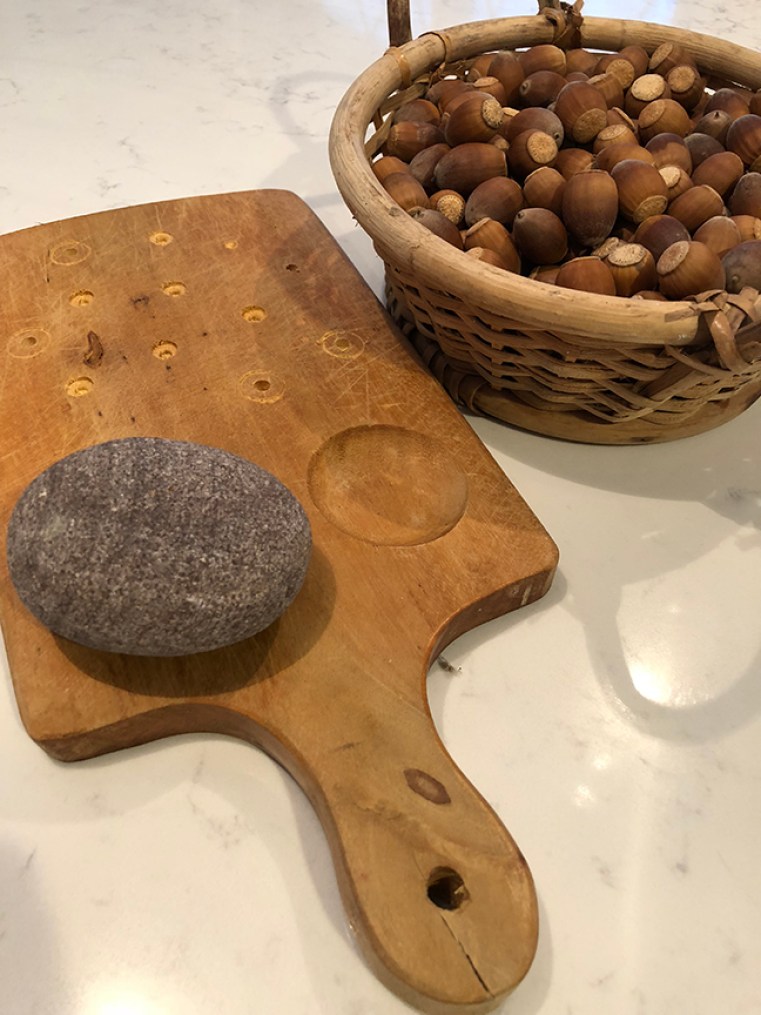
No matter what, shelling washed and dried acorns is a labor intensive process. But the payoff–being self-sufficient by creating delicious food from nature for FREE–is absolutely worth it! I go primitive with my shelling process, using a rock to crack the shells and extract the acorn nut meat. I even have a cutting board I’ve modified to make the process easier.

Acorns ready to be cracked and shelled.
Acorn in position on board modified specifically for acorn shelling.

GRINDING

After your dried acorns have been shelled, it’s time to grind them into meal or flour. I use a manual, hand-crank grinder for this. Not only does it feel “old-fashioned,” but it will come in handy if the grid were to ever go down and my electric appliances become useless.

Using my hand grinder to process whole acorns.
Ground acorn meal, ready to be leached of its tannins!

COLD-WATER LEACHING

While the tannins can be leached through boiling, I’ve never been a fan if it.  I prefer the passive and traditional method of cold-water leaching.  It’s not a fast process, but it is easy.  In fact, the squirrels in my yard prefer cold leaching as well.  Every fall, I watch as they bury bitter Red Oak acorns in the ground to uncover weeks or even months later after the rain, snow and ground water has (at least I assume) leached them to a more palatable level.  While acorns can be soaked in a creek or stream to remove tannins in the wild, I typically use large Ball jars for all my cold-water leaching at home.

The leaching process involves soaking the acorn meal in several changes of water. With each change of water, more of the tannins, providing the bitter, astringent taste to the meal, will be removed, making the end result a tasty meal that should be thoroughly dried before using as flour.

When it comes to how and when to change the water during the leaching process–it can vary. At the end of this post, I have included some resources to help you with this.

Acorn meal settled to the bottom of a Ball Jar in the leaching process. The tannins being leached out of the meal are turning the water at the top of the jar a dark brown. As the leaching process progresses and through several changes of water, the water at the top of the jar will grow lighter in color.
Acorn meal, leached of its tannin, drying in the sunlight so it can be stored and used as flour for baked goods.

USING ACORN FLOUR

Acorns contain valuable oils, proteins, vitamins, and minerals.  They really are one of natures most underappreciated super-foods.  Acorn meal doesn’t have the binding properties of wheat flower, so baked goods using it aren’t as doughy as you might be used to.  Don’t let this dissuade you from using it.  It can be substituted in equal quantity for any recipe that asks for wheat flour.  Or, as is oftentimes done, it can be substituted 50/50 with wheat flour as well.

Acorn meal was not only used by indigenous cultures in breads and ash cakes, but it was also used to make a nutritious porridge-like gruel.  This primitive gruel was/is similar modern day oat meal.  The coarsely ground meal was boiled in water and mixed with other seeds, nuts, and even berries.  Eaten this way, it has a very singular flavor, with specific nutty tones, and is much more palatable when sweetened with honey or maple syrup.

Take the Online Acorn Course! Learn how to harvest, process, leach, prepare, and eat one of the world’s most nutritious foods – for only $2.99!

The post SuvivalMyth: Are Acorns Toxic? appeared first on WillowHavenOutdoor Survival Skills.

SuvivalMyth: Are Acorns Toxic? Read More »

Log Cabin Update: Sill Logs and Hand-Hewn Floor Joists

by Todd Walker

Log Cabin Update: Sill Logs and Hand-Hewn Floor Joists ~ TheSurvivalSherpa.com

As the song says, “I started out with nothing, and I’ve got most of it left.”

Those lyrics summed up my feelings since starting this log cabin project in February. I all I had to show for my effort was a bunch of skinned logs scattered through the woods and fields. That all changed this summer. Here’s the progress as of mid July…

Setting Sill Logs

I had my doubts about dry-stacked stone piers as my foundation. The largest sill log measured 14 inches in diameter by 18 feet long. A handy online log calculator estimated the weight for this one log to be 925 pounds. The stones/boulders were far from flat. I did my best to shim them with smaller stones to keep them steady.

Log Cabin Update: Sill Logs and Hand-Hewn Floor Joists ~ TheSurvivalSherpa.com

Dry-stacked stone piers have supported log cabins for hundreds of years… but I had my doubts.

I spent way too much time with a water level trying to ensure all the piers were the same height. Round logs are not dimensional lumber. Get the stones close to the same height and lay logs on top.

In all honesty, my plan was to use only hand tools for this trial of self-reliance. Trees were felled and bucked with an ax, debarked with a bark spud and draw knife, and hauled to site by me as the mule pulling my LogRite Junior Arch… until I attempted to move those half-ton sill logs. A real mule was needed for this job.

My best friend Philip had just finished skinning the two sill logs when Allen, the land owner, walked up to visit. He told us he had just acquired a Kawasaki Mule. Perfect!

Log Cabin Update: Sill Logs and Hand-Hewn Floor Joists ~ TheSurvivalSherpa.com

Philip taking a break after debarking one of the 925 pound sill log with the barking spud in the foreground.

Even with Junior hooked to the back-end of the Mule, the big sill logs were a beast to haul back to the cabin site. But it worked!

Log Lifting Tripod

Lifting close to a half a ton of wood, even a few feet off the ground, would require a lot of mechanical advantage using simple machines. Dead cedars were cut and lashed together to form a tripod. The largest leg/pole was about 6 inches in diameter. Standing this heavy tripod up by myself was like watching the Three Stooges. Wish I had filmed this for some comic relief.

Here’s the video of how I lashed the tripod for those interested…

After positioning the tripod over the heaviest sill log, I attached a four-to-one block and tackle system at the top of the tripod. Upon testing the pulley system, I could only lift the log a couple of inches. Not good. I quickly realized that, even if I was able to lift the log, I could not hold the log in place by myself and control the placement on the piers with precision. I needed a lifting device I could control when working alone. I bought a one-ton chain fall (hoist) for $60 the next day. This one tool revolutionized the job!

Log Cabin Update: Sill Logs and Hand-Hewn Floor Joists ~ TheSurvivalSherpa.com

The chain fall rigged to the tripod made light work of heavy logs.

Our video below shows how maneuverable the logs are when choked at the balance point.

Sill Logs Notched and Set

I positioned the first sill log on the ground next to the piers to mark for notching. I made relief cuts with my bow saw on each mark about one inch deep. I used a boy’s ax to remove wood chips between the saw cuts. This produced a flat surface for the log to rest on the non-flat stone piers.

Log Cabin Update: Sill Logs and Hand-Hewn Floor Joists ~ TheSurvivalSherpa.com

Flat notches were cut using a buck saw and ax.

I re-choked the log with the tow strap near the bottom of the log. Lifting by myself with the chain fall, the log slowly turned until the notches faced down. Then the log was lifted to the height needed to be lowered onto the piers. On the way up, the log scraped the side of the piers toppling a few. I re-stacked them and lowered the log cautiously. They held up fine but had a touch of wobble. Small rock shims were inserted to steady the piers.

After months of preparation, the feeling of seeing a huge log off the ground and resting on rocks was pure excitement!

Log Cabin Update: Sill Logs and Hand-Hewn Floor Joists ~ TheSurvivalSherpa.com

The first log up!

Square Corners

The next day I set the second log to create the first corner. How do you make corners square using different sized logs which are not even? Here’s how I did it…

Log Cabin Update: Sill Logs and Hand-Hewn Floor Joists ~ TheSurvivalSherpa.com

The corner nail is near the head of the hammer where the two chalk lines intersect. The tape measure forms the hypotenuse of the right triangle.

I’ve used the Pythagorean Theorem many times to square corners using dimensional lumber. You need straight lines for this to work. I popped a chalkline down the center of each log. I tacked a nail at the intersection where the two lines crossed in the corner. From that corner nail, I measured three feet down the chalkline and tacked another nail. On the other log, I measured four feet and drove in a nail. I lifted the second log just enough to allow me swing in or out until the distance from both nails measured five feet. This creates a 3-4-5 right triangle ensuring the logs are perpendicular in the corner. A 6-8-10 triangle would be more accurate, but I was by myself and didn’t want to stretch a tape measure 10 feet from nail to nail.

Tight-Pinned Corners

The Butt and Pass method requires no notches. Metal pins hold the logs together to create a sturdy, solid structure.
Log Cabin Update: Sill Logs and Hand-Hewn Floor Joists ~ TheSurvivalSherpa.com

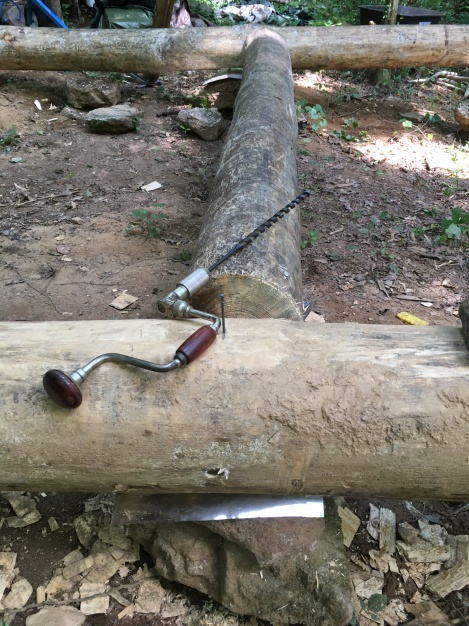
The brace and bit used to make pilot holes for the rebar pins.


I cut 1/2 inch rebar in 20 inch lengths at my shop. Back at the build site, I use a brace and bit to bore a 1/2 inch hole almost through the first log. Probably should drill all the way through but almost through seems to work. Now I drive the pin through the pilot hole and into the adjacent log. I started using a 6 pound sledge with a 36 inch handle. My accuracy suffered. The long handle also kissed my ribcage a few times while hammering bent over. We sawed the handle in half and found it to be the ticket.

Log Cabin Update: Sill Logs and Hand-Hewn Floor Joists ~ TheSurvivalSherpa.com

A twenty inch rebar pin hammered flush.

A note worth mentioning on driving pins. If you miss hit and bend the pin, stop. Straighten the pin as best as possible before pounding more. A bent pin will find its way through the side or top of the adjacent log. Once all four corners were pinned together, the sill logs became unbelievably steady on the piers.

Log Floor Joists

Log Cabin Update: Sill Logs and Hand-Hewn Floor Joists ~ TheSurvivalSherpa.com

3 of 5 log floor joists set in sill logs. I’ll explain the leveling process on our next article.

I’ve begun hewing log floor joists. Dimensional lumber would speed up the process but I want to use as many raw resources as possible on the cabin. One side of a log gets hewn flat and notched with tenons on both ends. The tenons will mate with mortises notched into the sill logs. I’ll do a more detailed article on what I’ve got planned for the floor system.

Until then, here’s our latest video on the floor system…

Keep Doing the Stuff of Self-Reliance,

~ Todd

P.S. – You can also keep up with the Stuff we’re Doing on TwitterPinterestYouTubeInstagram, and Facebook… and over at our Doing the Stuff Network.

P.P.S – If you find value in our blog, Dirt Road Girl and I would appreciate your vote on Top Prepper Sites! You can vote daily by clicking here or on the image below. Check out all the other value-adding sites while you’re there…

Thanks for Sharing the Stuff!

Copyright © by Survival Sherpa: Content on this site (unless the work of a third-party) may be shared freely in digital form, in part or whole, for non-commercial use with a link back to this site crediting the author. All links in articles must remain intact as originally posted in order to be republished. If you are interested a third-party article, please contact the author directly for republishing information.


Log Cabin Update: Sill Logs and Hand-Hewn Floor Joists Read More »