October 1, 2025

Pistol vs Revolver: Which is the Better Bug Out Gun?

Ever since the semi-automatic pistol was invented, there has been a considerable degree of controversy over whether these guns or revolvers are better.  Each of these handguns has advantages and disadvantages.

If you are looking for the perfect handgun for bugging out, you can consider the pros and cons presented in this article while you are making your choices.  Bear in mind that the gun that looks best for you as a beginner, intermediate shooter, or expert may also look different.

When evaluating guns for bugging out, you should always be aware of how your abilities change and also how your view the situations you may encounter.

Semi-automatic Pistols Pros and Cons

Pros

The most popular type of handgun in use today for protection is the semi-automatic pistol. The main reasons people choose these guns include the high capacity magazines, reliability, less recoil, the triggers are easier to use, the sights are better, and they fire faster.

The ability to shoot quickly with a pistol is one of the most important advantages of this type of firearm. Most people who use semi-automatic pistols would rather be able to fire off several bullets even if they aren’t as well placed rather than rely on one or two shots that were better aimed.

At the end of the day, this belief can be a “pro” to some, but make others with more experience think twice because surviving a gun fight is still very much about hitting the optimal place on the adversary as quickly and efficiently as possible.   That being said, the fact that a semi can carry 12 – 20 bullets versus 5 or 6 in a revolver still gives you the chance to hit multiple targets if needed. Since the semi-automatic also come with better sights these days, the high capacity magazines definitely add up to an advantage over the revolvers.

Semi-automatic pistols are also much easier to reload.  Since the magazines are smaller and more compact, you can also carry several of them pre-loaded and be ready to fire again in a matter of seconds.  On the other hand, the speed loader for a revolver can be quite bulky and take more time to reload.  Even if you plan on carrying them. It is still easier to fit a semi magazine into your pocket.

Cons

There are few drawbacks with a semi-automatic pistol.  First, they must be kept meticulously clean.  They can also be very picky with the ammunition that will go through them without causing damage or jams.  For a semi-automatic pistol, the cartridges must have the proper shape for reliable feeding.  It must also have enough powder in the case to fully function the slide without battering and breaking the internal parts. The case must have the proper head spacing so that it moves easily in and out of the chamber without hanging up.

A semi-automatic pistol to a new shooter can be complicated because they must learn how to operate slides, slides stops, magazine releases, decockers, and safeties.  In addition, some individuals are not strong enough to pull back the side. This problem is as old as the pistol design itself because of the heavy recoil spring and the small width of the slide.   If you have problems fully pulling back the slide, but still want to have a semi for your bug out gun, try the following:

  • First, hold the back of pistol slide in the grooves with your left hand.
  • While holding the frame of the pistol in your right hand, with your trigger finger outside of the trigger guard, push the frame forward to work the slide. This will load the chamber of the pistol. The reason this works is that it takes less muscle power to push the frame forward than it does to pull the slide back.

Another problem with pistols is that if the magazines are lost or broken your pistol turns into a single-shot weapon. If your pistol has a magazine safety and you have lost your magazines this pistol will not be able to fire at all.

When compared to revolvers, semis have limited energy and penetration. In some shooting scenarios, limited penetration could be an advantage, however, it will not work in other situations. For example, a  nine-millimeter hollow point projectile is much less likely to penetrate multiple walls then the classic    357 Magnum projectile.  On the other hand, if you need to get past low-grade body armor or shoot longer distances, the lack of penetration can leave you with a serious problem on your hands.

If you keep your pistol with a loaded round in the chamber. It is to your advantage to have a pistol that has a safety or a decocker to keep the pistol from accidentally discharging if the trigger is pulled.

Pistol malfunctions represent the greatest problem with semi- automatic pistols when compared to revolvers.  You must know how to recognize and clear the four most common different types of pistol malfunctions.  While the following steps may not seem complicated, bear in mind they can cost you in terms of valuable concentration and time in an actual situation.

The Hang fire

  • The trigger is pulled and no bang. A hang fire occurs when there is a delay in the powder being ignited.
  • Keep the pistol pointed down range for about 30-60 seconds to ensure the round will not go off.
  • Remove the magazine.
  • Clear the pistol by pulling the slide back.
  • Check the chamber to ensure that it is empty.
  • Reinsert the magazine.
  • Clamber a new round.

Squib load

  • This is an extremely deadly malfunction that can cause serious injury or death to the shooter.
  • It is caused when a bullet doesn’t leave the barrel when fired and a second bullet hits the front bullet causing a bulged or a ripped open barrel.
  • If there is the possibility of a squib load, the sound of the round in question would be quieter than normal.
  • If something doesn’t sound right, clear the pistol, lock the slide back, and check the barrel for obstructions.
  • To check the barrel use a pencil down the barrel to feel for any obstructions.
  • If there is an obstruction or a bulged barrel, stop shooting and take the pistol to a gunsmith for repair.
  • If the barrel is clear, you should still take the pistol to a gunsmith for a safety check.
  • A squib load can be caused when a round has a primer, but little or no powder in the case.

Failure to feed

  • Is when a pistol fails to feed the next round from the magazine into the chamber.
  •  In this situation, the slide will not be all the way forward because the round did not travel all the way that is needed to be chambered.
  • To fix this problem, first, remove the magazine from the pistol. Then remove the round from the magazine well if it hasn’t already fallen out.
  • Put a fresh magazine in the pistol and chamber the round.

Stovepipe

  • A stovepipe happens when a spent casing fails to eject correctly. This causes the spent casing to get trapped upright in the ejection port.
  • The stovepipe is caused by not holding the pistol correctly or limp wristing.
  • To clear the pistol remove the magazine.
  • Lock the slide to the rear to remove the spent casing.
  • Put a fresh magazine in the pistol and chamber the round.

Revolvers Pros and Cons

Pros

Revolvers are known for their simplicity and dependability.  They are extremely safe handguns to operate in either single or double action mode.  New shooters can grasp how they function easily.  Revolvers take a minimum of training to learn how to use.   Another reason some individuals prefer to carry revolvers is that they simply do not need to worry about having the strength to pull the slide back on a pistol and chamber a round.

It is very easy to recover brass from a revolver. When the revolver is empty, just swing out the cylinder and push the extractor rod. The spent cartridges will fall into your hand.  From there the brass can be saved in your pocket and used with reloading equipment later on to make a new bullet.

Revolvers are also far more forgiving in terms of ammunition choice.  Basically, if the ammunition fits in the cylinder and the cylinder locks, the revolver should fire the bullet.  While you should never use ammunition that is too hot for the gun in question, a revolver will take a lot more variance than a semi-automatic pistol.

Cons

Revolvers only have a few drawbacks as a prime personal protection sidearm. They have a limited capacity, are extremely slow to reload, and the cartridges which they shoot can be too heavy for city or in home use. To fix these problems, practice with the speed loaders regularly and carry ammunition that will not shoot through walls.

In conclusion, there are pros and cons associated with both semi-automatic pistols and revolvers.  At times, you may think that the revolver is the best bug out gun for your needs; while a semi-automatic pistol may seem more appealing to others. As Jeff Cooper would say: “The police cannot protect the citizen at this stage of our development, and they cannot even protect themselves in many cases. It is up to the private citizen to protect himself and his family, and this is not only acceptable but mandatory.”   In the end, this is a highly personal choice, and the best gun will be the one you have with you and know best how to use.

If you have any comments, please put them in the comment section below.

Further Reading


About Fred Tyrell:

I am an Eagle Scout and a retired police officer. I love the great outdoors and I am very conservation minded. It is my wish to pass along to other generations what I have learned in my lifetime. I am a champion marksman with handguns, rifles, and shotguns. You can read more of my articles on Survivor’s Fortress.

Pistol vs Revolver: Which is the Better Bug Out Gun? Read More »
“Adapting To Survive”: Firearms-Part 1, The .308 Winchester to .32ACP Cartridge Adapter

I have been fascinated by cartridge adapters since I read an article about the .22LR to .223Rem adapter when I was a kid. The idea that you could have a full powered firearm, and be able to use a less powerful round for taking small game or practice with, just made sense for this aspiring […]

“Adapting To Survive”: Firearms-Part 1, The .308 Winchester to .32ACP Cartridge Adapter Read More »

14 Interesting Places to Visit in Morocco

Over two weeks we found a lot of interesting places to visit in Morocco, starting and ending in Casablanca. The “real trip” started in Marrakesh. From there we did a clockwise loop that took us over the Atlas Mountains to the Sahara Desert. Continuing, we drove southwest towards Icht where we could see Algeria off in the distance. Then we turned north and headed to Essaouira via numerous stops detailed below to complete the loop and finish at the Casablanca Airport.

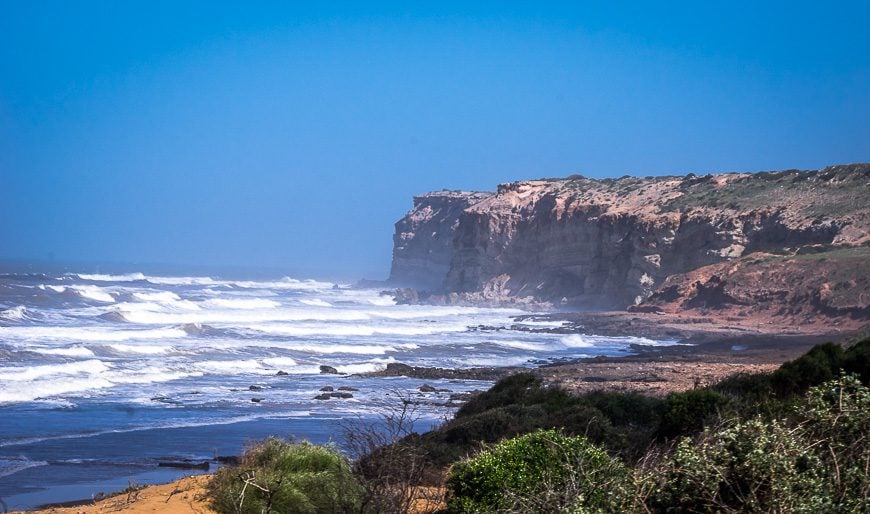
The coast north of Essaouira

The coast north of Essaouira

It was a marvelous trip that was organized with the help of Sun-Trails, a local Moroccan company I found online and would recommend.

There were certain things I absolutely had to do while in Morocco. That list included a multi-day hike and an overnight visit to the Sahara Desert but we were open to other suggestions, especially from someone who lived in the country. What you see below is our agreed upon route – with a private driver for most of the trip. 

The trip cost about $Cdn5000 – and yes we could have done it for less if we’d rented a car and done the route ourselves. But when you’re really busy and you just want a holiday, I think a personal driver who intimately knows the country, is the way to go. Especially in Morocco.

A driver allowed for huge flexibility everyday – stopping where we wanted for lunch – usually with a picnic that Mustafa, our driver, had purchased for pennies in a local market. If we wanted a photo or just to get out and walk, it was always easy to do.

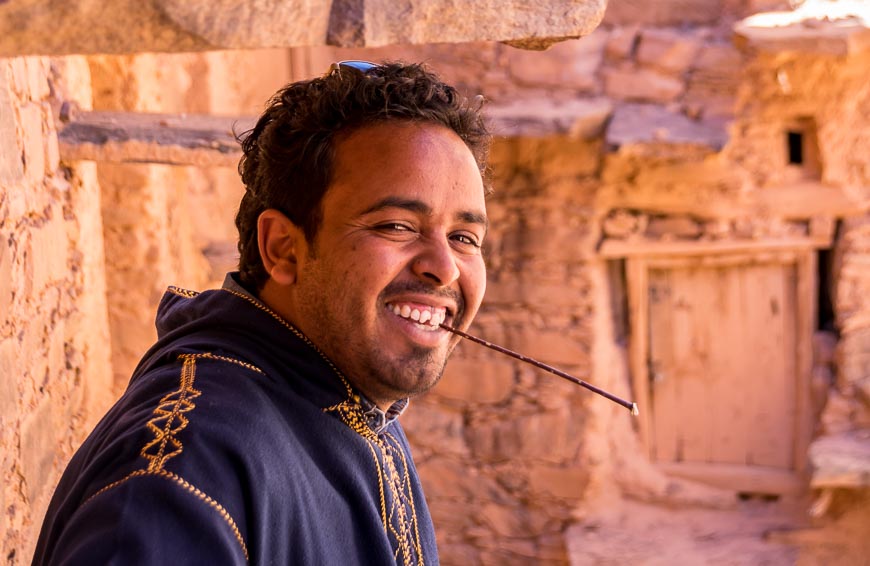
We also never had to get out the map to figure if we were on the right road. And there’s no chance we would have had the same experience in the Sahara without Mustafa. Actually there were a huge number of experiences that made the trip much richer because of him, especially as he grew up as a nomad in the Sahara and was a master at telling stories.

We had a couple of breaks from Mustafa – and he from us – while on a two day hike in the Anti-Atlas Mountains (a highlight) and for the couple of days we spent in Essouaira. 

Mustafa our driver in Morocco

Mustafa our driver in Morocco

Here’s a look at our two week trip – in chronological order – and 14 places to visit in Morocco covering the southwestern part of the country.

Allow a day for Marrakesh – even though it was one of my least favourite places to visit in Morocco 

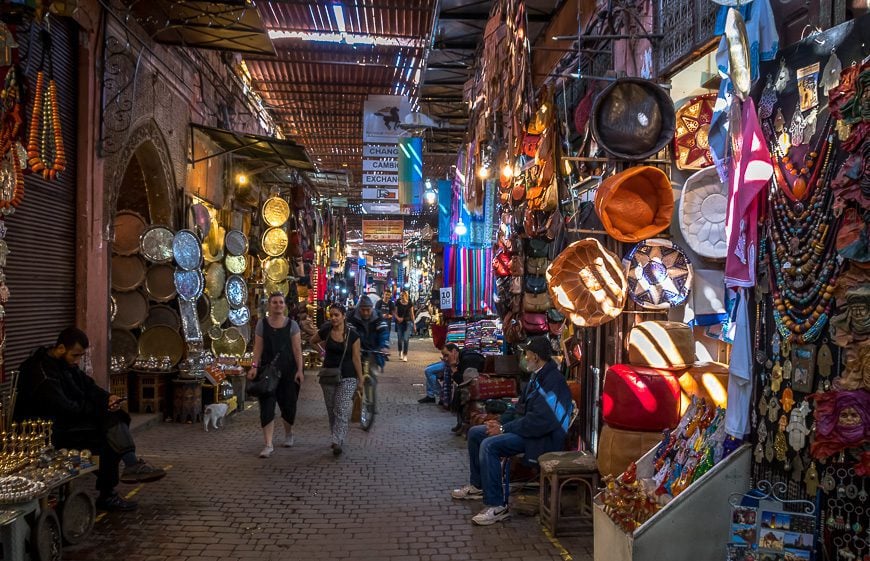
Exotic images probably come to mind when you think of Marrakesh. Colourful, noisy souks, snake charmers in Djemaa el-Fna, fancy riads and a lot of brilliant colours. Marrakesh is partially that but it’s also noisy and polluted. The medina is full of motorbikes – an addition in the last 6-7 years – and not a good one. 

Overall it was my least favourite city that we visited in all of Morocco (though we didn’t see them all) so I really wouldn’t recommend a lot of time here. Allow 2 nights and a full day with a guide so you can see the main sights. Then get out of town. It’s also if you’re a solo traveler where you’re most likely to be hassled.

Read: Marrakesh Places to Visit When You Only Have a Day

The souk in Marrakech - one of the places to visit in Morocco

The souk in Marrakesh

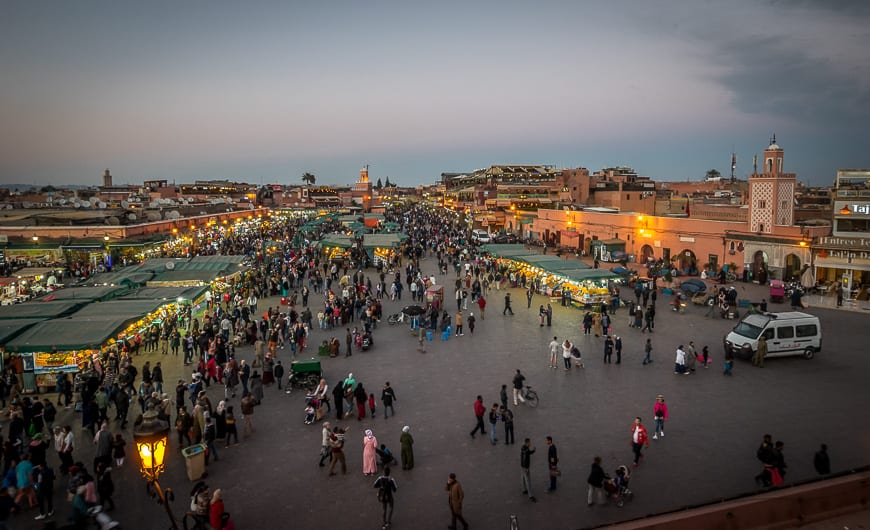
Sunset over Djemaa el-Fna

Sunset over Djemaa el-Fna

Drive through the Atlas Mountains

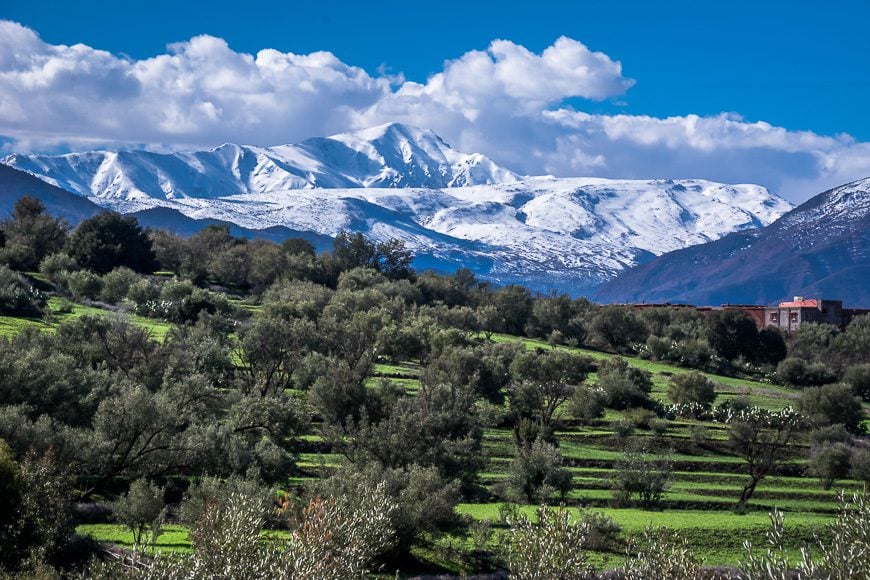
The Atlas Mountains, the highest mountain range in North Africa, stretch for almost 1,000 kilometres from the Atlantic Coast northeast to northern Algeria. They are easily accessible from Marrakesh as a day trip, but if you’re planning to visit the Sahara or many of the places listed below, you’ll see them one way or another. 

The Toubkal area of the High Atlas is the most visited area – and is accessible by public transit from Marrakesh. If you’re into hiking or rock climbing then you may want to spend an extended time in this part of Morocco. There are local and international trekking companies that run tours here, some several weeks long.

But even just a drive through the Atlas Mountains will give you a sense of their grandeur. The road is good and if you’re heading to the Sahara Desert, rest assured you’ll get a taste of the Atlas Mountains. The road we drove took us over Tichka Pass at 2260 metres.

From there we followed an itinerary hitting the following interesting places in Morocco over a two week time frame.

The road to the High Atlas takes you from summer to winter

The road to the High Atlas takes you from summer to winter

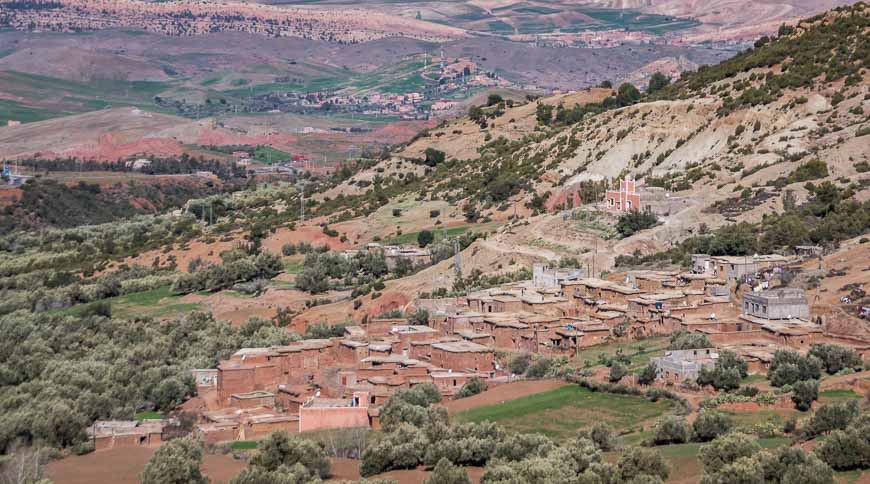
Driving through Berber villages

Driving through Berber villages

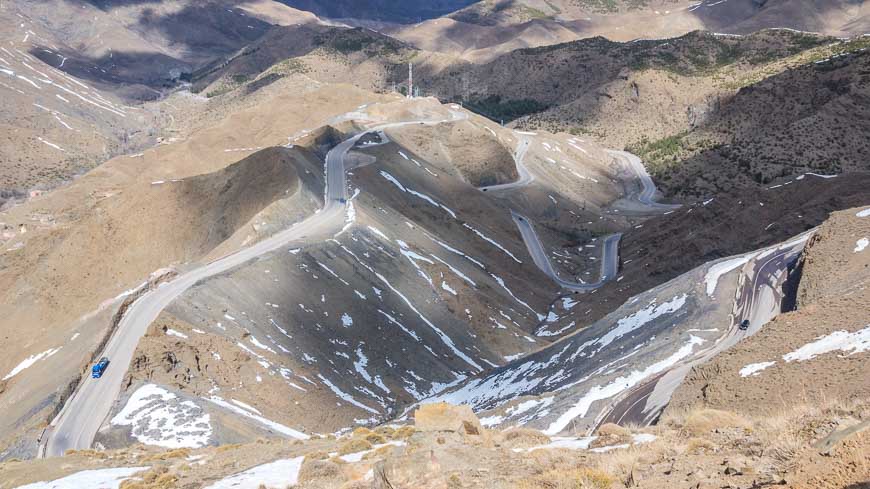
Lots of hairpin turns through the Atlas Mountains

Lots of hairpin turns through the Atlas Mountains

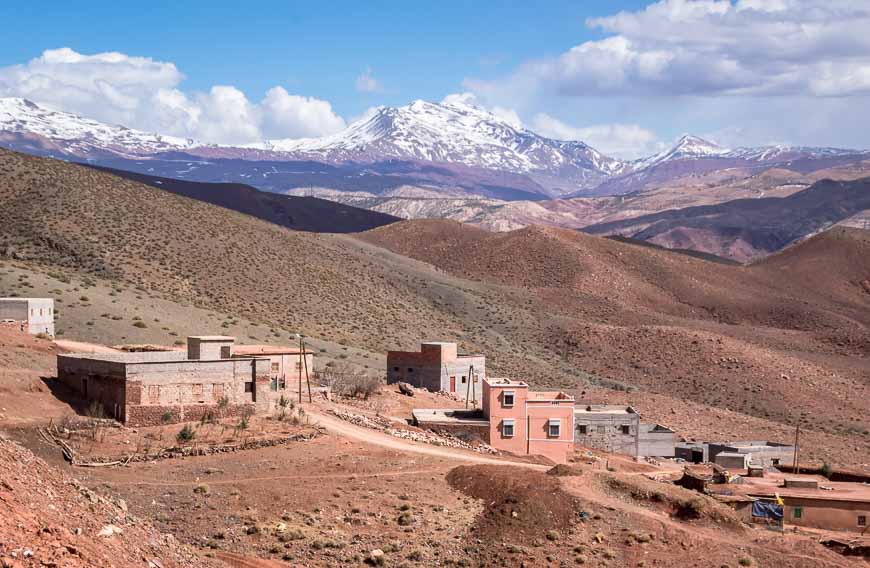
On the other side of Tichka Pass

On the other side of Tichka Pass

Tour the Kasbah Telouet – one of the unusual places to visit in Morocco

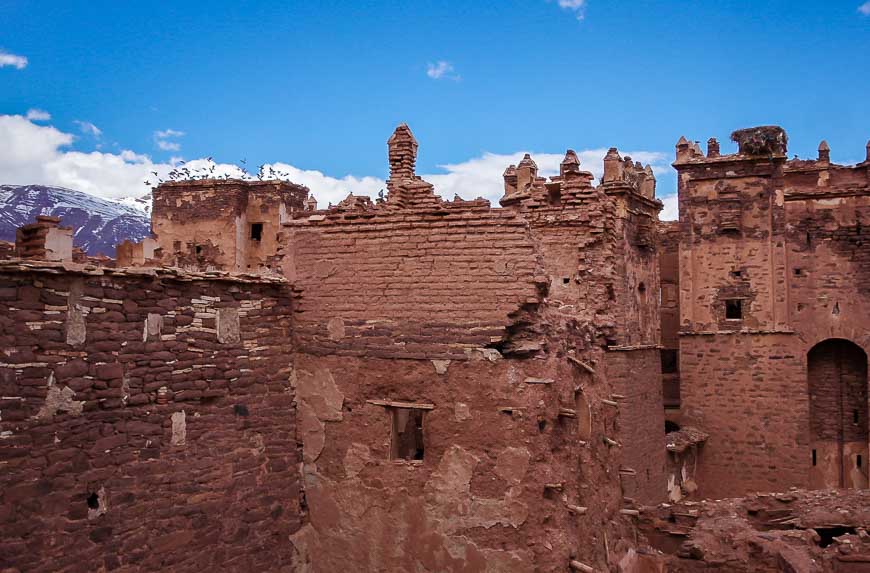
The Kasbah Telouet is on the former camel caravan route to Mali. It served as headquarters for the Glaoui tribe until Morocco gained independence in 1956. Then it was seized by the state and has mostly been left to decay.

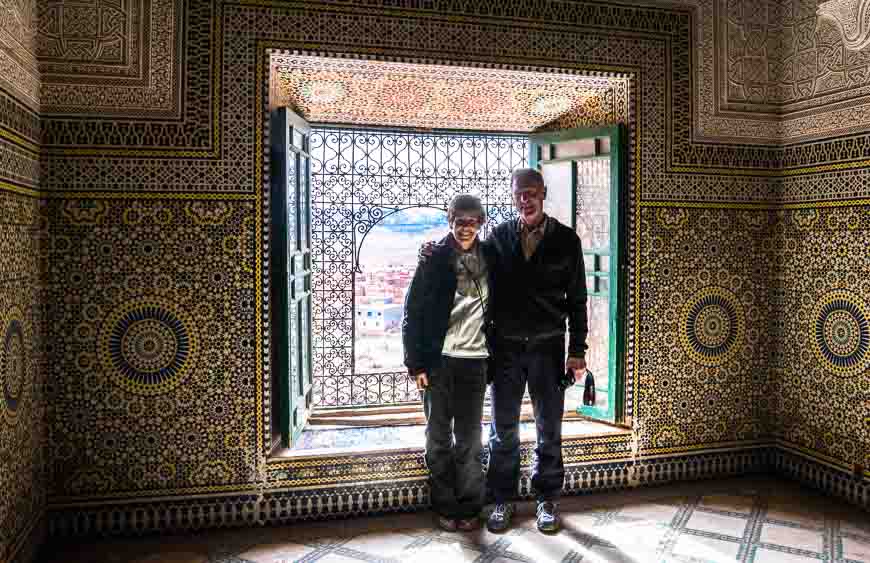
Today it’s hardly a major tourist stop but if you’re driving across the Atlas Mountains to Tamdaght, it’s definitely worth a stop. Only about 10% of the structure can be visited, including a climb up onto the roof. What you will see are some magnificent tiled rooms – the site of many a lavish party back in the day.

The view from the top out to the countryside is very beautiful so be sure to explore what you can. There is a very small entrance fee of about a dollar. Allow about 45 minutes.

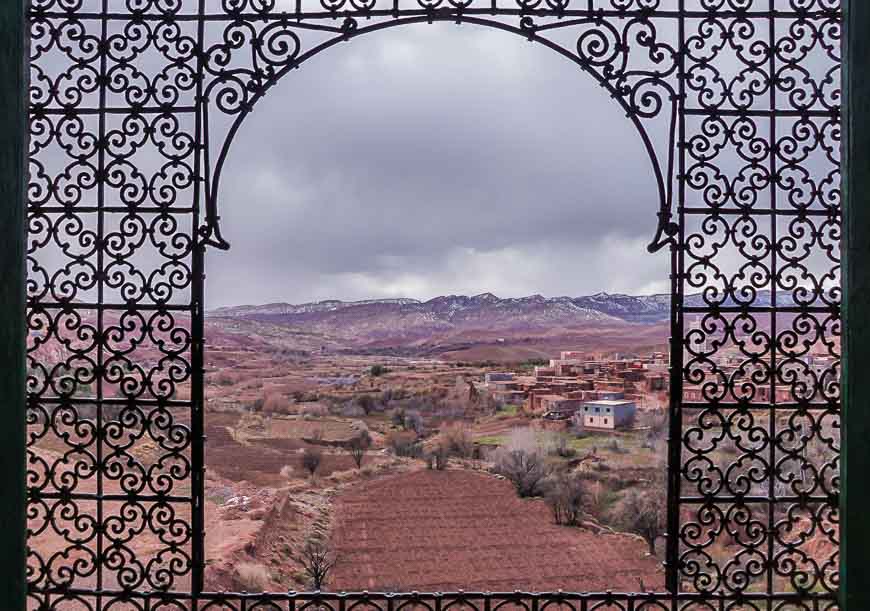
Looking out from the upper floor of the kasbah in Telouet - one of the places to visit in Morocco

Looking out from the upper floor of the kasbah in Telouet

Much of the Kasbah is in terrible condition

Much of the kasbah in Telouet is in terrible condition

Incredible tile detail inside the kasbah in Telouet

Incredible tile detail inside the Kasbah Telouet

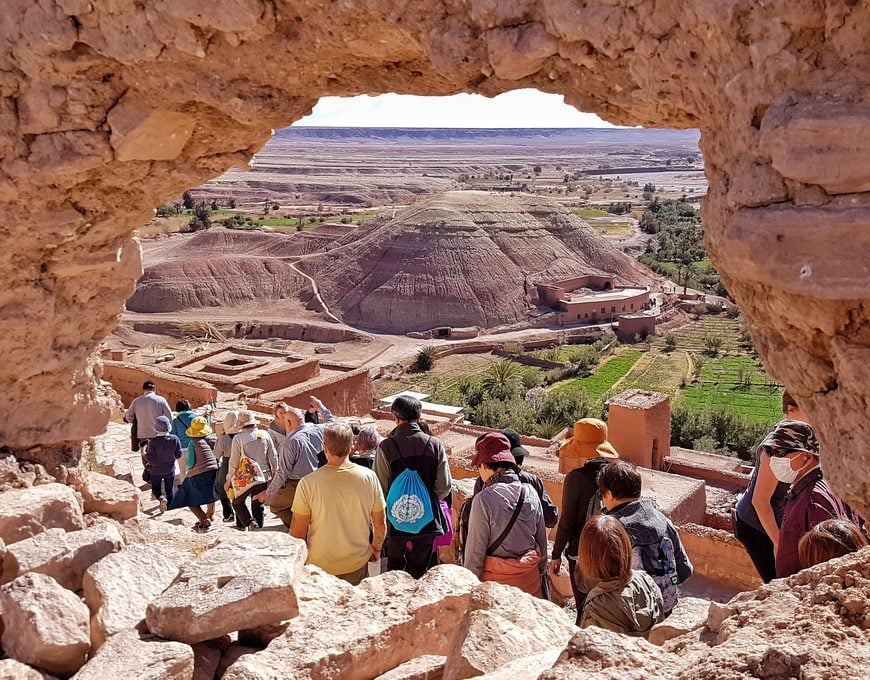
Visit the fortified Kasr of Ait Ben-Haddou – a UNESCO site

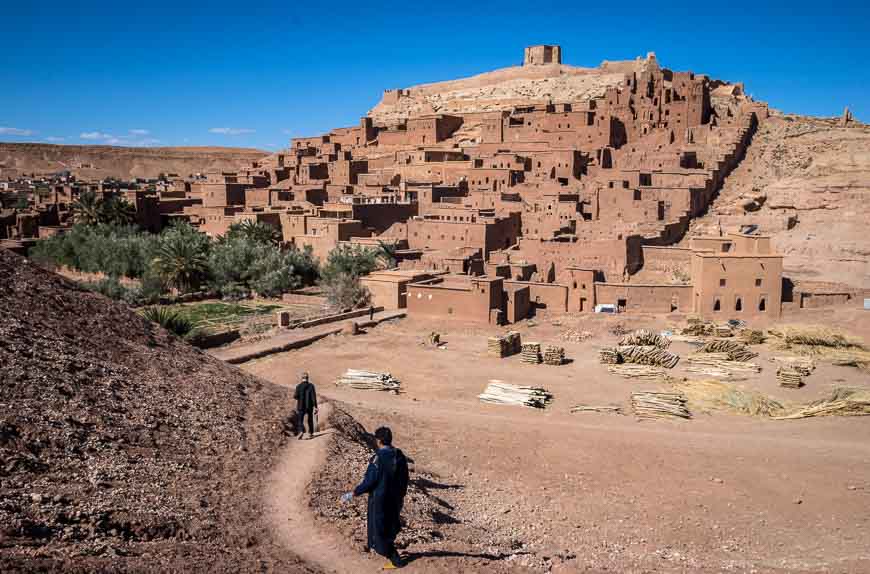
Ait Ben-Haddou, near Ouarzazate, is one of the best preserved kasbahs in Morocco’s Atlas region. You may have seen it unknowingly in theatres or on TV as its been included in scenes of at least 20 movies including Lawrence of Arabia and more recently in the Game of Thrones.

Ait Ben-Haddou won UNESCO status because it exemplifies “traditional earthen habitat representing the culture of southern Morocco”. The community was on a trading route between Marrakesh and ancient Sudan. As such it had to protect itself which it did by building dwellings onto the side of a hill. At the top is a fortress, the last line of defense.

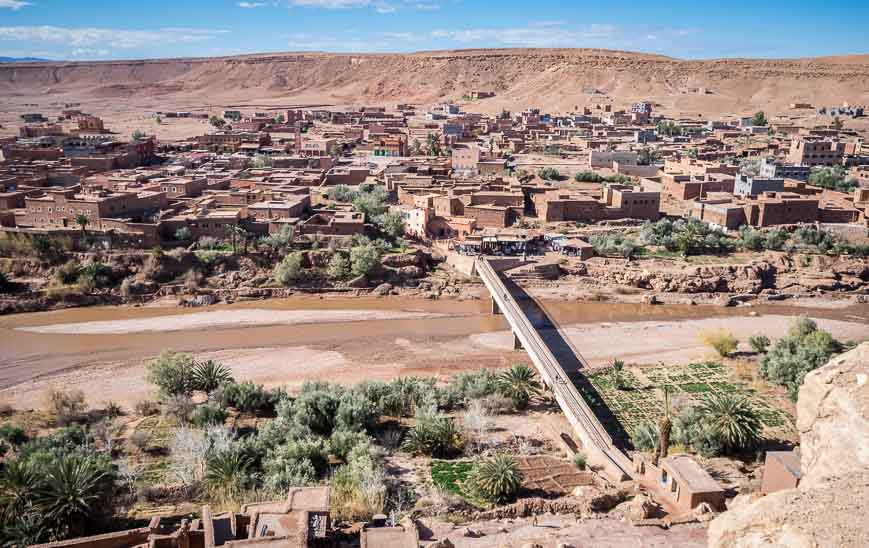
Ait Ben-Haddou sees throngs of tourists and tourist buses so get here early to beat the rush. You have to get past the souvenir shops to get across the river and the main entrance – near more souvenir shops. You don’t need a guide – even though many men will offer their services.

Pass through a touristy section to get to Ait Benhaddou

Pass through a touristy section to get to Ait Ben-Haddou

Looking across to Ait Benhaddou - one of the places to visit in Morocco

Looking across to Ait Ben-Haddou

Ait Benhaddou gets very busy

Ait Benhaddou gets very busy

Admire the Drâa Valley

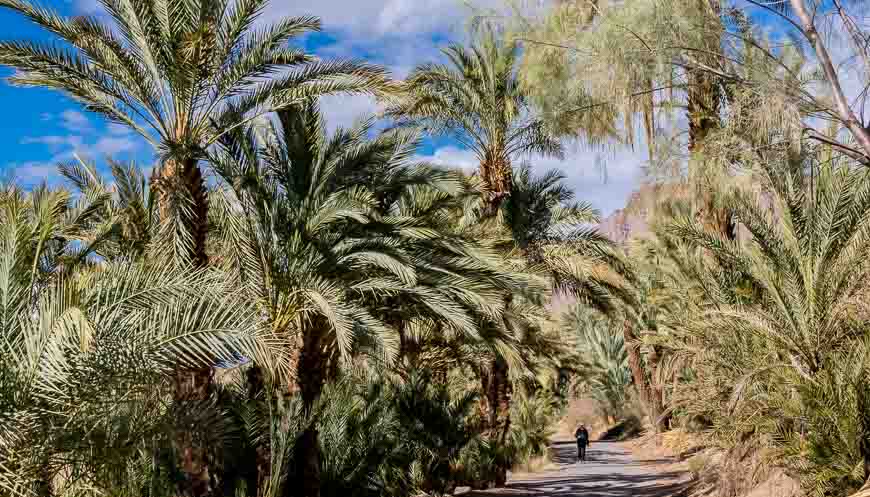
The Drâa Valley, home to Morocco’s longest river, the 1000 kilometre Drâa River, is a gorgeous oasis, home to kasbahs, Berber villages, lush green plains and endless stretches of palm trees.

The valley starts around Ouarzazate and continues into the Sahara Desert. Mostly we just drove through it, stopping to get photos – and for one lovely hour to hike in the shade of some giant date palms on route to Zagora.

Palm trees in the Draa Valley

Palm trees in the Drâa Valley

The Drâa Valley - one of the beautiful places to visit in Morocco

The fertile Drâa Valley

Buy pottery in Tamegroute

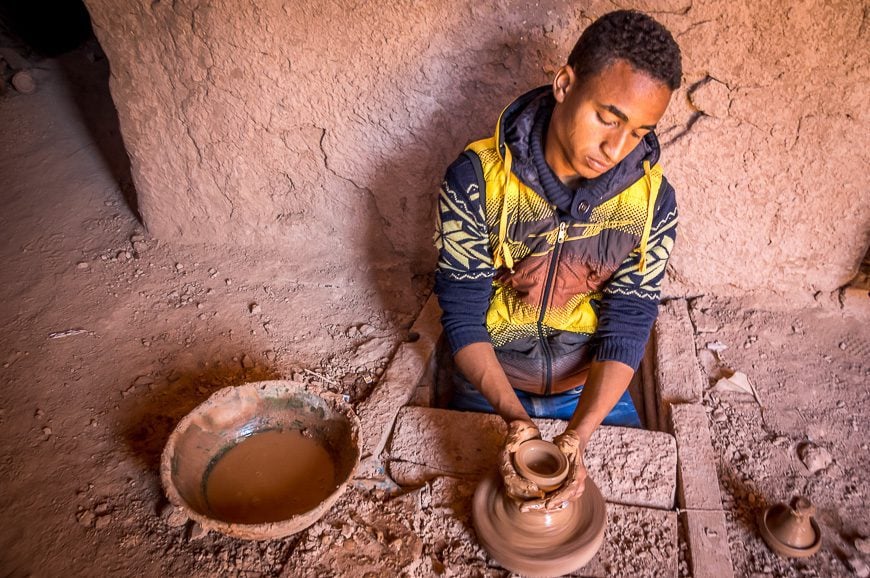
While the village of Tamegroute is home to the Nassira library that contains a 10th century gold-engraved Koran, it’s the pottery that draws people to stop.

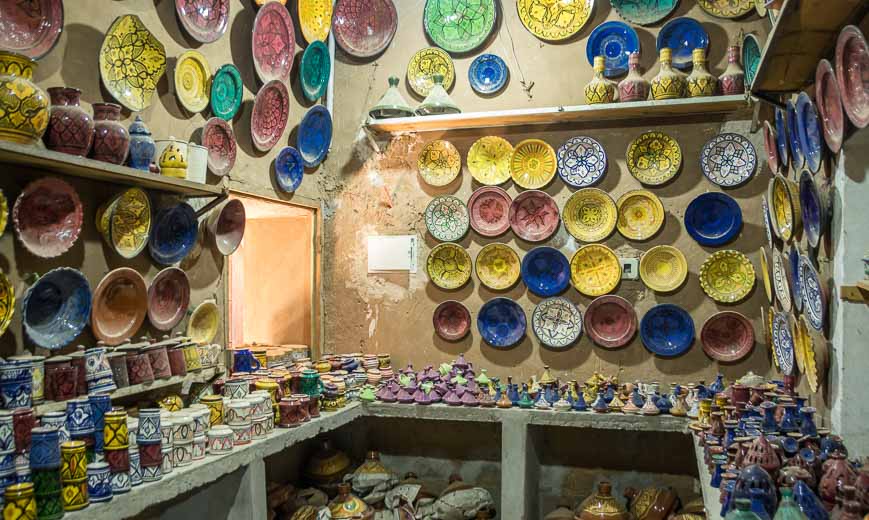
You can buy pottery in a rainbow of colours. But it’s the tell-tale emerald glaze that you see on mosque tiles and on dishes all over Morocco that people seem to be crazy for. Personally it’s anything blue for me.

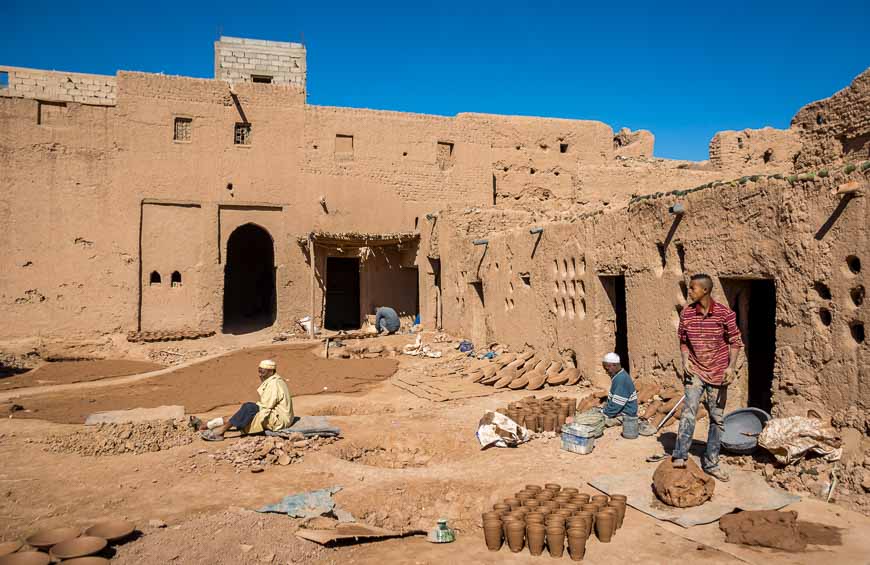
Collecting pottery when I travel is something I love to do, especially if it helps support a community. Here, where we saw people toiling for long hours, whether it be pounding clay or using the pottery wheel like the gentleman below, I cherish the few pieces that made it home intact. I feel like they have a real story to tell.

A man making pottery in Amezrou

A man making pottery in Amezrou

Making pottery in Amezrou

Making pottery in Amezrou is hot, dirty work

The finished pottery is very colourful

The finished pottery is very colourful

Spend a night in the Sahara Desert – one of the outstanding places to visit in Morocco

A true highlight of any trip to Morocco is a night or two in the Sahara Desert. The Sahara will mesmerize you with its otherworldly beauty and the infinite sand patterns in the dunes. It may surprise you with its lushness after a winter rain. And if you lie on a carpet outside your tent, you just might find magic in the night in the form of shooting stars.

Camel trips are optional at most places you stay in. If that sounds exotic to you, then do it. And be sure to catch either a sunrise or a sunset.

But be aware. There are two main desert camps in the Sahara. One has a quieter atmosphere – and one a party atmosphere. Be sure to choose one that fits the type of traveler you are.

Read: A Trip to the Sahara Desert in Morocco

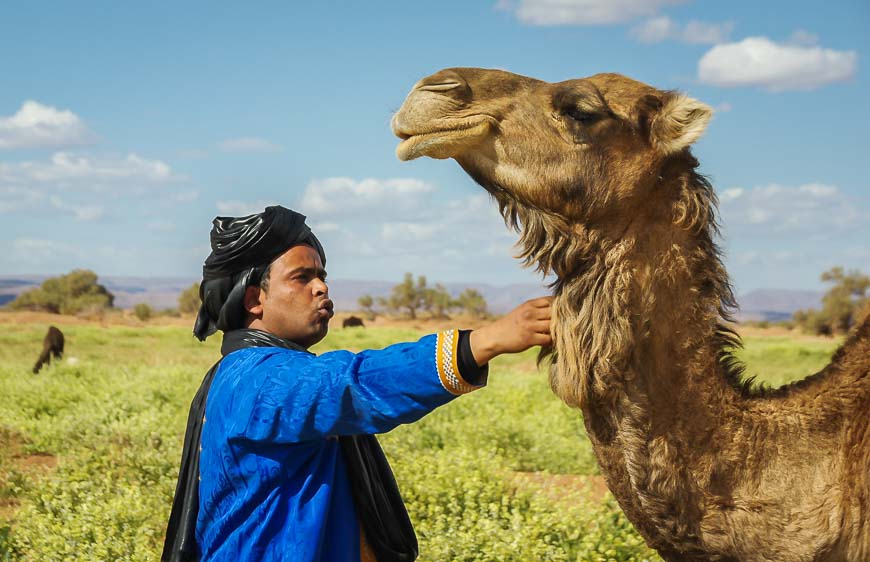
Our guide Mustafa knows camels very well

Our guide Mustafa knows camels very well from growing up as a nomad in the Sahara Desert

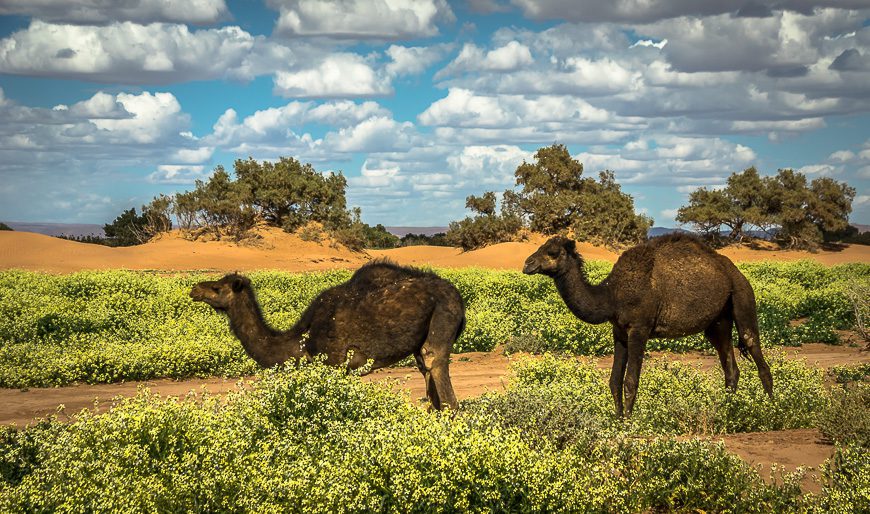
Camels in the Sahara Desert

Camels in the Sahara Desert

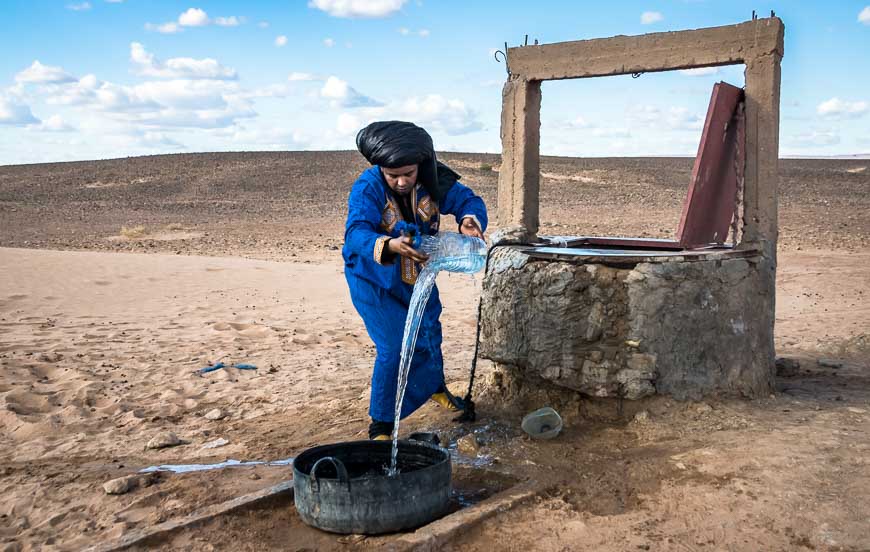
Its a courtesy to fill up the troughs for the next nomads that arrive at the well

Its a courtesy to fill up the troughs for the next nomads that arrive at the well

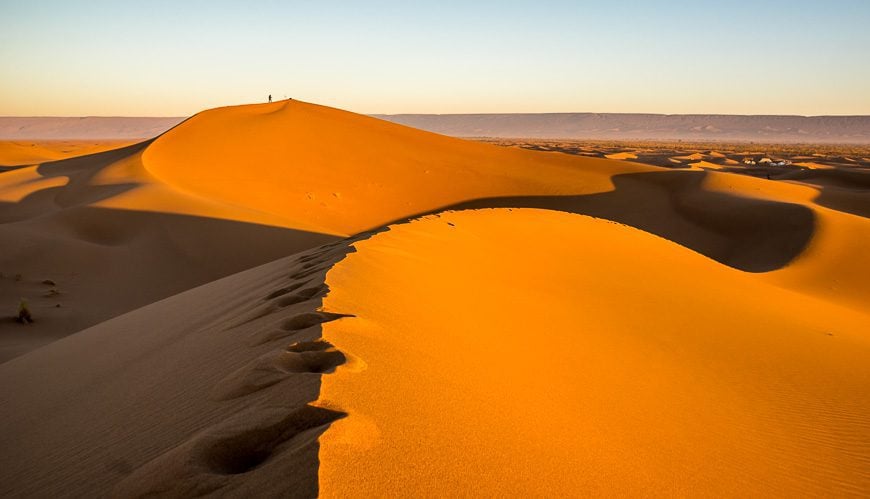
The Sahara Desert

The Sahara Desert

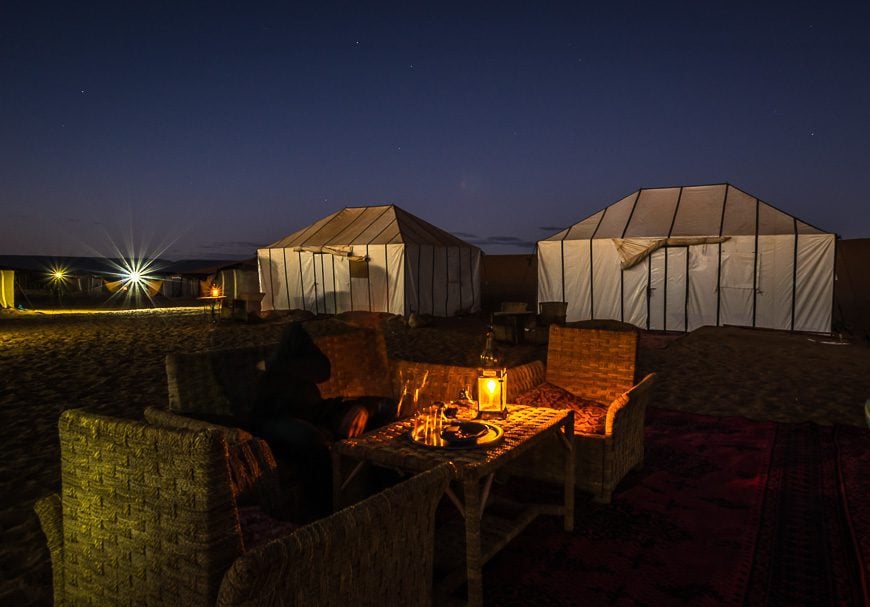
Stay overnight in the Sahara Desert

Stay overnight in Erg Chigaga, Sahara Desert

Drive across dry Lake Iriki – one of the unusual places to visit in Morocco

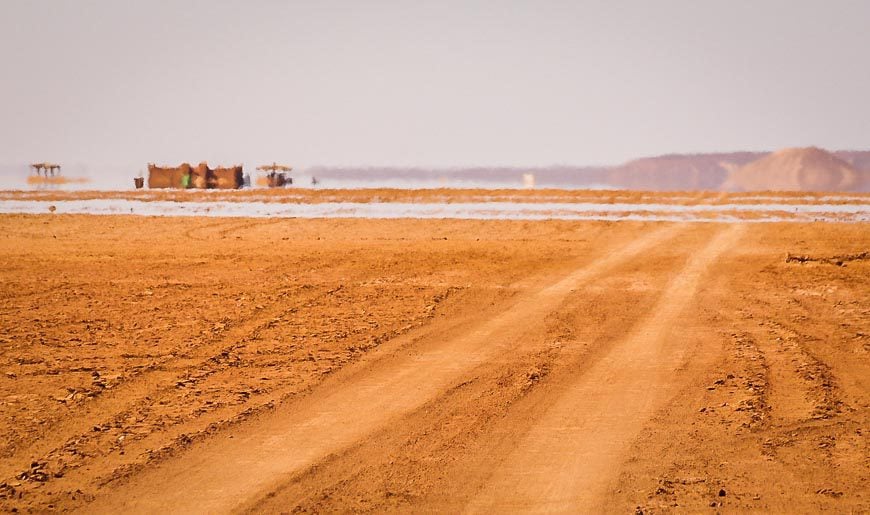
If you’ve been to the dunes at Erg Chigaga, then you’re very close to dry Lake Iriki. Drive across it on an almost-as-hard-as-tarmac road – stopping to look for fossils in one place, and to admire the Fata Morganas mirage, that is more often than not seen at sea.

The mirage, named after the sorceress Morgan le Fay in the legend of King Arthur, appear when the light is “bent” by contrasting air temperatures. It’s a regular occurrence on Lake Iriki.

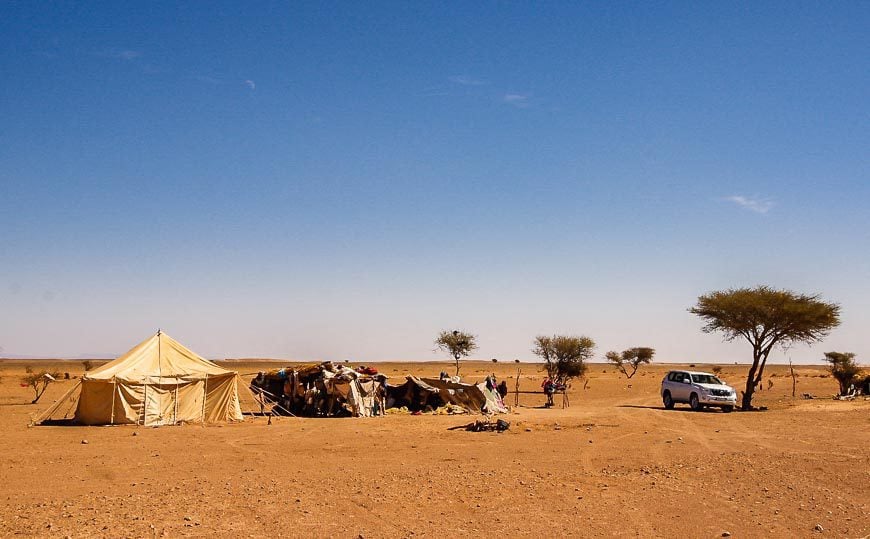
Nomads are famously hospitable and many well welcome you into their simple tents. It’s an entrance into as foreign a world as I’ve ever been privileged to see. Cross your fingers your driver can organize something or that you get lucky and meet a family that invites you in as it’s a true highlight of a trip to Morocco.

Young nomad girl with her goat

Nomad girl with her goat

The fata morgana mirage - one of the interesting places to visit in Morocco

The fata morgana mirage on dry Lake Iriki

Nomad camp in Morocco - one of the eye-opening places to visit in Morocco

Nomad camp in Morocco

Meeting the nomads in the desertt

Meeting the nomads in the desert

Explore Amtoudi

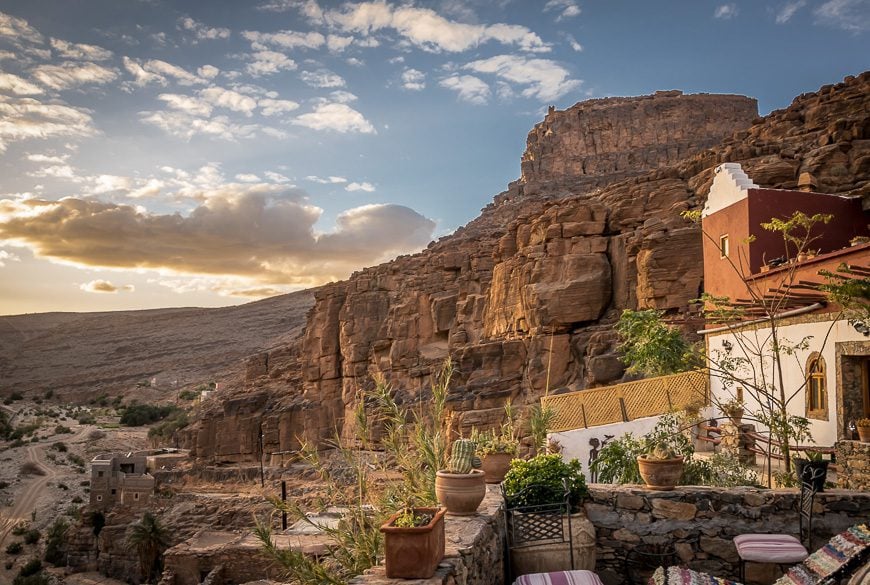
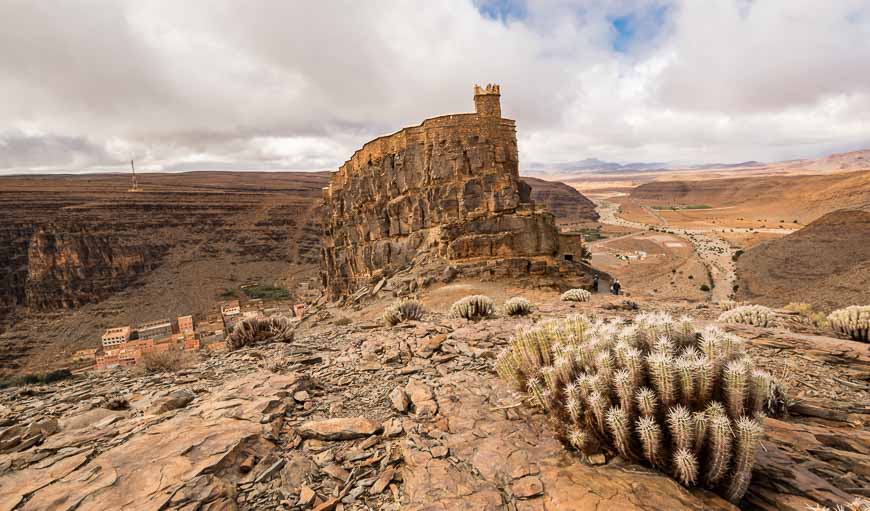
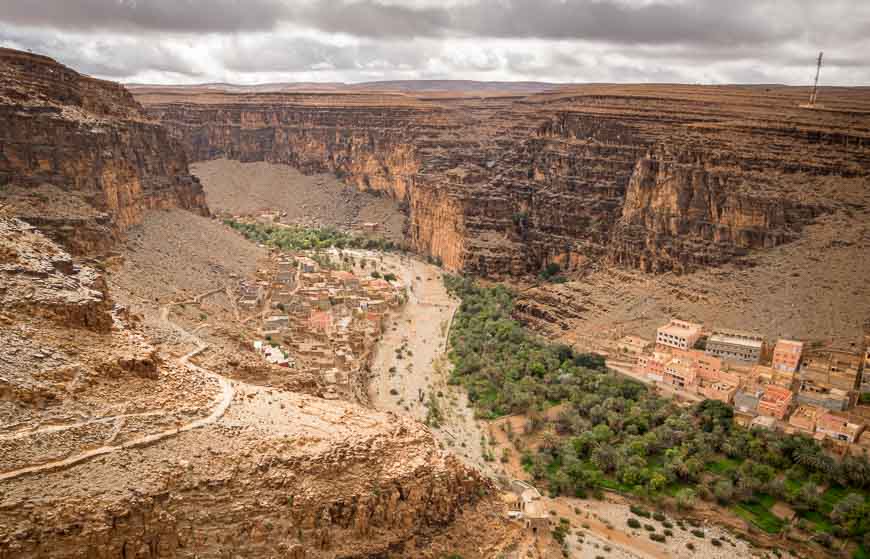
Amtoudi is a small village that sits at one end of a gorge, at the base of a 600 metre cliff.  It is well off the beaten track and perhaps that’s why I loved it so much.

The village was the end point of our two day Anti-Atlas trek. The final hike into the village through the gorge is absolutely stunning and would make a fine day trip in itself.

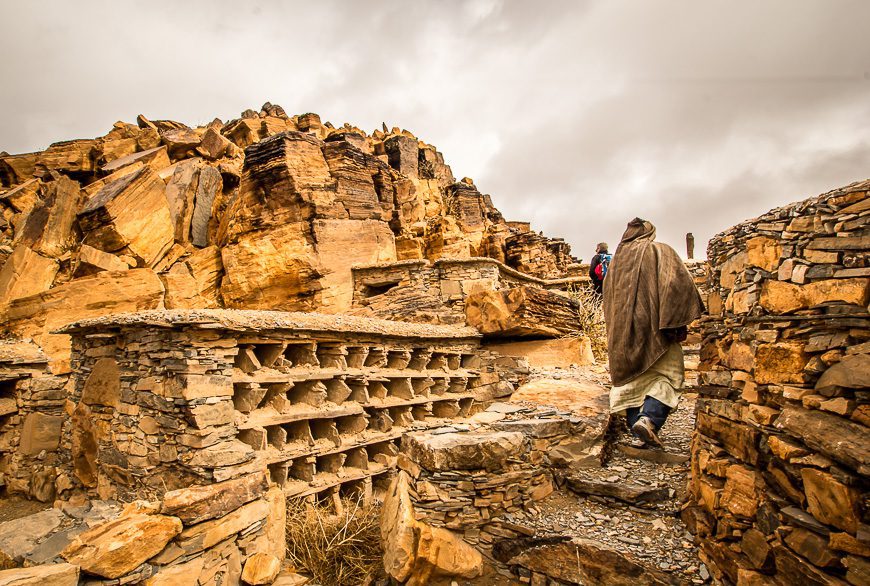
There is also the option to climb 600 metres to reach the ancient granary. It is here that locals would store water, stock grains and raise bees – in case of attack. It’s worth doing the steep hike. Views are spectacular and the place just oozes history.

Read: A 2 Day Hike in the Anti-Atlas Mountains of Southern Morocco

The village of Amtoudi is in a beautiful location - a highlight and one of the interesting places to visit in Morocco

The village of Amtoudi is in a beautiful location; the granary stands 600 metres above the town

The granary in Amtoudi

The granary above Amtoudi

Fabulous hiking up the gorge in Amtoudi

Fabulous hiking up the gorge in Amtoudi

Ancient beehives at the granary in Amtoudi

Ancient beehives at the granary in Amtoudi – a highlight and one of the very interesting places to visit in Morocco

Hike or mountain bike in Taroudant

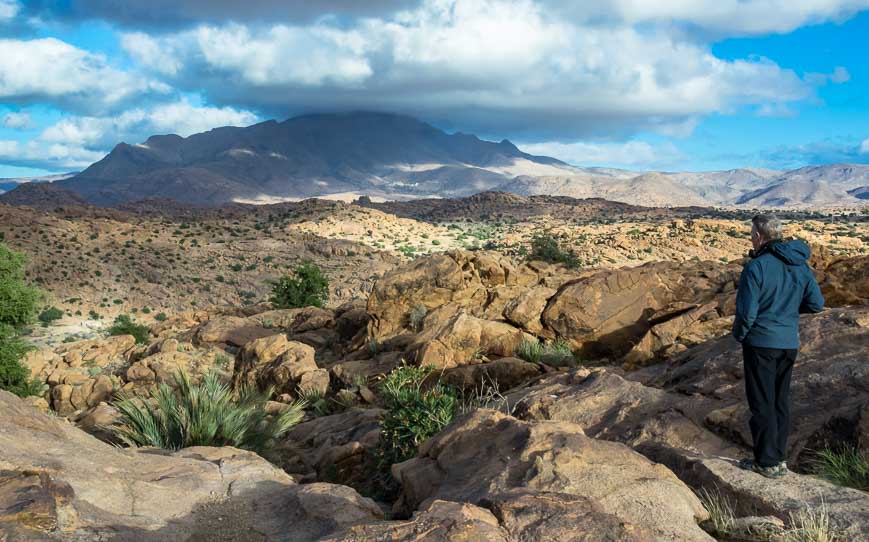
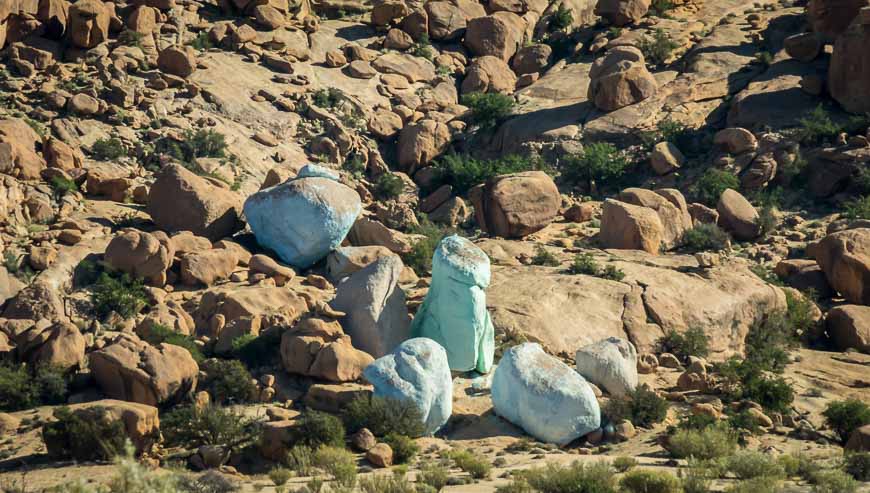
We didn’t have much time in Taroudant which is a shame as its ideal for hiking and mountain biking. Still we got a chance to explore near our hotel – slithering over and around massive rocks and enjoying the views. The following morning we checked out the painted rocks – just strange – along with the otherworldly landscape.

Interesting rocks and excellent hiking in Taroudant - one of the places to visit in Morocco

Interesting rocks and excellent hiking in Taroudant

The weird painted rocks

The weird painted rocks

Visit Souss-Massa National Park

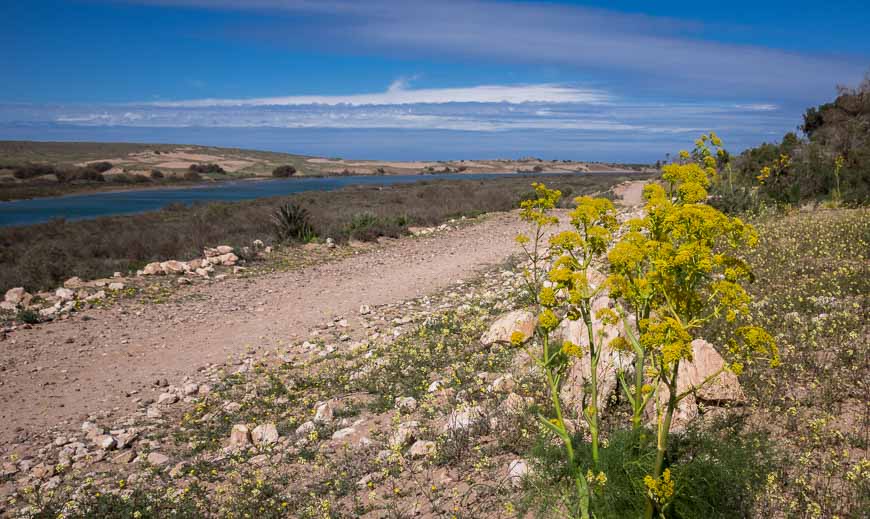
We were both ready for a nature break before heading to Essaouira. We opted to change our itinerary from a stop at an ancient apiary to a trip to Souss-Massa National Park. It turned out to be a real joy with a tremendous amount of bird life especially around the lagoon. We basically just walked in along a dirt road as far as we could go – taking a couple of hours to admire the birds and stretch our legs.

The park is supposed to contain some rare wildlife too though we didn’t see any of it. If you’re lucky you might see the Egyptian mongoose, the common otter or the Eurasian wild boar.

There’s a fenced in part of the park which is home to Dawker’s gazelle, Arabian oryx and the red-necked ostrich. The rare bald ibis are the biggest attraction but no luck for us.

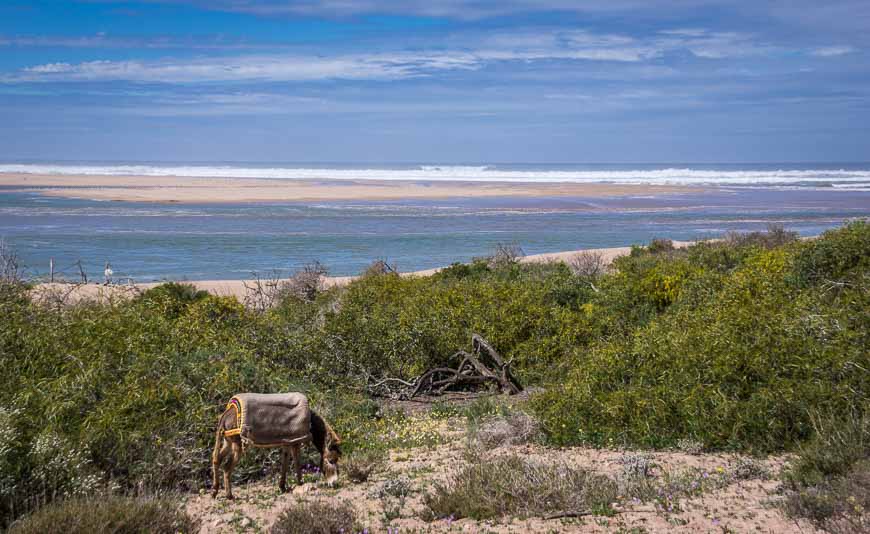
Beautiful walking once you get into Souss-Massa National Park - one of the uniques places to visit in Morocco

Beautiful walking once you get into Souss-Massa National Park

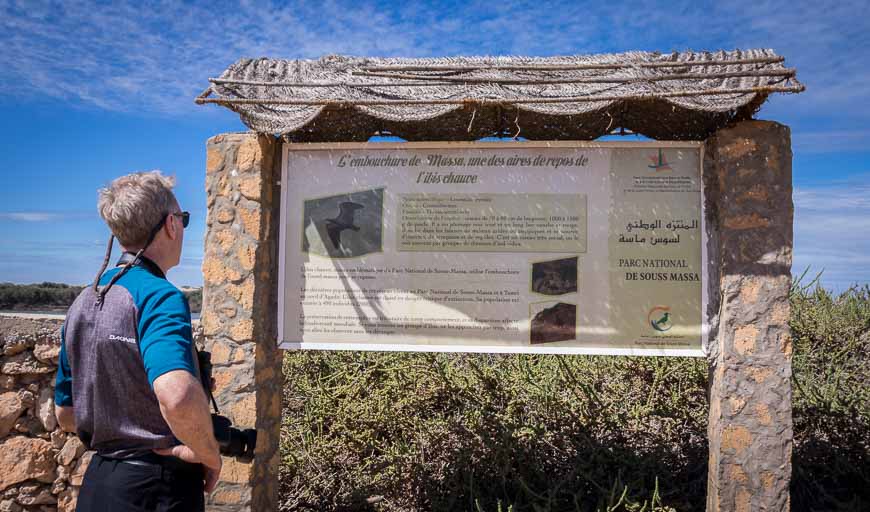
If you can read French then you'll get something from the signage in the park

If you can read French then you’ll learn something from the signage in the park

We walked out until we could see the coast

We walked out until we could see the coast

Spend a few days in Essaouira on the coast

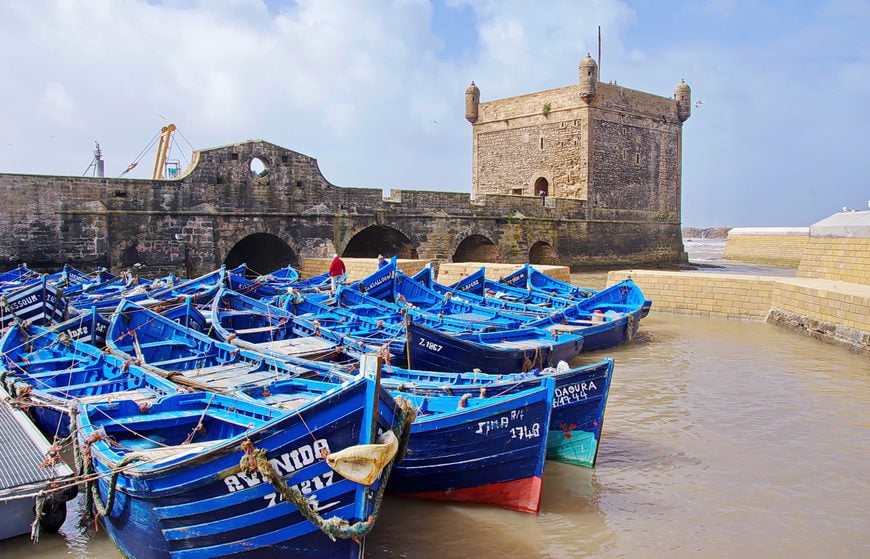
Located on Morocco’s windy Atlantic Coast, Essaouira a former Portuguese stronghold, is a popular holiday destination spot. Its got lots going for it from a rich history, excellent restaurants, a laid-back beach culture along with a medina that’s far more fun to explore than the one in Marrakesh. 

If you’re a windsurfer you must visit Essaouira. And if you’re not, just enjoy the beach, perhaps adding in a massage and a few days of relaxation in this pretty Moroccan city.

Read: 5 Great Things to Do in Essaouira, Morocco

Eassaouira is a colourful coastal city in Morocco and one of the places to visit in Morocco

Eassaouira is a colourful coastal city in Morocco

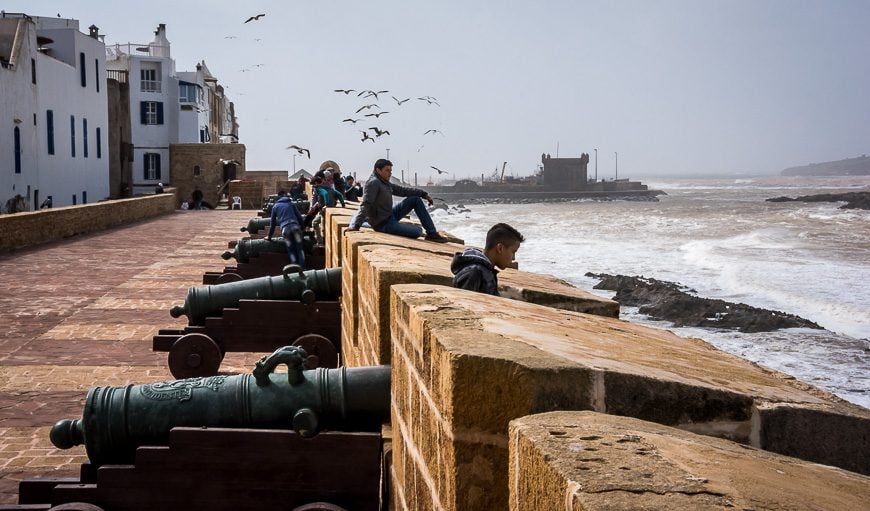
Walk the Ramparts and admire the pounding surf in Essaouira - another of the places to visit in Morocco

Walk the Ramparts and admire the pounding surf

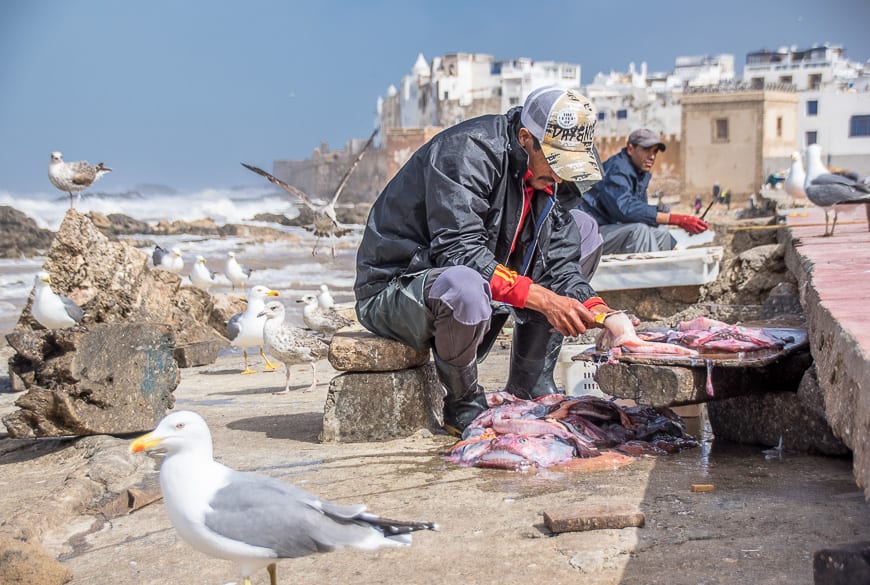
Fisherman busy gutting fish

Fisherman busy gutting fish

Stop in Oualidia for oysters, beaches and swimming

Oualidia is a relaxed fishing town halfway between Safï and El Jadida north of Essaouira on the Atlantic Coast. The majority of the town is sandwiched between a peaceful lagoon and the sea. There’s a nice walkway above the beach along with what looks like miles and miles of beautiful sandy beach.

The town – called Morocco’s “oyster capital” is also good for swimming if you stay in the lagoon. If its adventure you want try windsurfing.

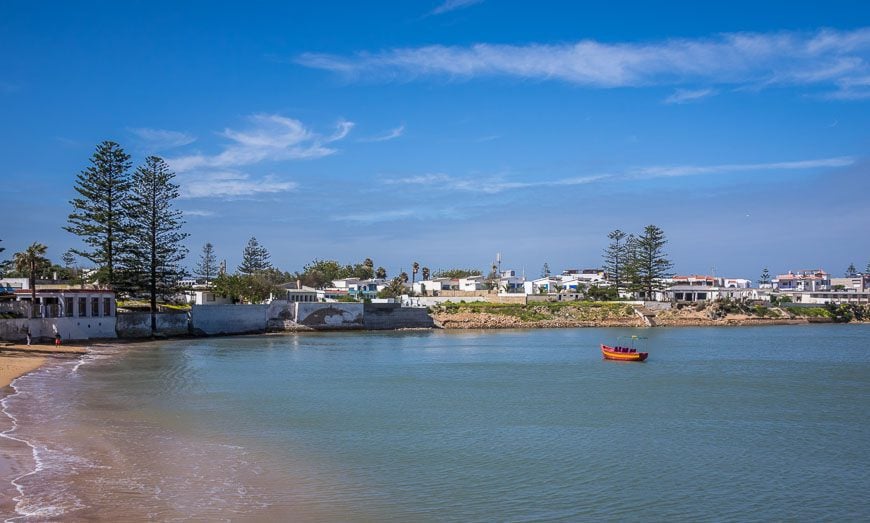
The peaceful lagoon in Oualidia

The peaceful lagoon in Oualidia

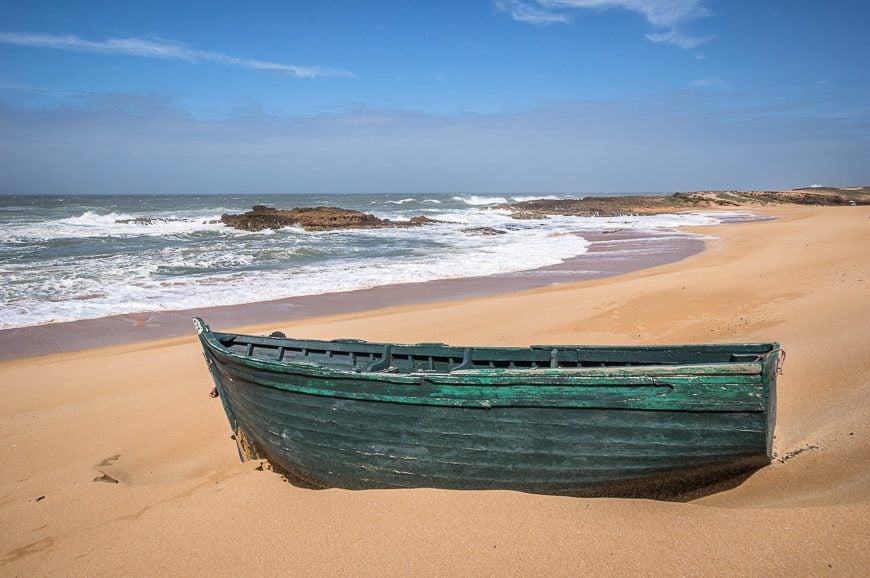
Deserted beach in the village of Oualidia - one of the places to visit in Morocco

Deserted beach in the village of Oualidia

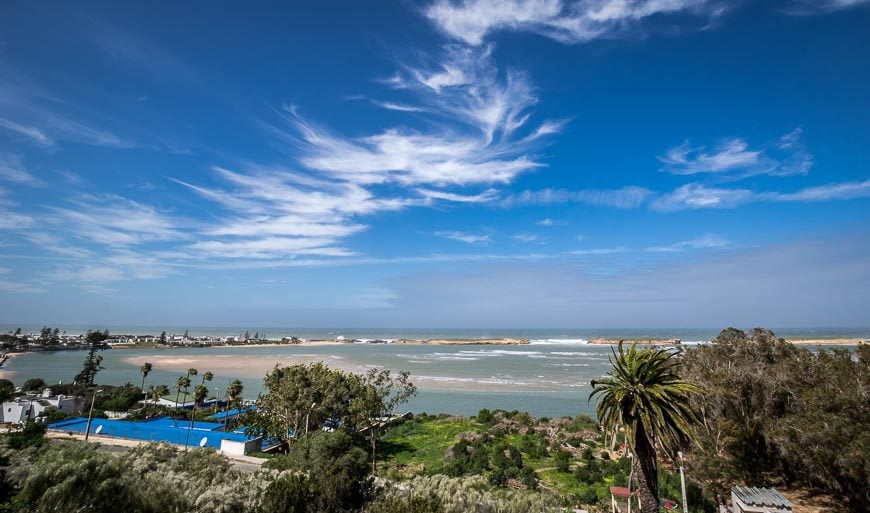
Contrast between the ocean and the lagoon in Oualidia - one of the places to visit in Morocco

Contrast between the ocean and the lagoon in Oualidia

Visit El Jadida – a UNESCO site and one of the unusual places to visit in Morocco

Only an hour away from Casablanca, El Jadida is a former Portuguese stronghold on the south Atlantic coast. The area around it is becoming popular because of beaches. But it’s a visit inside the Portuguese Cistern, another UNESCO site that makes this one of the more unusual places to visit in Morocco. 

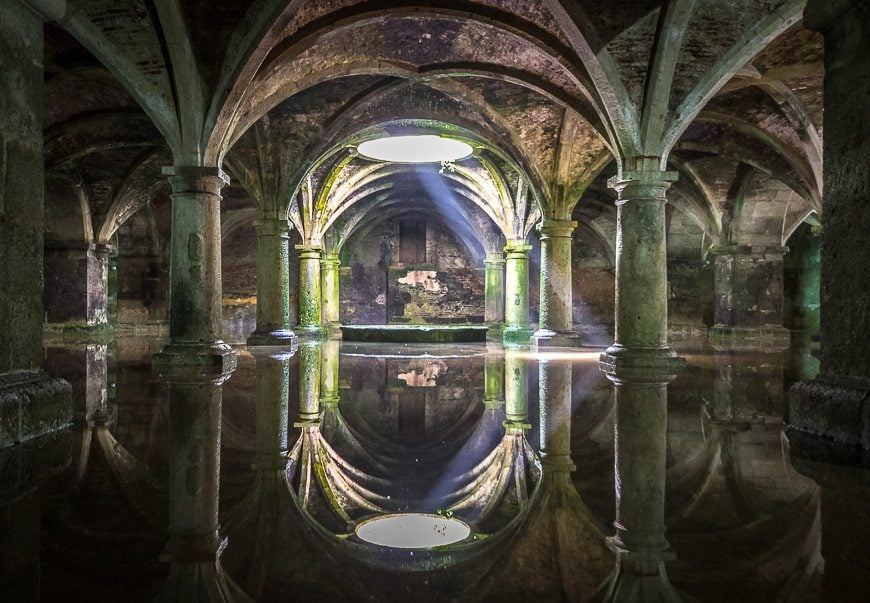
The cistern is a water reservoir – that was used in the 1951 Orson Welles movie Othello. There isn’t a lot of light in the reservoir – except for an opening in the ceiling so the place oozes eeriness – and hence the reason it was used in the movie. 

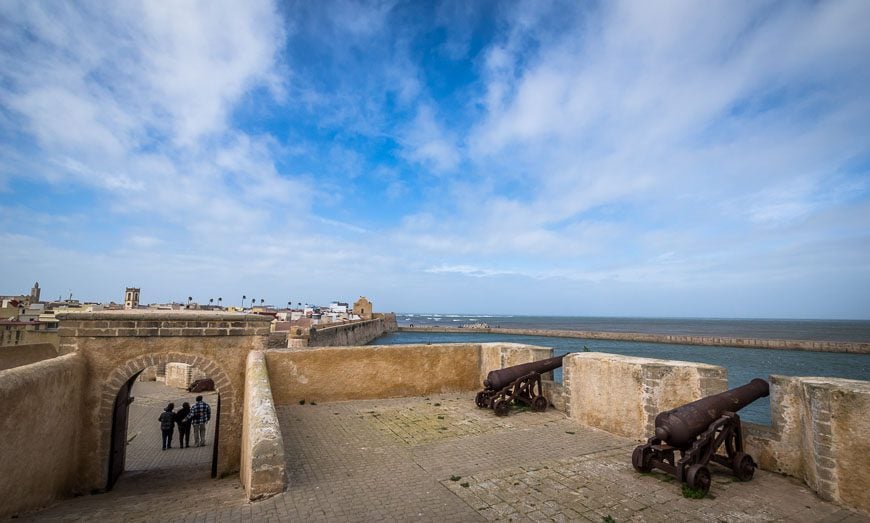
The Portuguese fortifications are also what give this part of El Jadida UNESCO status. According to the UNESCO website “the fortification with its bastions and ramparts is an early example of Renaissance military design.”

You only need about 45 minutes inside the cistern and perhaps another hour at most to walk the fortifications.

Portuguese fortifications of Mazagan

Portuguese fortifications of Mazagan

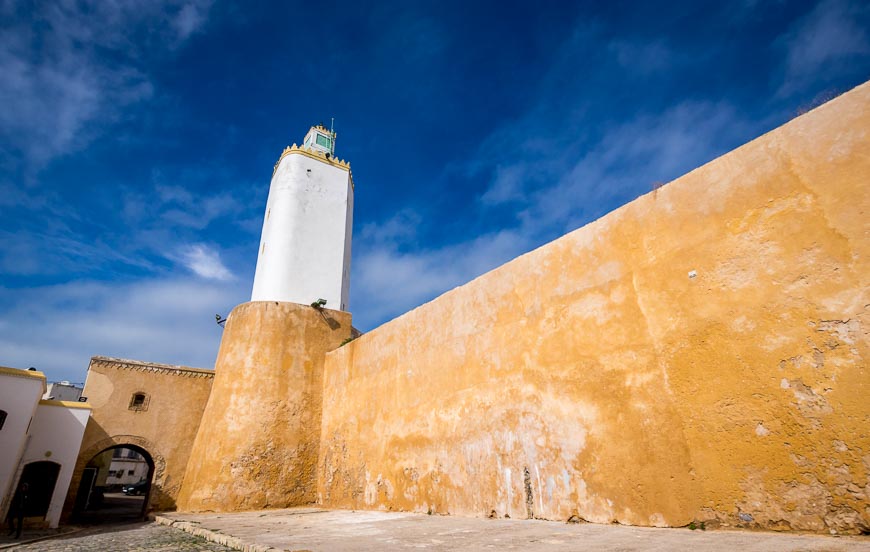
Colouful walls in El Jadida

Colouful walls in El Jadida

Incredible reflections in the Portuguese cistern - one of the interesting places to visit in Morocco

Incredible reflections in the Portuguese cistern – one of the interesting places to visit in Morocco

My favourite places to stay in Morocco

All the places I’ve listed below I stayed in except Amtoudi Adventure – and we did take tea in their house.

In Mmarakesh we stayed in Riad La Parathese. They have a lovely rooftop patio, a great breakfast BUT ask for a room that doesn’t back onto the street or the noise will drive you crazy.

In Tamdaght, not far from Ait Benhaddou, I highly recommend Kasbah Ellouze. Try to arrange to bake bread with the old ladies in the morning.

In Zagora the Azalai Desert Lodge, with its beautiful pool, is absolutely lovely.

In Icht stay in Borj Biramane – with a swimming pool and rooftop terrace. Rooms are simple but still a very nice place in what feels like the middle of nowhere.

If you don’t mind modest accommodations I’d recommend Amtoudi Adventure. We used Hassan as our guide for two days trekking in the Anti-Atlas Mountains (the highlight of our trip!!) and I can tell you his wife makes the most delicious bread – served with their own honey.

If you want a more upscale experience book Tigmi Boubol in Amtoudi. The village itself feels like you’ve stepped back in time.

In Tata I highly recommend a stay at Dar Infiane.

In Tafraoute you will enjoy a larger than normal room at Elmalara and very good food. Plus there is great hiking from the hotel.

Stay at Dar Zahia just outside of Taroudant. It’s a lovely spot with very well-appointed rooms. A great asthetic throughout the hotel.

Essaouira has loads of great accommodation choices.We stayed in the lovely Riad Perle dEau with windows that opened to beautiful views of the sea. And at high tide, the waves pounded the building which was actually really cool but a little scary too. They serve an awesome breakfast with a view on an upper balcony.

Kasbah Ellouze

View from our room at Kasbah Ellouze in Tamedaght

Click on the photo to bookmark to your Pinterest boards.

14 interesting places to visit in Morocco

The post 14 Interesting Places to Visit in Morocco appeared first on Hike Bike Travel.

14 Interesting Places to Visit in Morocco Read More »
Survival Gear Review: The Solo Stoves, Part One: Solo Stove Lite

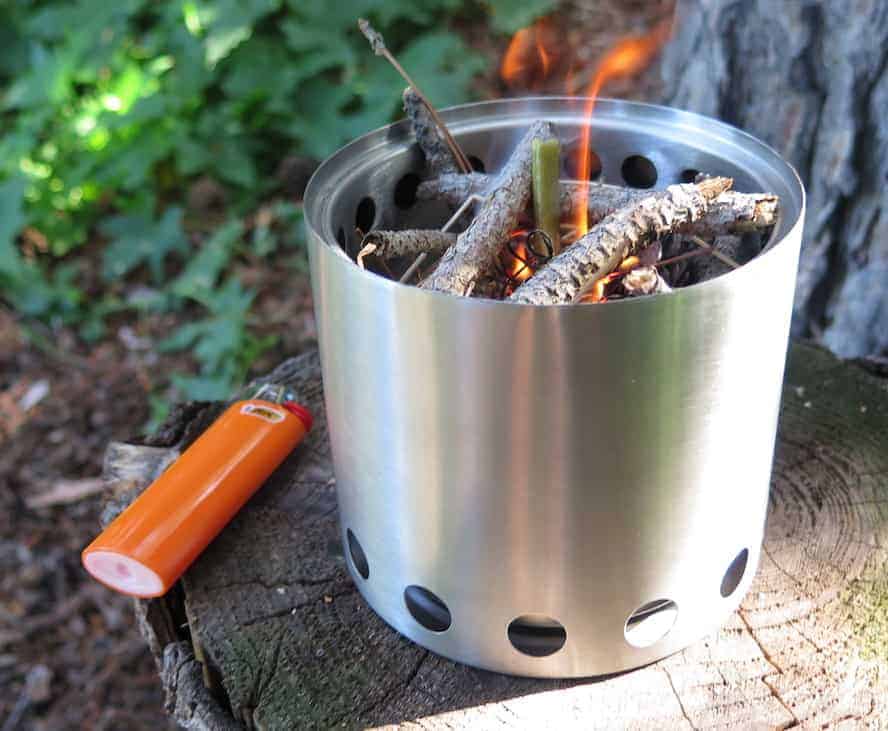
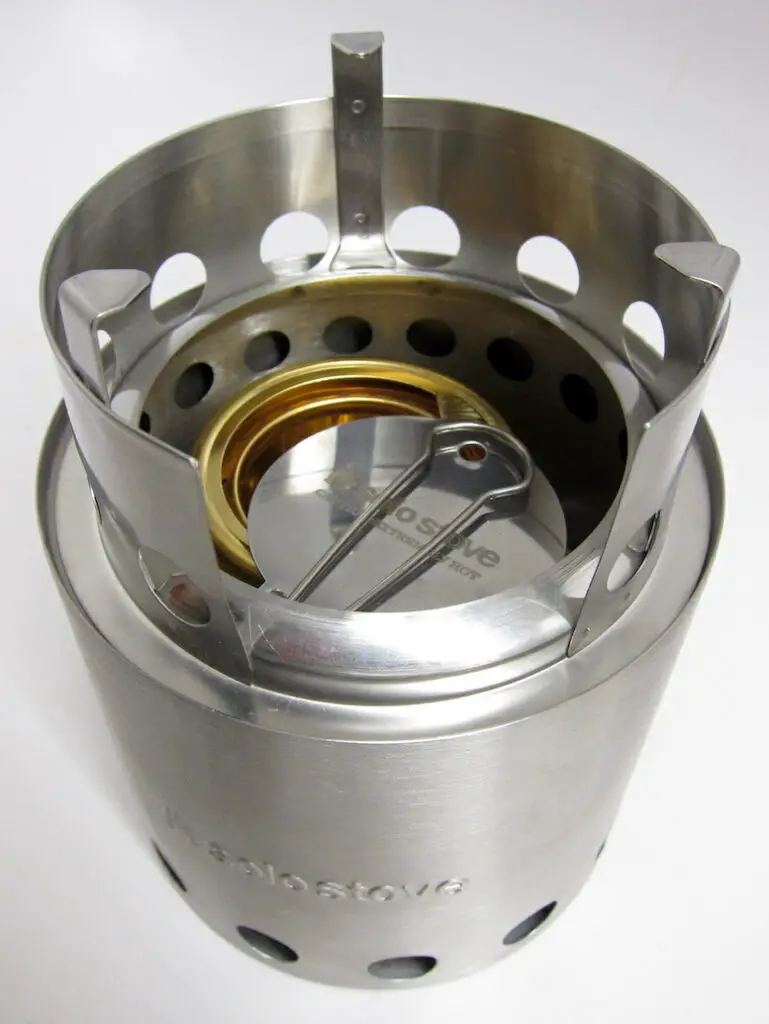
The Solo Stove design is a stainless steel can-shaped wood-burning container of numerous sizes from easy carry for backpacking, to a monster that needs two people to lift it. For this review, we will take a look at the Solo Stove Lite, the smallest of the Solo Stove offerings. Part 2 will address a larger Solo Stove stove, and a campfire-sized Solo Stove.

By Doc Montana, contributing author to Survival Cache and SHTFblog

The Solo Stove Lite is a beautifully engineered and executed stainless steel wood stove not much bigger than a can of beans. But what does raise eyebrows is the price; about $70. And even more surprising than the price is that those who use it absolutely love it! So much so that the price drifts into the ether becoming a non-issue after only a few uses.

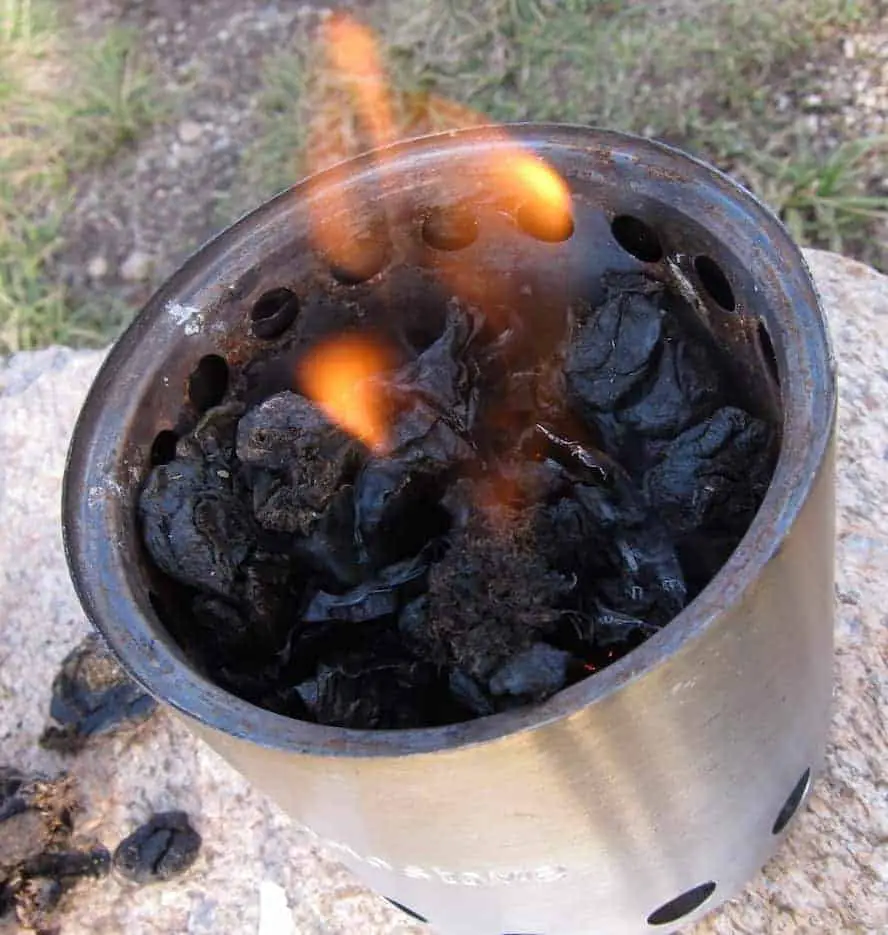
The Solo Stove is a dynamic option for those comfortable with placing their cooking needs in the hands of wood. And I am one who does. The Solo Stove is a trifecta of physics, engineering, and materials. On the physics side, the flow of oxygen to the Solo Stove’s main fire chamber follows a dual route “from the bottom to the top,” to quote the Talking Heads. As air enters the base of the Solo Stove through external holes lining the lower parameter, it carries ambient oxygen to the lower vent, and also to upper openings in the main chamber. The oxygen level in air is far above the O2-starved fires inside the stove. So much so that it appears as if flames are flowing out of the upper parameter holes into the main flow of flame. It truly is both inspiring and mesmerizing. You’ve got to see it to believe it.

Also Read: Survival Gear Review: MSR Whisperlite Stove

Air begins its journey under the main fire due to a wire grate that delineates the base of the burn chamber from a sub-chamber that doubles as an ash trap. As the combustion gasses ascent to the upper levels of the stove, they are heated before pouring into the chamber through the holes lining the upper reaches of the inside of the inner wall. The hot air offer an abundance of oxygen causing a gassification effect that takes the tradition campfire wood heating to amazing levels.

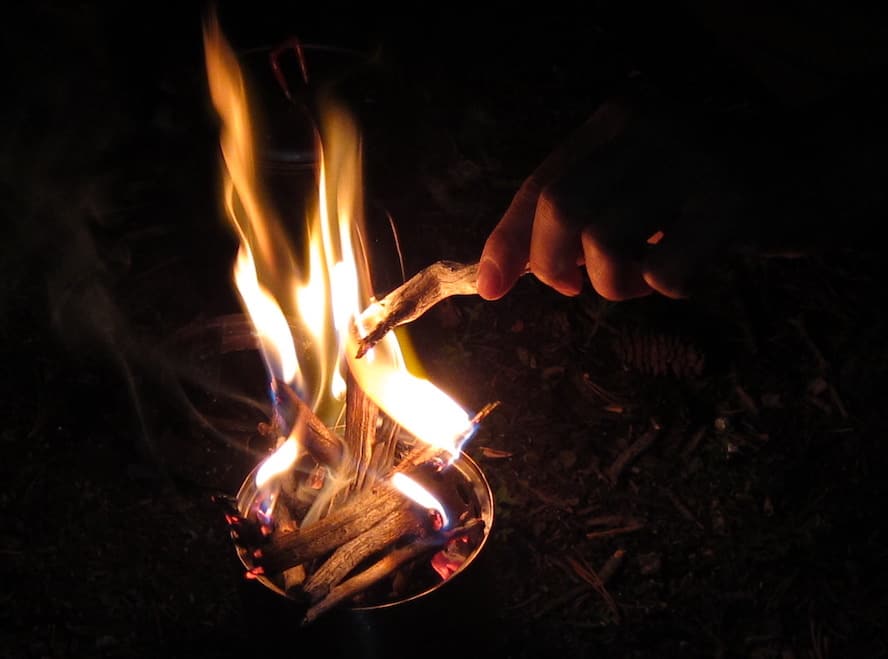
An additional benefit from the dual airflow system is that there is extremely little smoke from the stove when burning efficiently. Like none. Of course there is plenty of smoke on both ends of the time you use the stove, but a large part in the middle burn time when cooking and campfireing are done has no noticeable smoke. There is still plenty of woodfire smell, however. One time from a bit of a distance, I thought my stove was pouring out the smoke only to realize as I neared that it was spraying steam like a train whistle out of a snug fit pot lid. And no smoke.

When burning wood, you don’t have to be diligent about the stove’s operation. You can add some wood and walk away. If it burns down, you add more. If your water boils, then good and it will just boil longer. But the Solo Stove completely removes the worry about conserving fuel. And once you get into the Solo Stove mindset, you see fuel everywhere and in abundance.

The Solo Stove Lite is a wood stove on the smaller side that punches well above its weight class. The Solo Stove is made of 320 stainless steel which just means that its made of the most common stainless steel. But stainless steel nonetheless. The welds between the two “cans” are impeccable, and a thing of beauty. A mesh grate of nichrome wires criss-crosses the inside bottom providing a limited but ample supply of air to keep the coals humming along while allowing gravity to remove the spent wood. Sometimes a minor shake of the burning stove tidies up the fire by cleaning out the carbon from the fire.

There are two pieces to the Solo Stove, a main dual container consisting of the two layers of steel, the ash basin, and plenty of holes above and below main chamber. The other piece is a ring of steel with a lip that can either dip into the main can for storage or fly above it as a pot support and doorway for adding more fuel to the combustion chamber.

Related: Survival Gear Review: Vargo Wood Stove

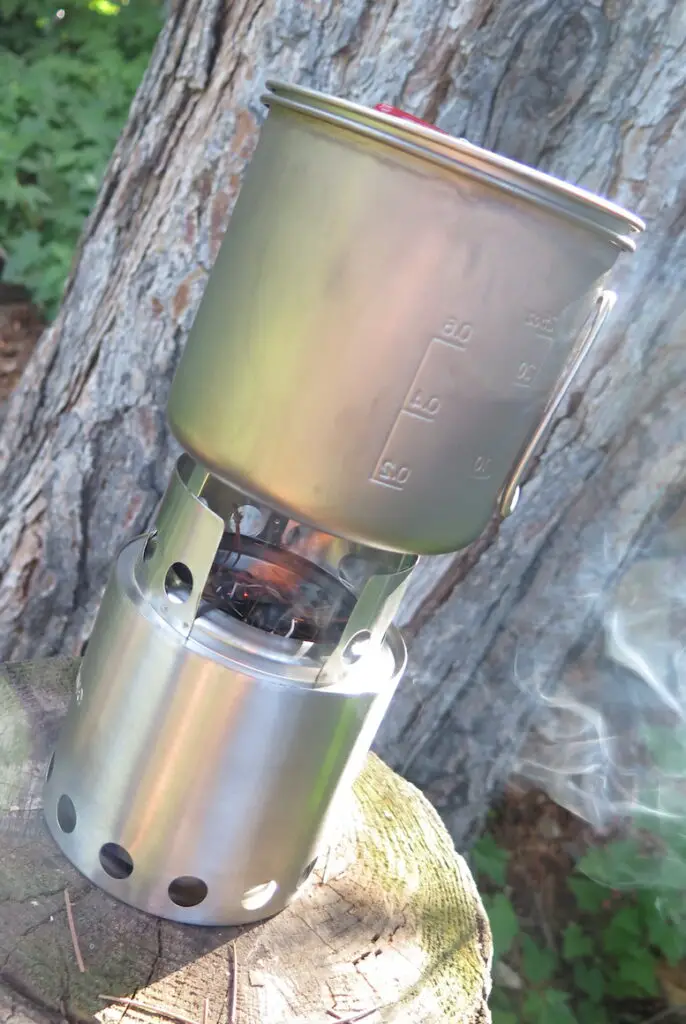
The riser is essential for cooking over the stove. Without it, a pot or pan would sit flush on the Solo Stove blocking the flow of hot gasses. But there is no need for the riser if just using the Solo Stove as a campfire pit. The riser can easily be added or subtracted from the system with a fire blazing. In fact, it is much easier to get the stove started without the riser.

I’m not sure if it’s right or not, but I’ve extinguished my Solo Stove Lite simply by dumping water on it. The water does run out the bottom holes carrying with it plenty of smaller pieces of wood and charcoal. The stove, when dry then clanks like a baby rattle until you dig out all the pieces of detritus rolling around in between the stainless walls.

Being a wood stove, the Solo Stove Lite will get dirty. And depending on how loose you are with the wood input, your pot might just have a black bottom, or the entire pot will become jet black and sticky with creosote. I’m happy to report that the Solo Stove made it through the normal cycle in my dishwasher. I can see the potential for rust however as stainless means less stains, not rustless. But it was nothing more that what I noticed after using the Solo Stove Lite for a few rainy days on a backpacking trip.

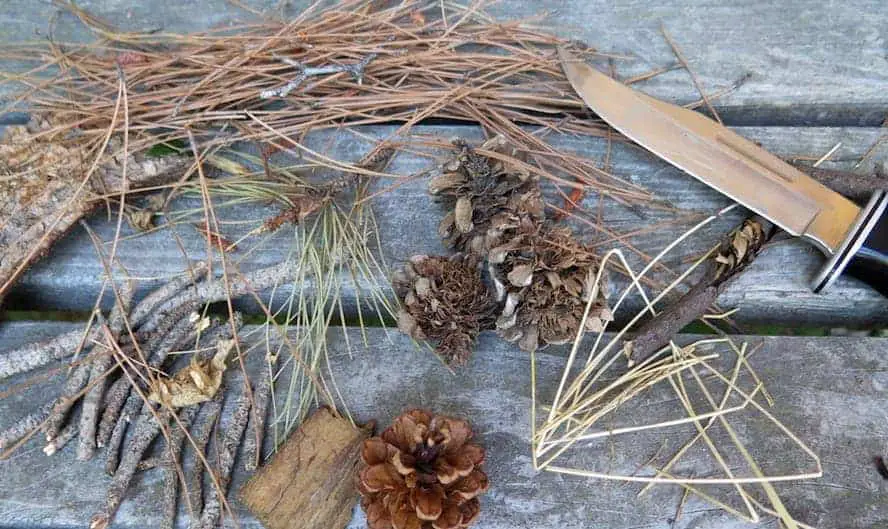
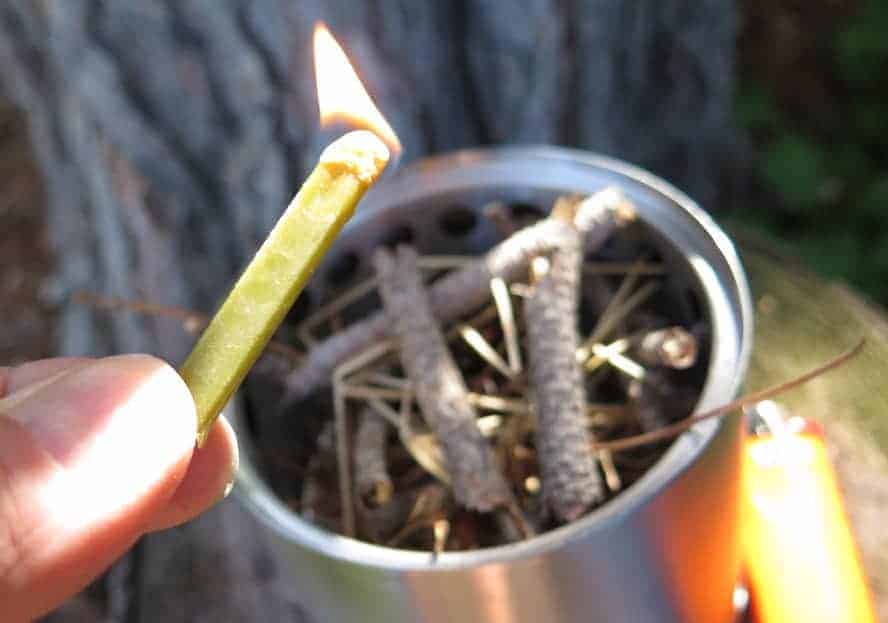
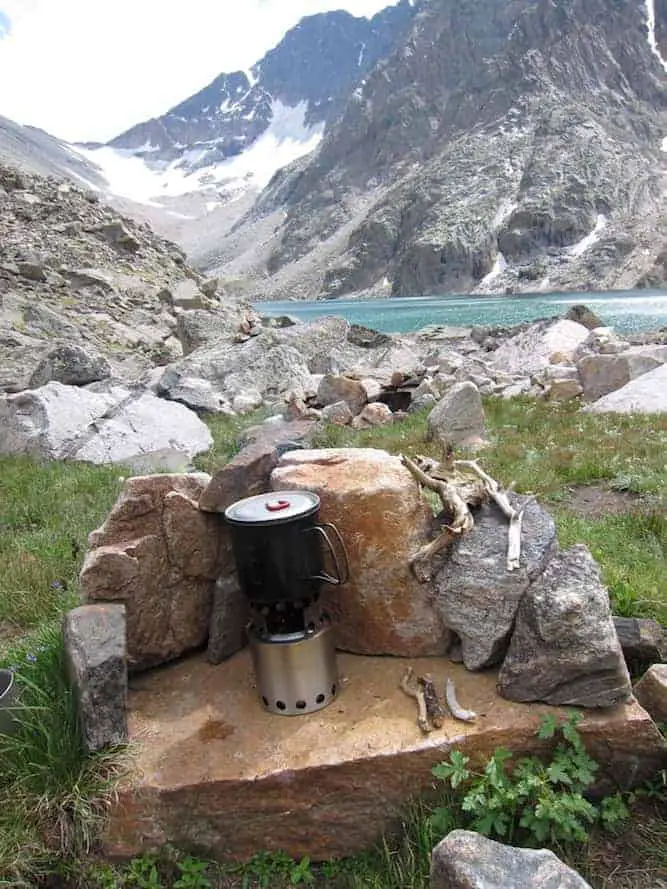
In use, I had a boiling quart of water in 10 minutes plus or minus. Usually plus. I used a commercial fire tinder to fire up the stove quickly, but you can use traditional tinder and firesticks to launch this rocket. Some of the benefits include no real concerns for fuel. The only time I ran into a fuel shortage was when I was over 11,000 feet in the Beartooth Mountains of Montana and there was literally no dry cellulose around large enough to burn. I did try to burn mountain goat dung in the Solo Stove Lite, but just couldn’t keep the flame long enough to boil water. Yak dung maybe? Just fresh out of yaks around here.

Even at 10k feet I located plenty of material primarily in two locations. The first was in natural microstream channels where the rain piled up small sticks at congested areas between rocks and narrow water pathways. The second was where small animals had made a home using locally sourced building materials. And in one case, where I knew I was headed to a high spot, I just grabbed a few inch-to-inch-and-a-half thick branches, stripped and resized them, and slid them into my compression straps on by backpack. When arriving at camp, I just processed the branches into Solo Stove-sized fuel. I got about two quarts of boiling water out of each three-foot branch.

Listen: Survival Cache Podcast: Only Choose One Piece of Gear

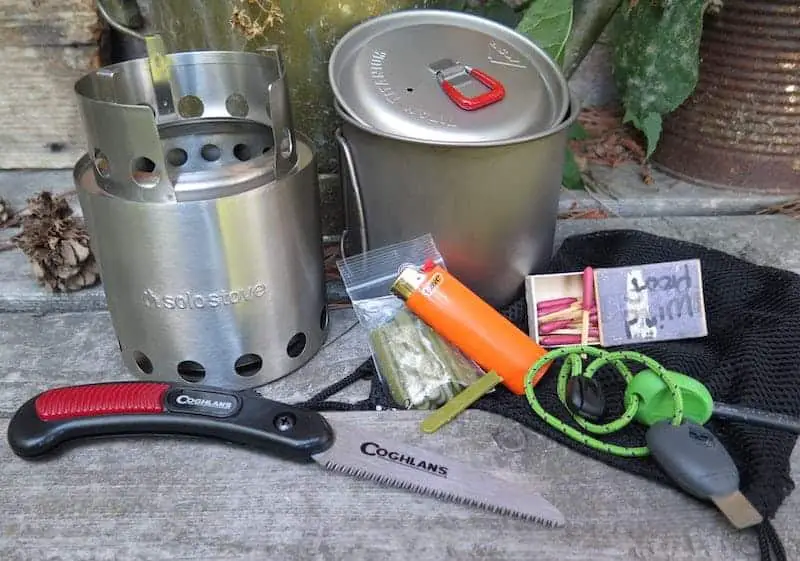
I have a 900 milliliter titanium pot and small fire making kit I carry with my Solo Stove Lite. The pot is made by Snow Peak and I use an MSR titanium lid from another cooking kit to cover the pot. My fire kit includes a Bic lighter or two, some matches, a firesteel, some commercial tinder/firestarter, and a tiny saw that I considered a joke until now. The Solo Stove Lite fits neatly inside the pot, and the whole kit fits into a mesh stuff sack with is important to reduce the sharing of black carbon with the rest of your gear.

I am so enamored with my Solo Stove Lite, that it has moved into my primary campstove position. And I have a dozen or so other stove choices. During a bug out, any liquid or compressed gas stove has a short life. However, should you want to run a liquid fuel in your Solo Stove Lite, there is an optional alcohol can with adjustable lid available for burning fluids. So if you can get over the price, the Solo Stove Lite is an exceptionally useful, efficient, and potentially life saving tool for fun and survival. I have absolutely no hesitation in recommending the Solo Stove Lite.

Please Visit Amazon Affiliate Sponsors of SurvivalCache.com

The post Survival Gear Review: The Solo Stoves, Part One: Solo Stove Lite appeared first on Survival Cache.

Survival Gear Review: The Solo Stoves, Part One: Solo Stove Lite Read More »
Europe Diagonal: Belgium GR 129 Part 1

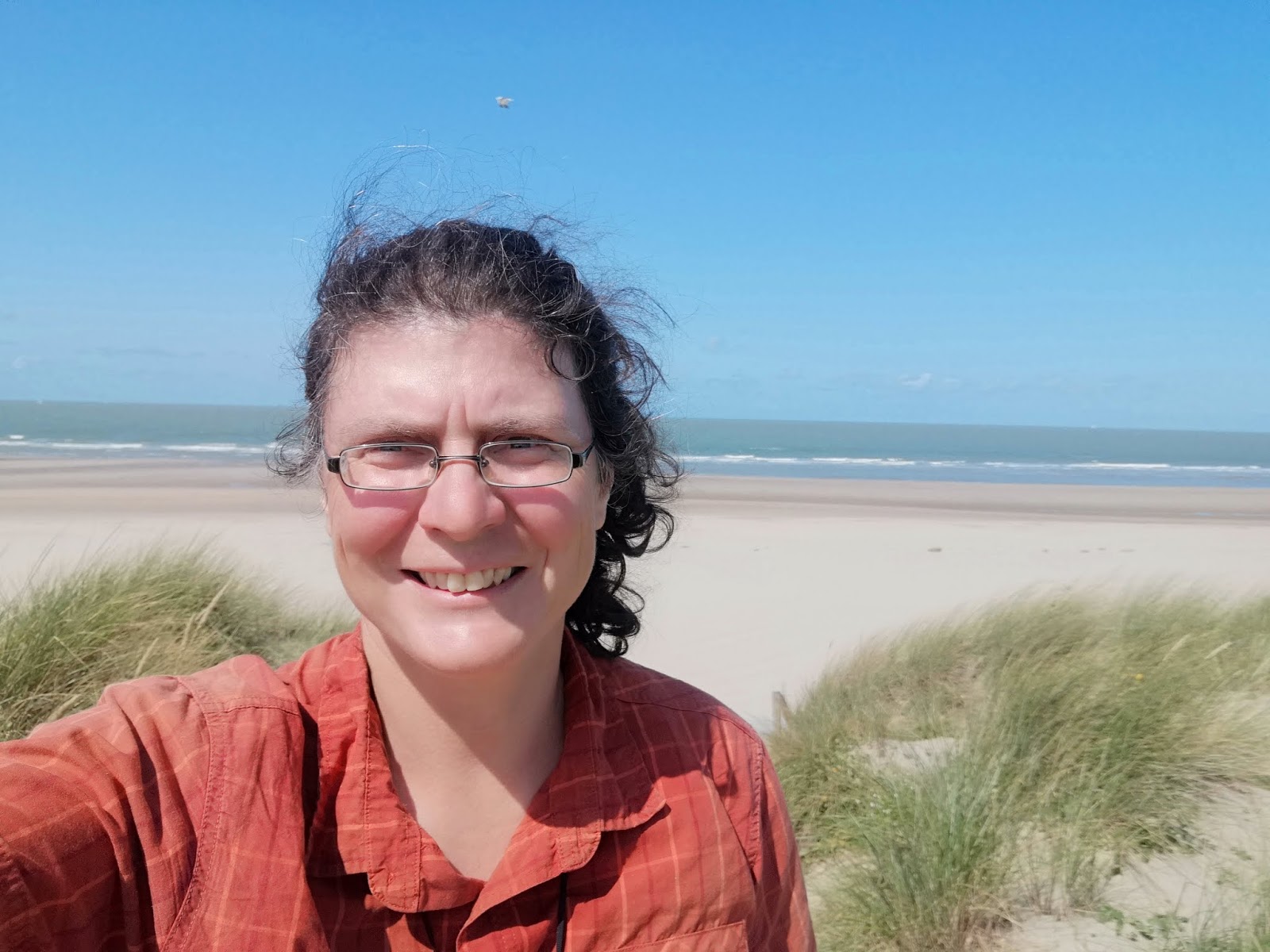
At the beach near Brugges

When I had started to plan this trip and was searching for a route through the BeNeLux countries, I stumbled upon the GR 129 through Belgium which is so aptly called “Belgique en diagonal”. With this title I could not resist and chose this trail which starts in Brugges. Travelling to Brugges from Germany turned out to be much longer than expected because a train broke down in Cologne, could not be “revived” and I had to wait for the next totally overbooked train two hours later. I was utterly exhausted when I finally arrived in Brugges at night. After half a day of sightseeing in this pittoresque tourist town I started my hike right at the coast in wonderful weather. The beach was fantastic but the 20 km walk back to Brugge showed me what was to come in the next days: endless road walk in very flat countryside!

Wild camping turned out to be a big problem because there was hardly any forest or trees to hide in! I had to plan very well in advance to find a suitable spot every evening. The trail itself wasn’t too exciting either: More than 50% I was walking on concrete roads or bike paths! Flanders is definitely more bike than hike country. To my big surprise I even met another female hiker who was even wild camping like me. Still there were some highlights on this stretch: an old water castle and the pittoresque town of Oudenarde. From Ath where there was a big festival taking place I took the train to Brussels for my first rest day in Belgium – and to meet a hiker friend!

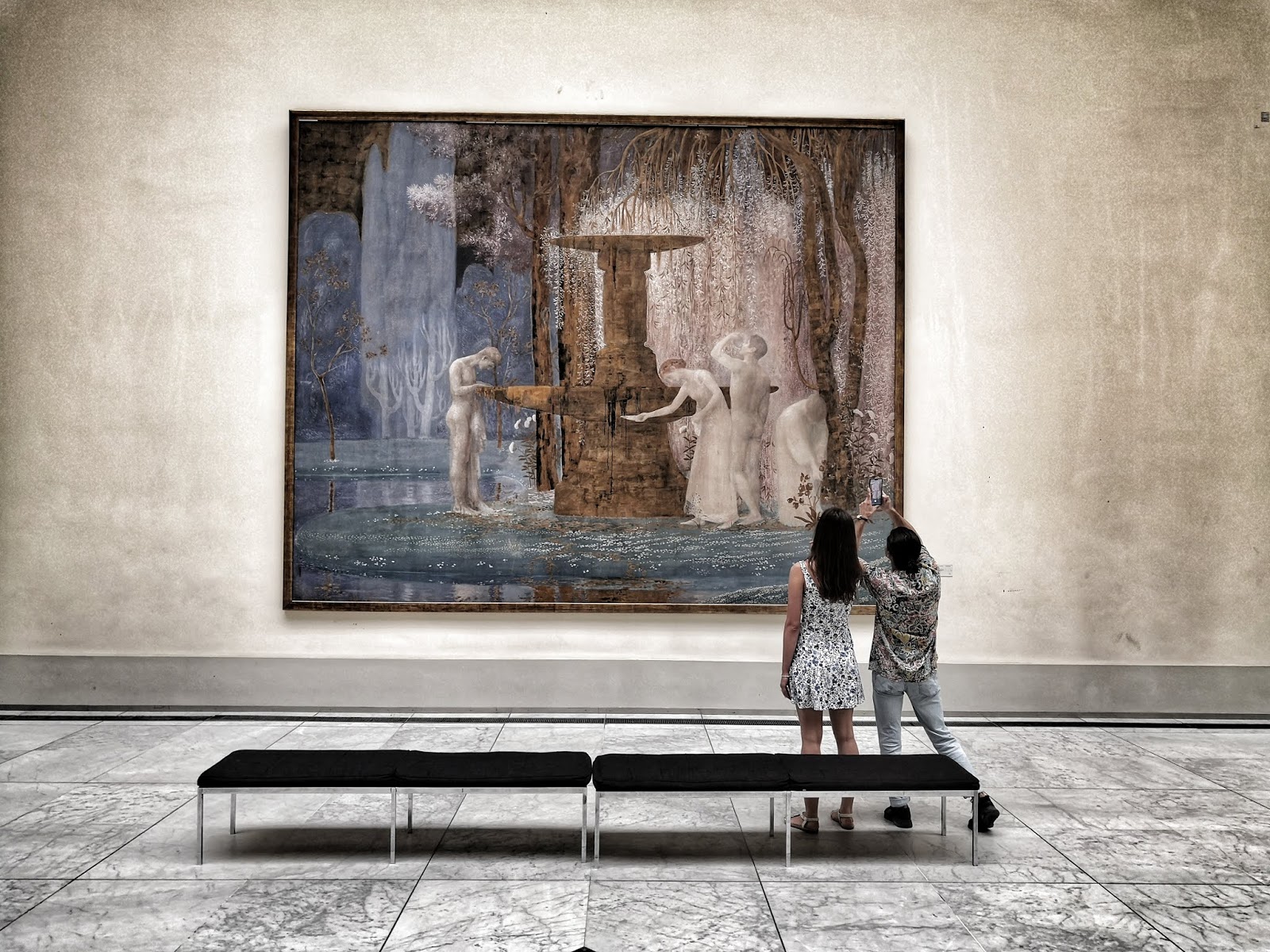
I had known Fatma only virtually but felt very welcome immediately in her flat in Brussels. She and her partner really pampered me with fantastic food and very interesting talks! I visited the Royal Palace and an art museum and we we sat together in the evening drinking a glass of wine together I could not think of anything that would have made that day more perfect! This was definitely the best rest day on this trip! After breakfast together I boarded the train again that brought me back to Ath and hiking – and the heat. Now in August it was almost unbearably hot and because there is so little forest there is also hardly any shade! These days really dragged on and on and I was very happy to be able to make phone calls and talk to my friends while hiking!

But there were also some highlights: Blackberries were ripe and I had always somehting to snack. And because I was walking along endless fields I could also skip lunch and eat corn cobs. And I passed the Mons which had just recently been Cultural capitol of Europe and was therefore full of interesting museums. There were so many that it was difficult to choose! I visited the War Museum because Mons played an important role in both world wars and the Silex Museum several kilometres away but along the GR 129. Here back in the stone ages flint stone had been mined and the museum  is in fact a huge tent where archaelogists are still excavating the old mine shafts. When I had a break in the shade there I found a lot of stone chips that could well have been created by our human ancestors.

Unfortunately this lovely day ended with a bad surprise: My “camping forest” turned out to be the garden of a castle and was completely fenced in! I ended up camping in a meadow right next to a cell phone tower. At least it was nice to have 4G reception in the evening …
The trail does hardly get any use here! Some paths are completely overgrown with blackberry bushes and nettles and I have to wear long pants despite the heat. Along the roads there are “mowers” to cut the grass and bushes and when one of these guys saw me coming out of the fiels he was so surprises that he mowed one of the guardrails off …

Europe Diagonal: Belgium GR 129 Part 1 Read More »
Extreme frugality: An occasional series.

During the last recession, people went to surprising lengths to make ends meet. Hypermiling. Navy showers. Dumpster-diving for food (aka “freeganism”).

Some practiced extreme frugality to keep from sinking further into the red; others did it to survive. (Some still do.)

Hailed at the time as examples of savvy consumerism, these sorts of activities don’t get a whole lot of press today. Some would say that’s a good thing, i.e., fewer people are living on the edge.

I’m not so sure.

While I’m glad the recession is technically* over, I remain sad that we seem to have learned nothing from the tough times of previous decades. There’s more things than ever to buy, especially as regards electronics – and quite a few us want these things at all costs.

In fact, a new survey from CreditCards.com suggest that 61 percent of people with credit card balances are willing to add more debt for the holidays.

Don’t get me wrong. I’m really glad I no longer have to wash all my clothes by hand, or live on the most basic of foodstuffs. But I think we could all do with a little bit more strategic frugality.

Some people think “frugal” means “impoverished,” and certainly it’s true that some people live frugally because they have no choice. It’s a way of life that can be terrifying. (Anyone else here ever raided the baby’s piggy bank** for bus fare to get to work on payday?)

In those days, and again during my lengthy divorce and return to college, I was frugal because I had to be. But even when times got better, I was still frugal – because I happen to think it’s a great way to live. To me, it means a life in which every decision is intentional. Every step I take (or don’t take) means something.


Frugality is the reason I’m out of debt and saving for retirement after some tough times. It’s also why I want to start a new occasional series of articles on the subject of extreme frugality.


Defining “extreme frugality”


No doubt some of the articles I plan to write will be considered tame by the super-penny-pinchers. For example, I know of one frugal blogger who doesn’t buy toilet paper: Her household uses “family cloths,” which are washed and re-used. #nopenopenope

I’ve read about people getting live-in nanny jobs to avoid paying rent, making their own cooking fat (free chicken skins from the butcher FTW!), never spending a dime on entertainment outside the home, growing a beard to save on razors, taking the same super-basic lunch to work every. single. day.

Then there’s the folks who think you’re extreme if you mash your own potatoes.*** Thus finding the balance between “no thanks, that’s just ridiculous” and “you call that frugal?!?” will be interesting.

But that’s okay. I don’t mind (much) being second-guessed. That’s why I have a comments section. And speaking of asking for feedback…


Got any topics to suggest?


I’ve already come up with a handful of extreme frugality topics. Since it’s already November (!), an obvious one is “celebrating the holidays without breaking the bank.” The piece will contain tactics that are actionable but that won’t embarrass you.

“Staying warm/keeping utility bills manageable” is another natural idea for this time of year. Also on the list: furnishing/decorating a home, staying healthy, finding affordable entertainment and, of course, stretching grocery dollars.

Who’s got ideas to share? Please leave them in the comments. I can’t promise I’ll do them all, but I’d like to hear what’s on your mind.

Finally: The point of this exercise isn’t to make people feel judged. You won’t get kicked out of the movement if you don’t use homemade dish soap to wash out your Ziploc bags for re-use. No one will force you to make your own soup stock or tsk-tsk if you decide that cable TV or subscription boxes really are right for you.

No, it’s all about my longtime frugal mantra: I save where I can so I can spend where I want. Small changes can help with some pretty big goals – stuff like debt pay-down, homeownership, retirement planning**** or a child’s education.

Who’s in?

*I say “technically” because I believe that for some people it never really ended. Some are still lip-deep and sinking; others merely treading water.

**Yes, I paid it back. Every time.

***While I’ll admit that there are some pretty tasty instant varieties out there, I’m simply not willing to pay so much more for a so-called “value added” product.

****You have until Nov. 14 to enter to win a copy of “The Only Retirement Course You’ll Ever Need.”

The post Extreme frugality: An occasional series. appeared first on Surviving and Thriving.

Extreme frugality: An occasional series. Read More »
How to Improve Your Archery Skills

Archery: we all want to look gracious while doing it, but we seem to miss our targets whenever we try to shoot. Moreover, while we do manage to shoot, our “technique” still has us flailing around after we release the arrow.

With that in mind, how can you improve your arrow shooting skills? How can you become a better archer and actually hit your targets, for a change? Well, it might take a lot of time and practice – but overall, you might see improvement if you follow the right steps. 

  • Correct Your Stance

Many self-taught archers do not know that the correct stance plays a very important role in the way you shoot with the bow. Unfortunately, not many of these archers actually KNOW what that stance is – so, they simply try to wing it.

You should be facing your target at approximately 45 degrees, with your feet in a parallel position and spread about 18-24 inches apart. Your toes should be facing towards your target, pointing at it – and not at a 90-degree angle as most beginners do.

Keep an open stance as you point at the target. Your bow forearm should be in line with the arrow. The bowstring should also be kept away from your arm and chest – because even if it slightly brushes against your skin, it will veer the arrow to the side. 

  • Make Sure the Bow Is Tuned

In a way, a bow is just like a musical instrument; if it’s not tuned, it won’t work properly. You have to create balance and stability in the tension – so, if it seems as if the bow is lacking in strength, you might have to tune it. It will greatly improve your accuracy when you are shooting an arrow. 

There are many guides out there that will teach you exactly how to tune your bow. However, if you are a beginner and are not completely confident in your tuning skills, you might want to take it to a pro shop. Watch how they do it a couple of times – and before you know it, you’ll learn how to do it yourself.

Particularly if you are a beginner, you should go for bows that have newer, better mechanisms – to make things run more smoothly. You may get a bow with an older system simply because it is cheaper – but there is a high chance that this one will be more difficult to tune. You need to get something that you could easily tune. This way, you won’t end up dropping your archery practice simply because you cannot tune your bow. 

  • Make Sure Your Grip Is Correct

You need to hold your bow with a relaxed hand, but with a closed grip. If your grip is a white-knuckle tight one, then there is a high chance you will compromise the accuracy of your shot. Your entire bow will be tensed, which is why you might end up missing your shot. The bow will only have to lightly touch your thumb to the middle finger or the forefinger in front of your grip.

If you simply cannot master the loose grip, then you might want to try the open bow hand with the addition of a wrist sling. The sling will help tie the bow to your hand – and this way, it cannot fall while you are attempting to shoot. The more you shoot, the more your grip will improve – and eventually, you should be able to do it without the sling. 

  • Your Movement Has to Remain Subtle

Every movement that you make, as small as it may be, may affect the outcome of your shooting. The way you move has is essential, so you will have to control each and every inch of your body. The way in which you breathe, grip, stand – as well as the amount of force that is applied with your hands – are all factors that will have a great impact on the way you shoot.

This is why you need to learn how to be relaxed while you are shooting with the bow. You cannot expect accuracy if you are all stressed out and nervous. Those feelings need to be pushed away if you want to become any better at archery.

One good pointer is to never practice when you are beaten down by stress. Archery doesn’t really mix well with anxiety and stress. Your diet might greatly influence this, so you might want to watch what you eat – or drink – as well. You might not be happy to hear this, but consuming energy drinks, such as coffee, can elevate your stress levels –therefore, this won’t really be very convenient for your practice.

  • Practice Makes Perfect

No one becomes a skilled archer right off the bat; this is achieved only through repetition and consistency. This does not only apply to archery – but to every sport and activity as well. 

It’s like learning to ride a bike: before you learn how to ride in a straight line, you will probably fall a few times in the beginning. But through those fails, you will learn the proper way of riding the bike – and before you know it, you’ll be riding without training wheels and doing miles.

The same thing goes with archery: the more you shoot, the better you will become. It’s the kind of hobby that you will have to commit to if you want to get better. Even if you get the hang of shooting, you should never stop practicing – because practice leads to perfection. 

Final Thoughts

Archery is a skill that might take years and a lot of practice to master. This is why you need to follow the right steps to ensure that your stance, the way you draw and even the way you breathe are correct. As an archer, you need to ensure that accuracy is your top priority.

How to Improve Your Archery Skills Read More »