Heckler & Koch is proud to announce the US availability of the HK SP5, the only authentic sporting version of the legendary MP5 submachine gun available. The SP5 was developed by HK as a semiautomatic, civilian sporting pistol that matches the look and feel of the legendary MP5 submachine gun. “Our whole team is very […]
I wanted to share a technique I created that uses fir resin as an effective fire tinder. I call it, The Fir Resin Match. Growing up in the country with older brothers, the great outdoors was our playground. We did a lot of wild foraging, since we missed dinner many times because we were just too busy playing in the woods. We built a lot of shelters and did a lot of fishing and hunting.
Of course, we needed FIRE to cook those fish on the riverbank, or a rabbit we hunted on a cold, winter’s day. I have made fire many ways, but I learned, over the years, about resin-saturated wood, and found fir resin makes for a great fire tinder, and it burns very hot.
DISCOVERING FIR RESIN FOR FIRE
It started when I took a stick and poked the blisters of a fir tree. There was a snap as the bark broke and the resin underneath popped out. If you’re not careful, it can shoot onto you, even get on your face or in your eyes. Needless to say, I got covered in resin, but I kept going—popping the blisters and wiping the resin on a piece of bark or letting the resin drip on to the bark. It was a little time consuming and I had to pop a lot of blisters, but man did it make a nice fire in the end!
Blisters on a fir tree
Eventually,
I wanted to come up with a method for harvesting fir resin for tinder that was
quicker and easier than I had done previously.
Thus, the Resin match was born! I created this method to be used in conjunction with both a ferro rod, as well as a flame source. When looking to gather fir resin, you must examine the bark and look for the blisters the size of a raisin on the bark. Just under the blister is where resin resides. The resin can be gathered year-round. In the heat of the summer it’s loose and runs freely, and it reaches a thicker consistency in the winter. Whether you collect the resin in warmer months or cooler months, it works just as well. The resin is highly combustible and burns long and hot—this is what we want!
MAKING YOUR OWN RESIN-HARVESTING TOOL
Now that we have the material to be collected, I had to create the perfect tool for harvesting and I did just that! Follow these two simple steps to make your own resin-harvesting tool:
Choosing the perfect stick for the job
I cut a 1-inch diameter stick to a length of about 8 inches. The end of the stick should be at a 90-degree flat angle.
On one end, start carving outward to flatten one edge like a spoon—carve down until you reach the center line, making the spoon area as wide as possible. The larger the spoon area the more resin can be collected.
Carving the spoon
It’s as simple as that! Now, let’s harvest!
HARVESTING FIR RESIN
Harvesting fir resin
To use this tool, we are going to locate a blister and press into the tree, just under the blister. Now pressing firmly, we are going to scrape up the bark, tearing off the blister while capturing that precious resin. If the blistered bark lands on the spoon area that is fine. Continue doing this until you fill the spoon with at least a 1-inch diameter circle of resin.
Fir resin in spoon basin
TAKING FIR RESIN TO FLAME
Now, it’s time to light it! Simply lay the stick on the ground and step on the back side of it, holding it into place. Then, place your ferro rod into the resin, firmly plant it, and begin to strike. Personally, I use the multi-strike method, where I drive sparks into the resin and stop about ½” before the length of the rod. I move up and down the rod rather fast to shower and concentrate the heat into the resin, until I see flame.
Multi-strike method for ferro rod in actionThe Resin Match, taken to flameFire from fir resin
I have shown this method to many folks and they use it often and have loved it. I wanted to create a way to make fir resin an effective tinder. I feel that I have succeeded, so I wanted to share this with as many folks as possible. It can be very useful and maybe, one day, save a life. I’ve also included a video below.
What’s your favorite fire tinder?
Thank you.
Wayne
Wayne Russell has over 35 years of wilderness and survival experience, which he loves to share and teach others. You can find his YouTube channel to see more here: http://www.youtube.com/user/kullcaven
LEARN SKILLS RELATED TO THIS POST:
document.getElementById(“thinkific-product-embed”) || document.write(”);ENROLL NOW
document.getElementById(“thinkific-product-embed”) || document.write(”);ENROLL NOW
document.getElementById(“thinkific-product-embed”) || document.write(”);ENROLL NOW
There are many other ways to open a can. You can use a knife, a spoon, a hatchet, and even the concrete you walk on to open up your cans. #urbansurvivalsite #foodstorage #preparedness #cannedfood #survivalhacks
A pen that leaks into your pocket, the ink that spills on your carpet, the tip of a marker that touches your sofa … An accident happened quickly. You are now confronted with a...
Are you married to a hunter or outdoors enthusiast and are unsure of what would make a great gift? No worries, the editors at Tactical Gun Review and Texas Outdoors Network have come together to offer 12 outstanding gifts that any hunter, fishermen, or shooter would love receiving. Let’s get started! Aimpoint Micro T-2. The […]
A construction punch list, also called a builder punch list, is a simple document that shows the progress of a construction process. It is created when a project nears completion (when most sections are...
I attended the HEAT I class last week. It was my third HEAT 1 class (CRCD 2014 & CTT 2015. Link to my AAR from 2014)
It had been awhile since my last class (life happens). Wow. Besides being total fun, I learned a lot – or relearned what I should have remembered. One thing I relearned was just how essential training at MVT is!
I train locally of course (on a rural, private range), but it does not provide the same level of training/experience you receive at MVT.
The biggest difference is local training tends to be individual reaction to contact. Facing drills, muzzle control, safety manipulation, and effective scanning are all essential and prerequisite skills. As are the ability to clear weapon stoppages and malfunctions.
But the bigger lesson from MVT is it is not about the individual – it is about the team. This is the big disconnect with just about every other “tactical” training class you will take. They teach individual skills. MVT also teaches individual skills – but they then take it to the next level and teach working as a team under contact.
An effective team is a force multiplier! A team working together has an exponentially better chance of mutual survival. Many of us know this – but the truth of that tends to get pushed to the back of our minds because if you do not practice maneuvering as a team, you forget how hard it is! We tend to think that because we have had some training, we will be able to “make it happen” in an emergency. I am totally guilty of this.
But damn, working as an effective team, while under contact, is really, really hard! It is very difficult to get individuals to properly and effectively communicate, to move as a unit, to react as a team to contact, to maneuver as a team when going from one formation (such as extended line) to a different formation (the peel for example), to change the orientation of the line when the contact goes from the front to a flank, to move as a line, etc.
Working as an effective team takes training. Lots of regular training. Without that training you have as good a chance of killing each other, as you do of being killed by the enemy.
Effective & correct training = experience. Experience = force multiplier.
The best way to get that (effective & correct) training is at MVT. Max and Scott are professionals. SUT is one of their core competencies. Training is another. They are dedicated to providing the most tactically sound training possible. And the range Max has constructed is unique and exceptional. As a civilian you will not find this level of realism anywhere else. If you are serious about this, you will train at MVT.
As a side benefit, MVT is also an excellent place to meet individuals who are like minded. Thanks to training at MVT, I have met several lifelong friends.
According to the Washington DC Metro Police, in 2018 alone the city averaged 80 car break-ins a day; that is a little shocking! One of the most painful things that can happen to you, as a car owner, is the “smash-and-grab” car break-in. They don’t even steal your whole car, just the valuable items in it – which you then have to painfully replace while dealing with the costly window repair process. My wife’s friend from college used to play in a band. One night after a show in Milwaukee, she left all of her musical equipment in the car, only to wake up in the morning to a broken window and she found everything was stolen.
Contributed by By Mark, Former Marine Reconnaissance Team Leader, Marine Infantry Officer, Cross Fit Coach, and Survivalist.
In this day and age of concealed carry and being prepared, many people like to keep handguns and spare money in their car in case of emergency. Losing a handgun would make a typical smash-and-grab even more painful, since now you would have to report a missing gun to the police and possibly your state firearms registration office (depending where you live).
My New Toy
I recently upgraded from my old truck to the new Jeep Gladiator, which I have been waiting patiently to come to market for a few years. This is my first Jeep, and I can already see the problem with owning a Jeep: There are just too many options for aftermarket modifications. It is like Legos for adults! It very much reminds me of the AR-15 market, where you buy a rifle and then a year later you have 20 things hanging off the end of your rifle for the zombie apocalypse. I can see myself already saying, “The steel bumper on the Gladiator Rubicon is fine, but what if…..”
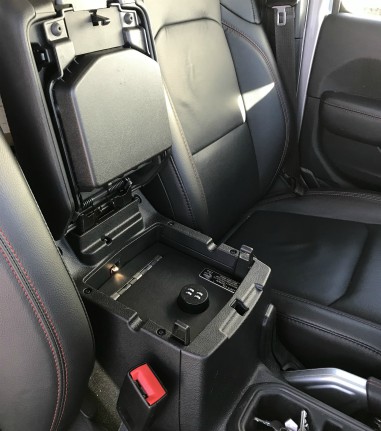
But one thing that I needed right away was a place to securely store my valuables inside the new Jeep. Of course, with the Jeep Gladiator being a new model, the options for lockable center console or glove box are limited. I also wanted something that was quickly accessible. I did not want a key lock; I feel like a key lock would be too slow in an emergency. I wanted something that either came with a combination lock or possibly a fingerprint scan system (combination lock was the preferred method – batteries are always a bad option).
Choices
So after searching both Google and Amazon for the “center console safe for Jeep Gladiator”, I found products from two companies, Tuffy and Lock’erDown. I read a lot of reviews and contacted both of their customer service departments to ask detailed questions about the products. Lock’erDown seemed to have people available all day to answer questions and they really took their time with me and made me feel like they knew their stuff. Tuffy on the other hand, left me on hold for sometime. They also answered my questions but I seemed to get transferred around on their phone tree before finally finding a human. Another feature I loved about Lock’erDown that they build all of their safes in the United States. It is always best to support American based workers!
The construction of the Lock’erDown center console safe seemed to be superior based on reviews and description of the product. Lock’erDown uses both 10 gauge & 12 gauge steel in their product, while Tuffy uses inferior 16 gauge steel. The Lock’erDown also came with a Lifetime Warranty; that is pretty tough to beat.
Heavy 12 Gauge Gauge cold rolled plate steel construction.
10 Gauge plate welded to lid.
Welded tab and notch seams.
Superior 3 point locking system resists prying.
Drill resistant locks.
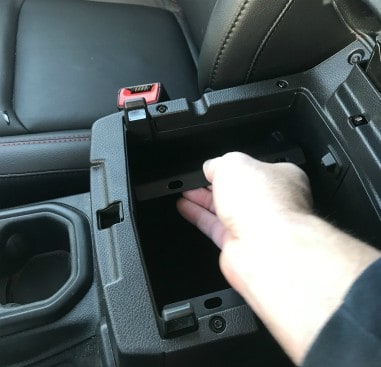
Easy 10 minute installation.
Must be assembled inside console.
Counter balanced door with spring assisted hinge.
Largest selection of lock options in the industry.
Only product in industry with lifetime warranty.
Don’t Follow My Lead
Installation: Installation would have been easy but I did not read the directions completely before I (Mr. Know It All) started to install the center console safe. By not reading the instructions, I skipped a major step that bit me in the butt by the time I finished. On my first attempt to install, the center console lid would close when I finished installing the safe. I went back and re-read the directions and realized that I skipped over a critical step that was made pretty clear in the instructions. I am not going to go into the installation steps in this review, just read the directions and don’t be a (Mr. Know It All) like me.
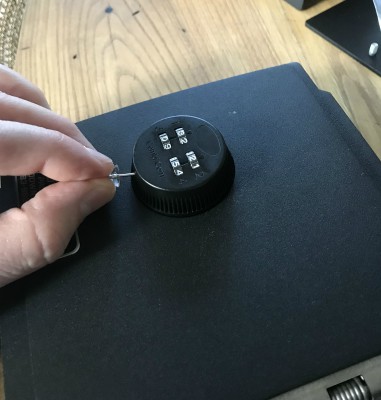
Setting the Combination: Again, this is one of the steps where you want to take your time. I can report that after I screwed up the installation, I took my time and read and re-read the combination directions. I made sure not to screw this part up, and neither should you – or else you might be locked out of your new center console safe. So take your time, “measure twice and cut once” as they say.
I have had the Lock’er Down Extreme Console safe now installed in my 2020 Jeep Gladiator JT for over two months. I haven’t had any attempted break ins with my Jeep to report but I do feel pretty confident leaving it parked anywhere that when I come back, the contents of my safe will still be there. Lock’erDown makes center console safes for many models of vehicles. Check out their site to see if they make a model for you.
Visit Amazon Affiliate Sponsor Products of Survival Cache
A Saudi national opened fire this morning at a Naval Air Station in Pensacola, Florida. The attack, which happened in a classroom building on Friday morning, left four dead and multiple people wounded. […]
By Jeff Gurwitch October 29, 2019 Last updated on 10/29/19. In this episode, I sit down with Mike Keenan (retired Navy pilot), who served with me in Afghanistan, to go over the M4A1-type work-gun clone he built in virtually the exact configuration of the customized/modified M4A1 carbine he carried on the ground while supporting SF …