Brett

Europe Diagonal: Ireland E8

Peat laid out for drying

Back on the trail I had to learn how to deal with Irish forest! First of all there is little of it because most of the land is used for cattle grazing. If there is forest, it consists mostly of impenetrable plantations that are covered with blackberry bushes around the edges to make things even worse. Finding discreet stealth campsites turned every evening into a nightmare. The trail was also not as nice as before: I was walking on small roads most of the time passing through rolling hills and moors where peat is still cut. When I discovered a brand new bike path along the river Suir which was even a bit shorter than the E8 I did not hesitate and walked it thus arriving a bit earlier in Carrick-on-Suir where I took a nero day.

With Andrea and Mike

I did not need it as urgently as I had thought! The day before I had caught up to Andrea and Mike
who were taking a nero day in Fermoy. They had invited my into their B&B to charge up my phone. In order to be not as smelly as usual I had even “bathed” in the river Blackwater before meeting them. Unfortunately this river is not called Blackwater for nothing. I was probably dirtier after bathing than before … The owner of the B&B took pity on me and let me take a shower despite the fact that I was just visiting and not staying at his place. The three of us chatted so long that my empty powerbank was fully recharged by the time I left …

Along the river Barrow

A couple of days I had another fabulous encounter. After resupplying in Craighuenamanagh (the town is really called that way) I was walking along the river Barrow, a really idyllic place with loads of paddlers in the water and ramblers on the former tow path. I had just passed two young women and had stopped to drink some water when they came walking back to me. To my utter surprise one of them asked my now in accent free German: “Are you Christine Thürmer?” It turned out that she was a German working here, had read one of my books and knew about my trip from social media. This is a small world and I loved chatting with the two Germans! I did not meet any other hikers on this stretch but one evening an older couple who told me: “We have already seen you this morning in our village, then we passed you in our car and now we see you walking here in the forest! You are such a brave woman!” I did not mention that I was about to look for a stealth campsite in the aforementioned forest …. And for once I found a great site immediately as soon as the two had disappeared.

Europe Diagonal: Ireland E8 Read More »

Just What Constitutes SHTF?

“SHTF” is a time-worn and borderline cliché prepper acronym we have all heard, seen and continue to hear and see daily in prepping circles. What will you do when the SHTF? Where will you go when the SHTF? Has the SHTF? It never ends.

Even so, it is an important concept. In case you have been sadly out of the loop for the past couple of decades, “SHTF” stands for Shit Hits The Fan, a vulgar euphemism for things going well and truly pear-shaped; FUBAR, sky is falling, hell on wheels, you name it.

A SHTF event is one where your daily survival necessities are no longer guaranteed, where the typical social order is suspended or heavily disrupted, where help in the form of emergency services is not available and where government intervention is either useless or part of the problem.

In this article, I’ll offer my thoughts on the matter.

Small Fans and Large Fans

Disaster is a matter of perspective, I suppose, and perception being what it is in this day and time with everything, every word, concept and interpretation rendered hideously malleable by the current cultural zeitgeist, it makes sense that event the concept of disasters would be subjected to the same.

A common car crash, however bad the effects on life, limb and property, is not a disaster and never will be unless the car crashed into a tanker full of nuclear waste and knocked it into a nearby river.

That has not stopped some people from treating car wrecks like “serious” SHTF events. And one could say they are if you treat SHTF as shorthand labeling for any event that requires you to employ emergency skills at any level.

How about the destructive crash of some larger conveyance? How about a train? I say that is not a SHTF event, either. How about a jetliner crash? I still say no, though the passengers aboard the doomed vessel hurtling toward terra firma would doubtlessly dispute my assertion. So what does qualify as a SHTF event in my eyes?

For me, it is a matter of scale, and not simply in property damage or lives lost, or the potential for either. A real, SHTF scenario will affect almost every facet of your day to day existence for some time going into the future.

How long that disruption lasts being of course dependent on the intensity of the event, its reach and any other of the thousands of potential variables that keep society knit together and recognizably functioning as such in 2019 America.

Severity Counts

As a ‘for instance,’ one could say that a powerful natural disaster would qualify as a SHTF event. Landfall of a severe and powerful hurricane could qualify as a SHTF event without question.

One need only look at the aftermaths of Hurricanes Katrina, Harvey and Andrew in the not too distant past to get a glimpse into the dystopian misery awaiting us. Natural disasters of many kinds, if severe enough, if they strike the right place at the right time, could do much the same.

But if one were to drive far enough outside the majorly affected area, one would probably see life as normal chugging on without a care in the world, save perhaps a rise in lumber and gas prices. I would not say an event has to have a truly regional or even national area of effect to qualify as a SHTF incident.

Disruption of Society

Anything you can walk away from and go get a burger after or go to get groceries after is certainly not a SHTF event. SHTF events by any measure should disrupt society almost entirely, or rather disrupt our day-to-day “normal.”

If you cannot turn a switch and expect electricity, cannot open a tap to get clean water and cannot expect waste in any form to be vacated from the premises, you are dealing with a SHTF event.

If you cannot reliably call on the cavalry in the form of EMS, police and fire responders, you are likely living in a SHTF scenario (or a major American city). If everyone has to seriously start relying on bartering and get deals done before returning home to meet a curfew, you are likely dealing with a true SHTF event. If you are fleeing rampant pillaging and looting, or a city on fire with no end in sight before it turns to ash, you are dealing with a SHTF event.

A major prolonged breakdown of any and especially multiples of the above facets of our societies should be considered herald enough for a true, blue SHTF instance.

A power outage lasting a half hour to an hour is not. A protest that turns violent and gets put down harshly is not. A freak fire that burns down a handful of buildings is not.

When the bad things we take for granted as taken care of start going unopposed unless you oppose them yourself, that is a SHTF situation.

Reach and Area of Effect

A SHTF event that affects a handful of people cannot be said to be a true SHTF event. You and three friends who get irretrievably lost in bear country while out joy hiking are in the shit now, for certain, but it is not a SHTF event, even when Yogi and Boo-Boo come sniffing around.

There will be people, authorities, friends, family, looking for you. Helicopters will be scrambled. Dog teams deployed. Rangers on four wheelers. The works.

An entire town a couple of hours away from a major metropolis that is left to rot and fend for themselves because what functioning government is left is triaging the situation and deploying all available resources to keep command and control facilities, government institutions and critical supplies and infrastructure solvent? Oh yeah, that would definitely qualify as a SHTF situation.

Essentially, the more people that have to say to themselves in chilling realization “No one is coming. I am on my own,” the more likely it is that you are facing a true SHTF scenario.

Paradigm Shifting Events

As awful as some things are, like city-wide riots and cataclysmic natural disasters, as much havoc as they spread, as much damage as they do and as many lives as they claim, they are not what I denote as paradigm shifting events, a sure symptom of a SHTF situation.

Flood waters will recede. Things will eventually dry out. Rubble will be swept away, bodies will be hauled off to be disposed of, power lines reconnected and life will eventually go back to normal.

So what do I mean by paradigm shift? When a paradigm shift occurs, things don’t go back to normal. It might mean a technological regression, a near-permanent loss of modern commodities, or living under the constant burden of some new threat or vulnerability.

A great example of a paradigm shifter is something like a typically imagined cataclysmic EMP that wipes out much of or the entire nation’s electronics and electrical grid.

Author R. William Forstchen imagined this precise scenario in stunning detail in his speculative fiction novel One Second After. Give it a read. You’ll get some inkling of just how irrevocably things will change in the aftermath of such an event.

So much of what we assume is “just the way things are” will vanish, permanently, with one stroke of fate. Something similar will happen in the wake of a nuclear exchange, major asteroid impact, or super volcano detonation.

As an example that most will understand, a paradigm shift would undoubtedly occur if zombies were to rise from their grave or aliens were to invade.

A paradigm shift is knowing, “Things will never be the same.” Whatever caused it is definitely a SHTF event.

Government Conflict

Any time a widespread, regimented crackdown is inflicted on citizens by their government that qualifies as a SHTF event unto itself. History furnishes ample examples of how badly and how quickly violence and loss of life and freedom happens when things finally boil over.

Even at the state level, it is all too easy for the government to start infringing on basic rights and liberties, imprisonment and executions being the hallmarks of tyranny.

Even for those outside of conflict zones, disruptions to travel, commerce and utilities can quickly turn a scuffle into a proper siege at the larger scale.

Checkpoints, inspections and constant stress will lead to flaring tempers, overreactions and the spilling of more blood and subsequently tighter restrictions. Your staples and essentials are now officially no longer guaranteed thanks to localized sanctions.

These things have a way of snowballing, especially in the histories of Western nations. We don’t generally do sustained, low-level, brushfire conflict, preferring instead to let things become intolerable before our animosity erupts in an orgy of violence that changes the course of history and the lives of the surviving populace forever after.

If the tree of liberty must be refreshed with blood, you can be certain of SHTF.

All Together

To me, a SHTF event is one that not only sends you scrambling to respond, but will put you and everyone else in your area, and probably your region, in prolonged mortal peril.

Your basic survival requirements, and I mean the necessities- clean air, shelter from the elements, clean water for drinking, food- will no longer be guaranteed unless you are clever enough and prepared enough to provide them.

The institutionalized trappings of a functional society will be strained past the breaking point or just cease to exist. The uneasy quasi-truce between the rabid dogs of society, criminals, and the rest of us will disappear, and the natural law will once again take precedence.

What is yours will only stay that way of you can keep it. Your next meal will only be ready if you provide it. Your continued existence will no longer be guaranteed by default barring a fluke. Survival, real moment-to-moment, day-to-day survival is the new normal. The Way Things Were is the simultaneous plea and eulogy on everyone’s lips.

Diseases that are rendered powerless by modern medicine will reassert themselves with fury. Death will harvest his grim crop in ways that were once laughable inconveniences. Infection from a scratch. A fever gone unchecked. Parasites. A rotten tooth.

Medieval ailments will once again spell nearly certain doom. There will be no competing pleasures to occupy your time. Every moment will mean another minute of life, earned, or a squandered opportunity in the face of the encroaching night.

When things have changed so utterly for the worse that your most fervent wish is full bellies and a warm, safer place to sleep next to your loved ones, that’s when you’ll know you the Shit has well and truly Hit the Fan.

Conclusion

The term SHTF should be reserved for major events that severely threaten lives and the fabric of society, not localized disasters and crises no matter how bad they are.

While events that mortally imperil you, even for days at a time, are scary and might be the penultimate test of your life, they are still likely not true SHTF situations.

Try not to water down the import of a term that should be reserved for properly cataclysmic situations by tossing it out every time a riot occurs or a tornado touches down.

what is shtf pinterest image

Just What Constitutes SHTF? Read More »

Cold Hands Effects on Shooting

Hello folks, we have been to the high desert in Northern Utah to do a bit of shooting today. So like all stories there is a good side and a bad side to this, first the good – we were shooting; now the bad – slow moving fingers and shaky hands.

While my fingers were thawing, this article came to mind. I am going to focus strictly on the local effects of cold on the hands in relation to shooting performance. I won’t get into hypothermia or frostbite; I have an idea swimming in my head for another article regarding hidden dangers (over dressing, cold weather dehydration, etc.) of cold weather where I will discuss those issues.

To “set the stage” of this subject we will quickly discuss the term “normal” in regards to hand/finger temperatures. We will call “normal” what people experience in everyday life under comfortable, often indoor conditions. With normal established, let’s look at “cold”, and just to keep it simple, the only terminology we will use is cold.

Cold Stress and Work in the Cold

Cold stress may be present in many different forms, affecting the whole-body heat balance as well as the local heat balance of extremities. Cooling of the whole body or in this case, parts of the body, results in discomfort, impaired sensory and neuro-muscular function and, ultimately, cold injury.

The most obvious and direct effect of cold stress for this subject is the immediate cooling of the skin. The type and magnitude of reaction are determined primarily by the type and severity of cooling. Local cold exposure may cause systemic arousal, what that means is that the increased stress level increases sympathetic nervous activity and, thereby, preparedness for action. When our bodies prepare for action and respond to the cold stimulus, our fight or flight nervous system function kicks in, and the adrenalin begins to dump. This function will work to fight the cold stimulus by giving the muscles stimulation to shiver AND cause the blood vessels in the extremities to begin to squeeze, which results in a reduction of blood flow to muscles and skin. This reduces fine motor skills and makes the “feel” for the trigger much less. That is not a welcome effect when trying to hit the target; great when trying to out run a bear or survive a blizzard, but we are not in those situations.

How do we fix this, the simple answer is to keep our hands warm or wear gloves. Prevention of cooling by means of donning cold-protective clothing, footwear, gloves and headgear interferes with the mobility and dexterity of the shooter. There is a “cost of protection” in the sense that movements and motions can become restricted and more exhausting.

Manual (hands) dexterity performance

Hand function is very susceptible to cold exposure. Due to their small mass and large surface area, hands and fingers lose heat while maintaining high tissue temperatures (86 to 95ºF).

Accordingly, such high temperatures can be maintained only with a high level of internal heat production, allowing for sustained high blood flow to the extremities. The most expedient way to tell if your hands are beginning to suffer from the cold exposure, and may result in decreased performance is to check for the “White Knuckle Grip.” If your hands look like you are holding the steering wheel of a truck on ice, headed down the hill, you will know the tissues are suffering from a lack of perfusion or blood bringing oxygen to the tissues, and hand grip, finger pull and support hand functions will be affected.

Hand and finger function is directly affected by the temperature of the skin (that is the only way to measure in the field). Fine, delicate and fast finger movements deteriorate when tissue temperature drops by only a few degrees. With more profound temperature drops in the tissues, gross hand functions will also be impaired, eventually, your hands will turn to “clubs” and the fine skill and gross skills will not be possible. You may get to a point where you cannot truly FEEL the gun in your hands.

Significant impairment in hand function is found at hand skin temperatures around 59ºF, and severe impairments occur at skin temperatures about 42 to 46ºF due to the blocking of the function of sensory and thermal skin receptors. The temperature of your fingertips may be more than ten degrees lower than on the back of your hand under certain exposure conditions.

In addition, the viscosity of tissues increases (meaning that instead of everything flowing like oil, it is now moving like sludge), resulting in higher internal friction during motion. With an increase of internal or muscular/tendon friction, smooth is not possible, and jerky motions will be the normal. Isometric (pulling) force output is reduced by 2% per ºF of lowered muscle temperature. Dynamic (general smooth movement) force output is reduced by 2 to 4% per ºF of lowered muscle temperature. In other words, cooling reduces the force output of muscles and has an even greater effect on dynamic contractions. This will have an effect of overall gun handling, and very dramatic effects on trigger pull, and proper grip functions.

Acclimatization

There is evidence for different types of acclimatization to long-term cold exposure. Manual (hand dexterity) performance is better maintained after repeated cold exposures of the hand, as we discussed later with the cold water bath and dry fire drills.

Improved hand and finger circulation allows for the maintenance of a higher tissue temperature and produces a stronger cold-induced vasodilatation. What this over the top science geek talk means is – warm up – flex the fingers, shake the hands, get them ready to operate the gun in cold temperatures. Due to the many complex factors that influence human heat balance, and the considerable individual variations, it is difficult to define critical temperatures for sustained work.

There is a simple way to test the effects of cold on your hands and performance, and train yourself to adapt to this environmental issue and improve your performance as much as possible. This simple and free or nearly free acclimatization method will make you less susceptible to cold hand issues. By exposure to cold water from the sink then maybe move to ice water in a bowl, etc., and dry fire drills, make sure to include shooting (dry fire) and gun manipulations, failure drills, etc.

These drills need to be practiced for all shooters, not just for the hand gunners, but hunters with long guns as well. Just to state the obvious – check then recheck that the gun is unloaded, and no ammo is in the room – OK, now we can move forward. Get ahold of a simple and inexpensive surface thermometer from the drug store, the type that just reads the skin temperature, then put your hands in the cold water, use the thermometer and take the skin temperature, run your dry fire drills. You can check your performance differences between warm and cold hands dry fire, use a stopwatch to test speed or function. Eventually, you will see if your acclimatization efforts are giving any value to your shooting and watch for improvement as you proactively train to beat the cold.

If precautions are followed, and a simple warm up can be performed your shooting should not suffer dramatically, it will a little, that is the way it is in cold weather shooting. If you find that you do a lot of cold weather shooting, and exact precision is needed. Try these simple steps to train your body to acclimate to that style of shooting. This combined with simple warm-ups, and you will be less affected and maybe even reach the “golden ring” of the only guy in the group that can shoot as well cold as everyone else does in the warm.

Good luck, and stay safe

96.8 – 90*F Optimal hand and finger dexterity Good Shooting
90 – 81*F Effects on finger dexterity, precision, and speed OK Shooting
81-68*F Impacted work with small details, reduced endurance Weak Shooting
68 – 59*F Impaired gross hand and finger work Poor Shooting
59 – 50*F Reduced gross muscle strength and coordination Very Poor Shooting
46 – 43*F Blocking sensory and thermal receptors of superficial skin Dangerous Shooting
<50*F Numbness, manual performance reduced to simple gripping, pushing, etc. Impossible Shooting
<32*F Freezing of tissues

Cold Hands Effects on Shooting Read More »

Quebec Road Trip: Quebec City to Havre-Saint-Pierre

If you’re looking for a Quebec road trip that’s a little different, why not drive the north shore of the Saint Lawrence River from Quebec City to Havre-Saint -Pierre, the last town of any size, with the option to continue to Kegashka, at the end of Highway 138 – a distance of 1,060 kilometres.

In theory you could do the road trip in one long day, taking about 12 hours. But there are a lot of beautiful small towns to explore, some incredible whale watching to do and one of Canada’s most beautiful and unique national parks to visit.

Planning a Quebec Road Trip

Join me as I take you on a day to day road trip in Quebec that can take you over a week if you’ve got the time – and the notion of slow travel appeals to you. Enjoy the mix of pristine wilderness and pretty towns and villages along a highway that isn’t a mainstream tourist destination. Check out what to do and where to stay in each location – largely garnered from personal experience with many trips to Quebec over the years. 

Some of the highlights you’ll encounter on this Quebec road trip include

  • The opportunity to see many different species of whales in a variety of ways – from shore, a kayak, your car or on a dedicated whale-watching cruise
  • Dine on freshly caught seafood
  • Be wowed by the islands and rock formations that make up Mingan Archipelago National Park Reserve.

If you want to leave your car behind and see some of the small communities along the north shore of the St. Lawrence River there is the option to hop on a working boat. You can find detailed information on the Relais Nordik website.

Best time to do this Quebec road trip 

Explore the north shore of the St. Lawrence between June and mid-September. Weather should be good and businesses will be open. But be sure to book well in advance as there are limited accommodation options in places. If you don’t mind camping, then there is a lot more choice.

Stops on a Quebec road trip

Day 1 on your Quebec road trip: Start in Quebec City

Allow at least a day in Quebec City, and more time if you’ve never visited before. Fly in and pick up a rental car.

Here are some suggestions on what to do in Quebec City.

  • Wander around the old city, especially Rue de Petit Champlain. It’s considered to be one of the prettiest streets in Canada. Poke in boutiques, galleries and have a drink or bite to eat in one of the many restaurants.
  • Pick up a detailed city map, so you can walk the ramparts (4 km one way) and enjoy scenes seeped in history.
  • Take the ferry over to Levi. Rent a bike and go explore the Parcour des Anses. It travels along the south shore of the St. Lawrence River for 15 kilometres along an old railway line and offers up superb views of the Quebec fortifications, the Château Frontenac and Île d’Orléans.
  • For more ideas check out this blog post

To book a guided walking tour with Get Your Guide click here.

Where to eat in Quebec City

I recommend Crêperie le billig at 481 Rue Saint-Jean. I have been to this restaurant a few times after I first found out about it on a Quebec City food tour. Order one of their delicious buckwheat crepes with a glass of local hard cider. I’d also suggest Le Tournebroche – an organic rotisserie with locally raised chickens.

Where to stay in Quebec City

For a splurge check out the most photographed hotel in the world – Fairmont Le Chateau Frontenac.

For a great B&B experience at a decent price try Auberge La Chouette in the downtown core.

I can also personally recommend the Hotel Marriott Quebec Centre-Ville and Hotel Chateau Laurier near lots of great restaurants.

For a health and wellness experience with divine food stay at Monastère des Augustines.

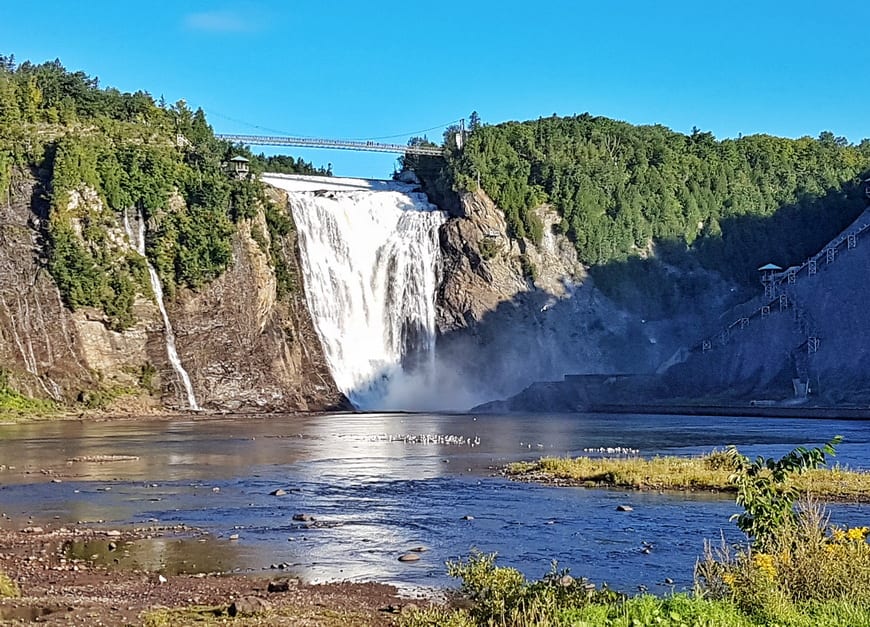
Montmorency Falls in Quebec - seen on a Quebec road trip

Montmorency Falls, just minutes from downtown Quebec City

Day 2: Quebec City to La Malbaie via Baie St. Paul – 140 km

You’ve got a whole day to knock off the 140 kilometres and you can comfortable drive it in less than two hours.

Montmorency Falls

If you didn’t make it to Montmorency Falls while you were in Quebec City, be sure to stop in and see them. They are 30 metres higher than Niagara Falls.

Baie St. Paul

Next head for the pretty town of Baie St. Paul, just 95 kilometres from Quebec City. It’s a spectacular drive, especially as you drop down into the town. I think you’ll find it reminds you of Old Quebec, without the cobblestones and a tad more compact but very pretty. Browse the art galleries, and blocks of shops, all locally owned. Drive down to the park on the bay and enjoy the views. 

When you’re hungry either pick something up at Boulangerie à Chacun Son Pain or grab a bite at Le Germain Hotel Charlevoix, where the train comes in from Quebec City.

Should you want to spend a night, stay in Le Germain Hotel Charlevoix or one of the cute B&B’s.

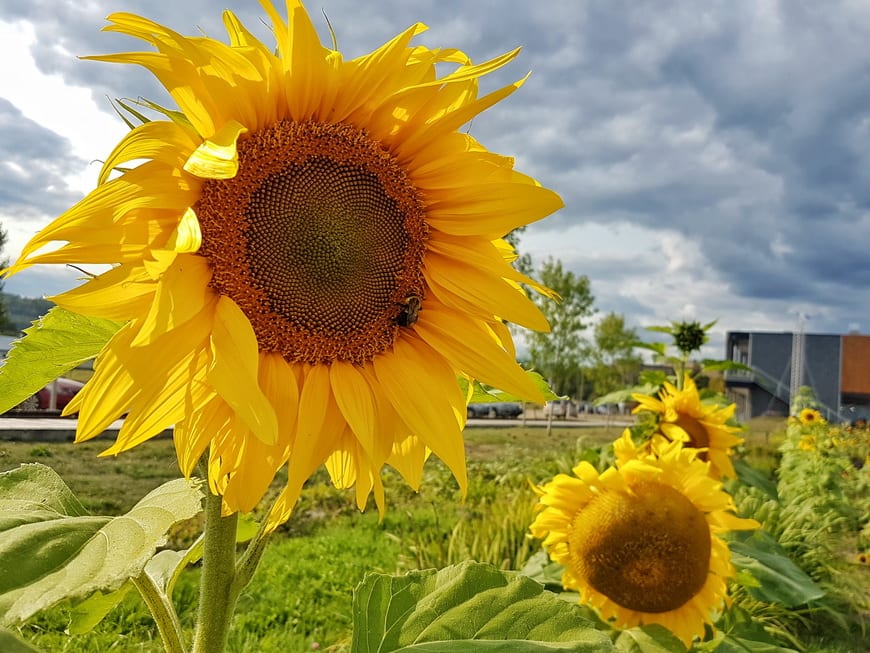
Sunflowers in Baie St. Paul add a blast of colour on a Quebec road trip

Sunflowers in Baie St. Paul add a blast of colour

La Malbaie

The drive from Baie St. Paul to La Malbaie along the north shore of the St. Lawrence River is a stunner. I did it in winter – under grey skies and it was still very beautiful. I guarantee if you’re a photographer you’ll want to stop at numerous points along the way.

Once in La Malbaie you can visit the Gardens of Quatre Vents. Tours only take place four times in a summer so plan accordingly if you love visiting gardens.

Head to Mont Grand-Fonds for some hiking. It’s the end point of the week long Charlevoix Traverse – and a downhill and cross-country ski destination in winter so you can count on a large network of trails.

Where to stay in La Malbaie

Fairmont fans will want to stay in the beautifully situated Fairmont Le Manoir Richelieu. It’s unlikely you’ll want to leave the premises.

For a less expensive option that comes rated as superb check out Hotel-Motel Castel de la Mer.

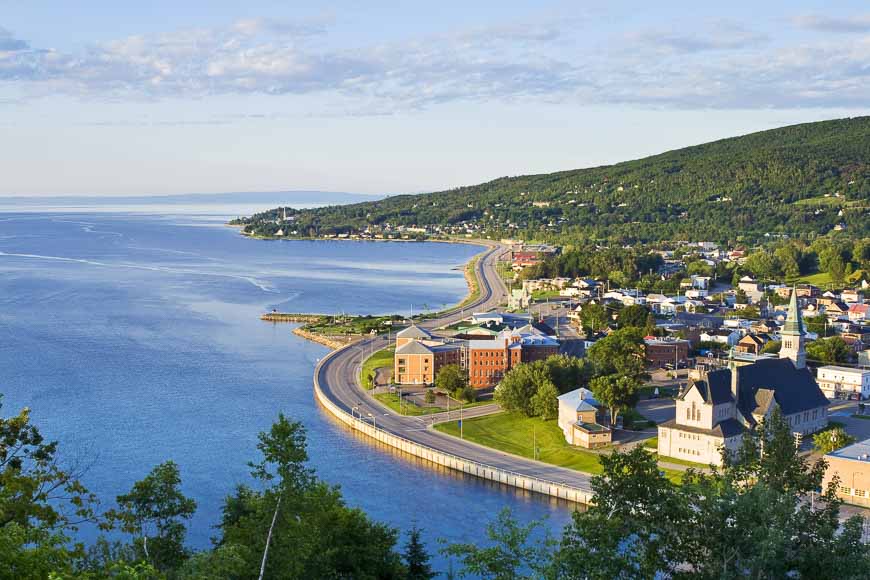
La Malbaie from above

The second largest city in Charlevoix, La Malbaie owes its economic prosperity to tourism (Fairmont Manoir Richelieu, Casino de Charlevoix and several fine inns) – Photo credit: Tourisme Charlevoix – Robert Chiasson

Pointe-au-Pic near La Balbaie

Opposite Cap-à-l’Aigle, is Pointe-au-Pic, with the train station nearby and Fairmont Le Manoir Richelieu – Photo credit: Tourisme Charlevoix, André-Olivier Lyra

Day 3 on a Quebec road trip: La Malbaie to Tadoussac – 74 km

The distance from La Malbaie to Tadoussac is short – just 74 kilometres, but it does involve a 10 minute ferry crossing from Baie-Saint-Catherine to Tadoussac. There is another option if you want to detour to Saguenay via Highway 170 and 172. It’s a beautiful drive and I do suggest it seeing at least part of Saguenay Fjords National Park on the return trip (see Day 8 below).

Tadoussac, a small village located at the mouth of the Saguenay River where it meets the St. Lawrence River, is famous as a centre for whale watching. Beluga whales are commonly seen at the mouth of the river – or even up the Saguenay River, but unfortunately I never saw them on my visit.

What you can do in the Tadoussac area (including Les Bergeronnes)

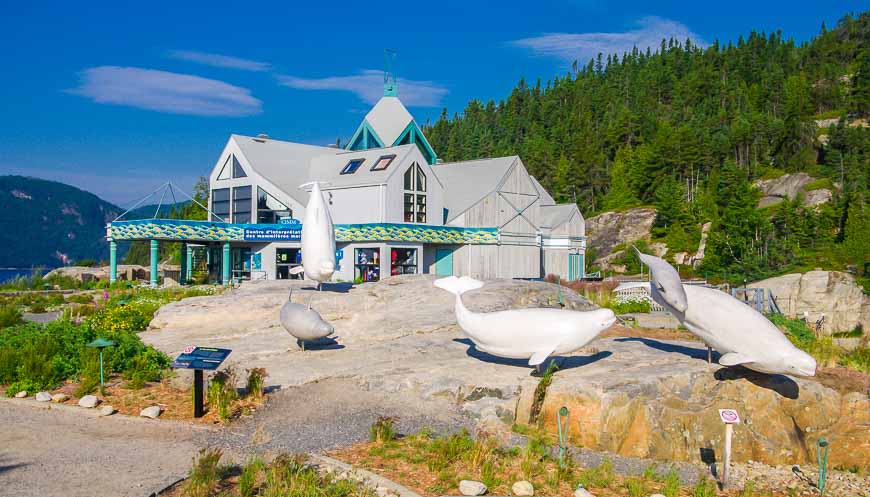
  • Visit the Marine Mammal Interpretation Centre.
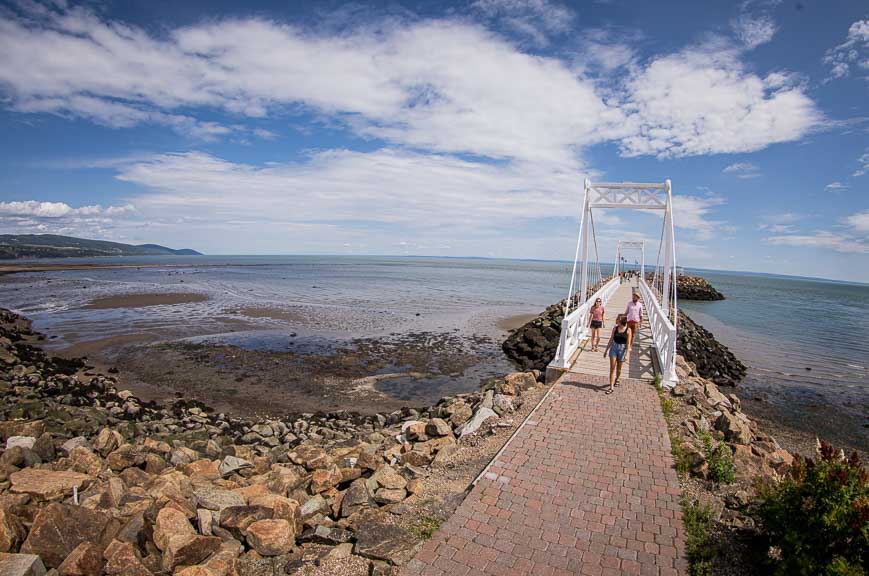
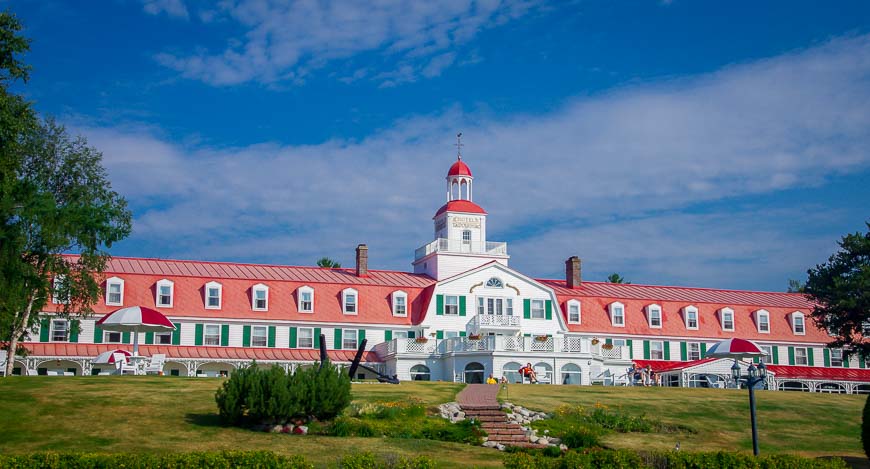
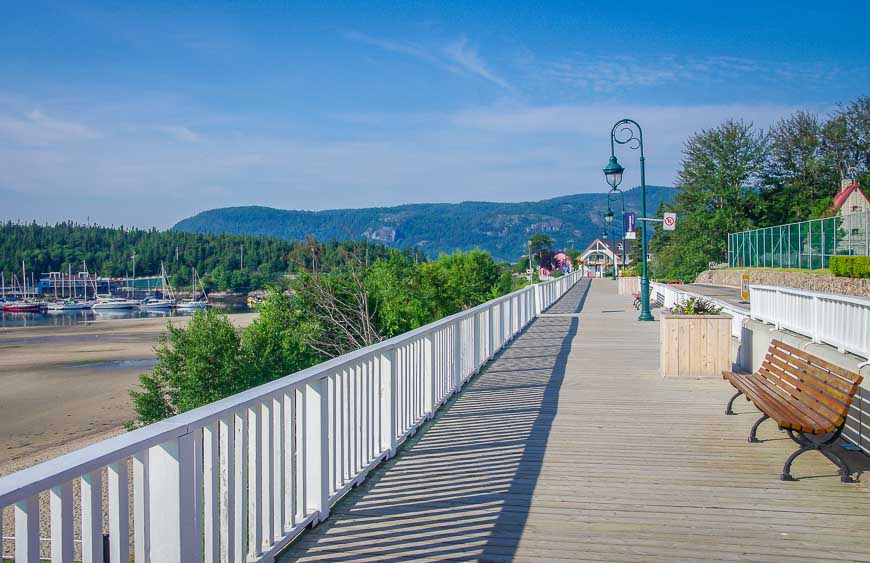
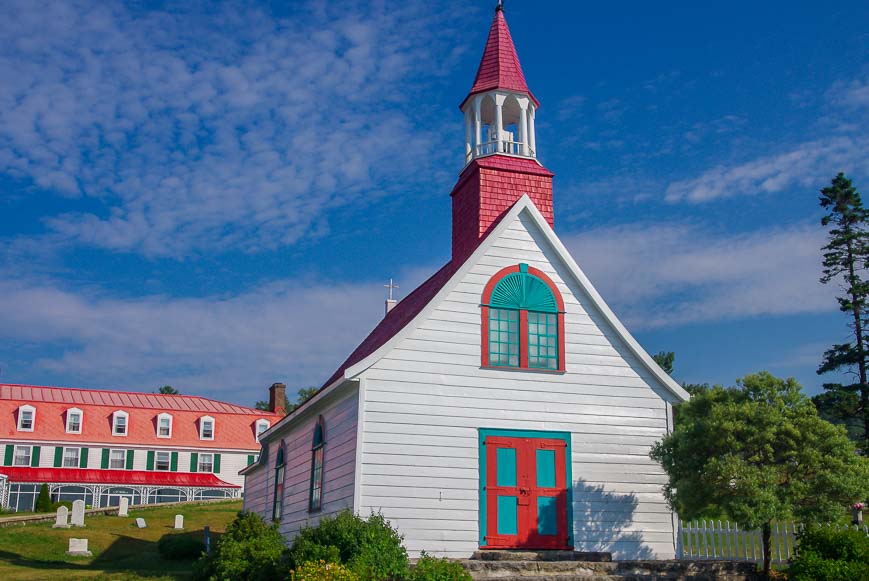
  • Wander the boardwalk in front of the colourful Hotel Tadoussac, stopping to check out the equally colourful Petite Chapelle, a wooden church – and one of North America’s oldest, dating back to 1747.
  • Do the beautiful walk on the Sentier Pointe-de-l’Islet viewpoint trail where you might get lucky and see whales from shore.
  • Check out the Chauvin Trading Post, a must for history aficionados. It’s a replica of the first fur trading post in Canada, built in 1600.
  • There are several whale watching cruises that offer a high potential of sighting some of the 13 varieties of whales that live in these waters. Visit Croisières AML and see what tour might appeal to you.
  • Stop at the Cap-de-bon-désir Interpretation and Observation Centre. Bring you warm clothes, a camera with a long lens and binoculars as this is a great place to spot whales. Sunrise or sunset is a particularly good time to go as the light is soft and beautiful.
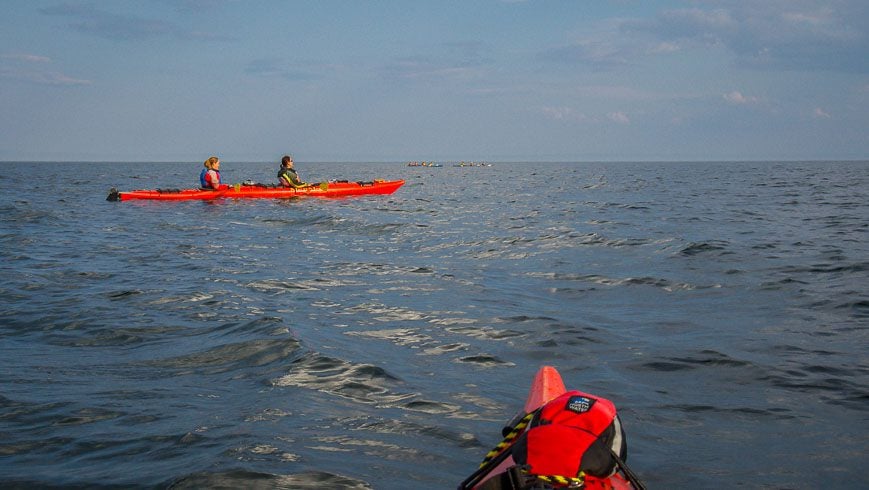
  • If you want something more adventurous drive north 20 minutes to Les Bergeronnes and book a trip with Mer et Monde to kayak with whales. They’re popular so book well in advance.
  • Take a kayaking tour into the Saguenay Fjord.

Read: Kayaking with Whales in the St. Lawrence River

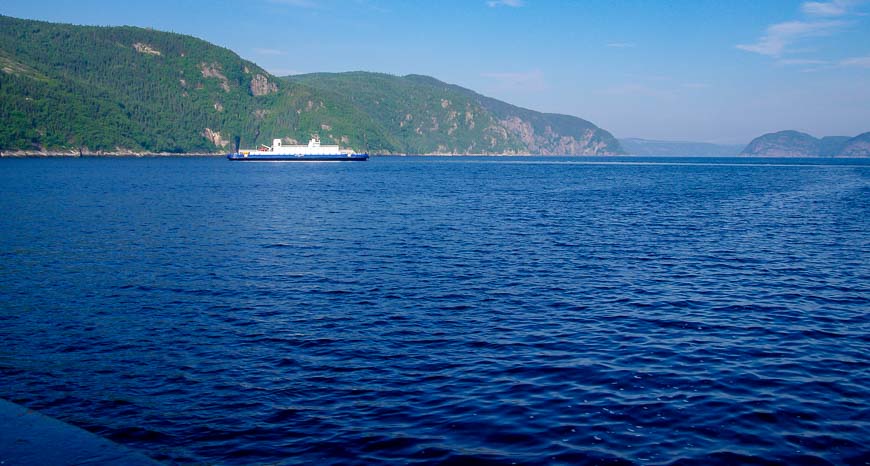
Crossing the Saguenay Fjord on the ferry on a Quebec road trip

Crossing the Saguenay Fjord on the ferry

Hotel Tadoussac in Tadoussac - a great place to stay on a Quebec road trip

Hotel Tadoussac

Boardwalk at Tadoussac beside the river

Tadoussac beside the river

On a Quebec road trip stop at the Marine Mammal Interpretation Centre

On a Quebec road trip stop at the Marine Mammal Interpretation Centre in Tadoussac

The Chapelle du Tadoussac built in 1747

The Chapelle du Tadoussac built in 1747

Waiting for the whales to resurface

Waiting for the whales to resurface near Les Bergeronnes on a kayaking trip with Mer et Monde

Day 4: Tadoussac – Baie Comeau – 200 km

It will take you just 2.25 hours to reach Baie Comeau without stopping. It’s another five hours to Sept-Îles from Baie Comeau so it’s certainly possible to do the drive comfortably in a day, but you’d have to nix a lot of the suggested stops.

On the way to Baie Comeau visit Parc Nature in Pointe-aux-Outardes – a peninsula with over 30 kilometres of beaches and sandy areas. Try and spot some of the 200+ bird species and 300 plant species that have been sighted here. And end the day if you’re so inclined, sleeping in a bird’s nest.

There’s a new bike path on the peninsula to explore that ends in Pointe-Lebel. It sits at the confluence of the St. Lawrence and Manicouagan Rivers – a place where the tides work their magic forming massive sandbars – so it’s also a perfect spot for a beach walk.

With Baie Comeau at the entrance to the Manicouagan-Uapishka UNESCO World Biosphere Reserve, there’s plenty of nature to explore if that’s what you’re after. Check out the fascinating Jardin des glaciers where you can “feel the 4 kilometre Laurentian ice sheet under your feet”.

Otherwise, stroll through Baie-Comeau’s pretty downtown checking out the boutiques.

Where to stay in Baie Comeau

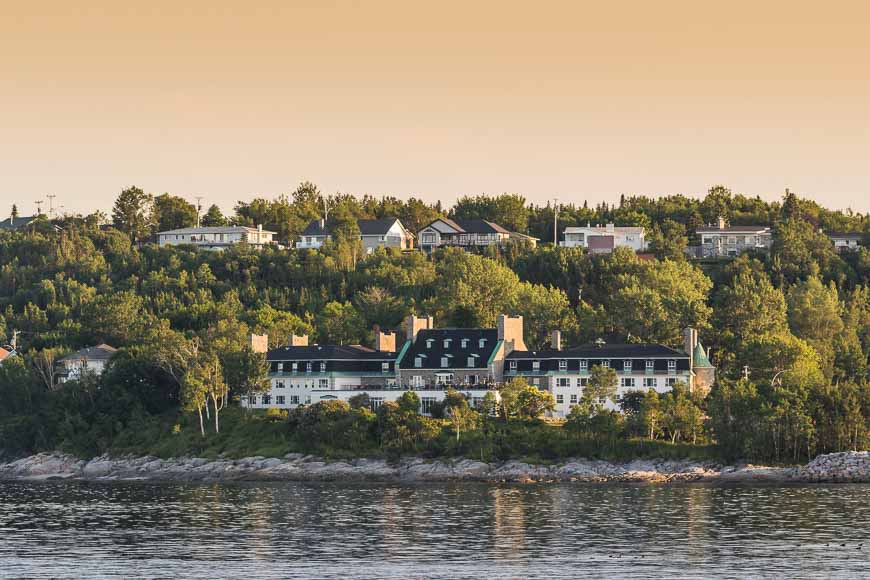
If you’re after river views choose Hôtel le Manoir Baie-Comeau. See the photo below.

Le Grand Hôtel is a great choice if you want a downtown location.

View of the Manoir de Baie-Comeau from the St. Lawrence River in Baie Comeau on a Quebec road trip

View of the Manoir de Baie-Comeau from the St. Lawrence River in Baie Comeau – Photo credit: Mathieu Dupuis/Le Québec maritime

Day 5: Baie Comeau – Sept-Îles – 230 km

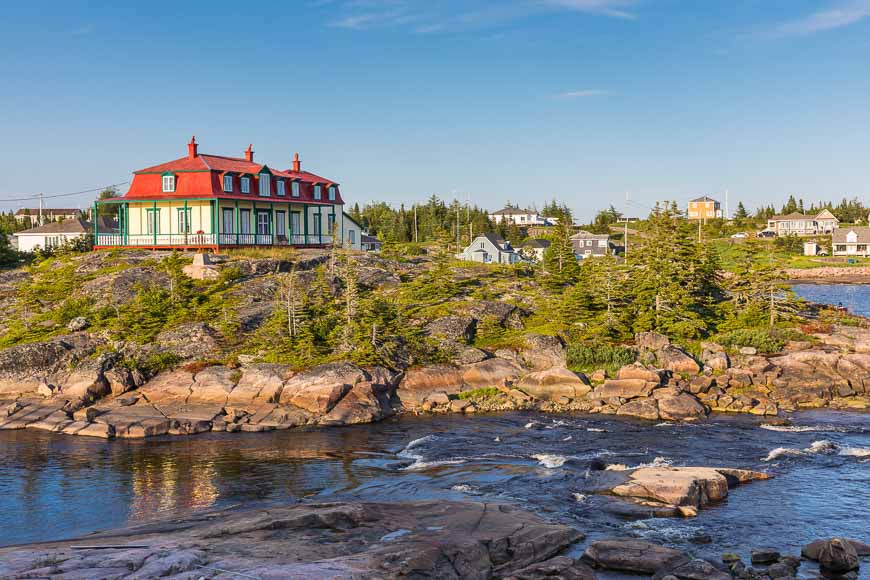
Seventy five minutes and 94 kilometres east out of Baie Comeau is the road to Pointe-des-monts. The 98 foot tall lighthouse, built in 1830, is the second oldest along the St. Lawrence River. Enjoy superb views up and down the river. You can also spend the night in the lightkeeper’s cottage on the property. 

Continue to Sept-Îles, about a two hour drive away. Plan to spend the night in the city so you can take advantage of a boat trip and explore the seven island archipelago. This is prime whale watching country again, but even if you don’t see anything, it’s fun to check out the deep-water port from the water and to explore Grand Blasque Island.

Grand Blasque Island

Grand Blasque is the only island in the archipelago that offers campsites. Though they are beautiful, be warned that they look across to an industrial complex, off in the distance – and you can hear some noise.

If you don’t plan to camp, you can hike the trails on the islands, do some beach combing and take advantage of all the photographic opportunities. Birding is excellent too.

Where to eat in Sept-Îles

You can eat inside a giant lobster trap called the Le Casse-Croute du pêcheur lobster shack. It’s down on the water and definitely worth doing. Les Terrasses du Capitaine is another solid choice.

Where to stay in Sept-Îles

I stayed in Hôtels Gouverneur Sept-Îles on the main strip. Rooms aren’t fancy but they are comfortable. And the hotel is minutes away from everything. Another good choice is Hôtel Sept-Îles with its own private beach area.

Beautiful beaches around Sept-Iles seen on a Quebec road trip

Beautiful beaches around Sept-Iles

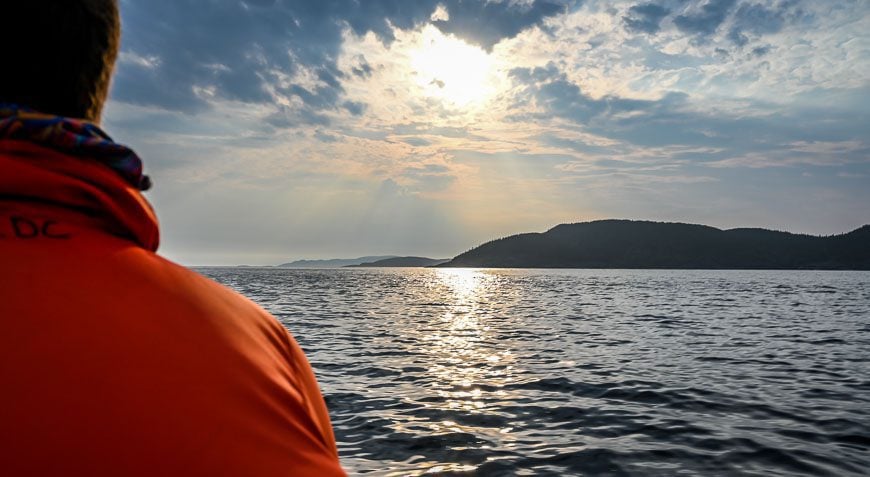
Whale watching out of Sept-Iles - a stop on a Quebec road trip

Whale watching out of Sept-Iles

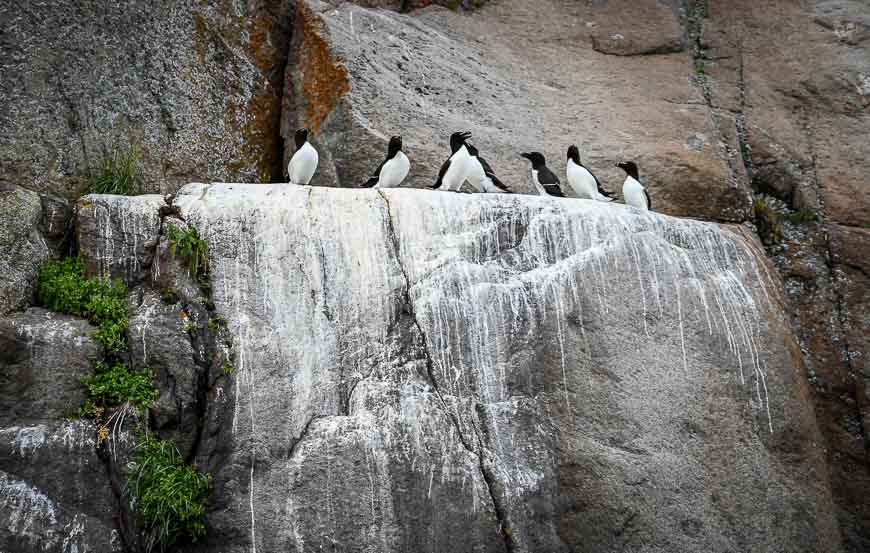
Sea birds seen on a whale watching tour

Sea birds seen on a whale watching tour

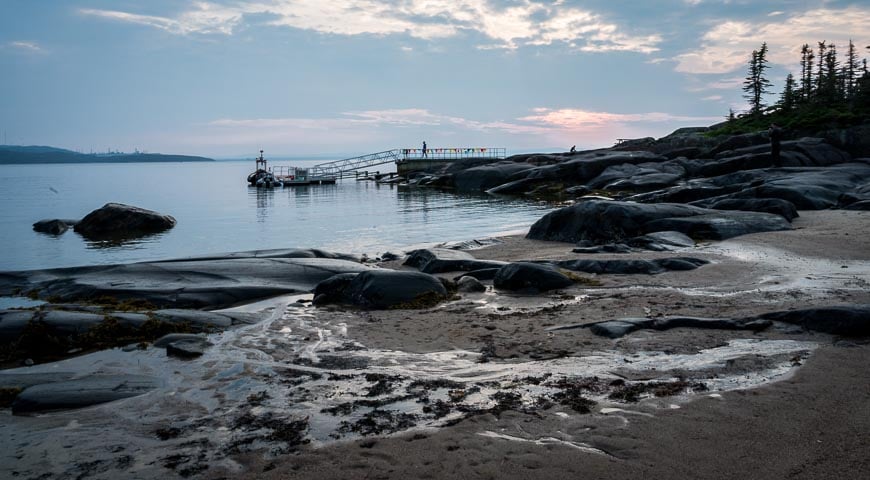
A stop at Grand Basque Island on the whale watching tour

A stop at Grand Basque Island on the whale watching tour

Day 6 on a Quebec Road Trip: Sept-Îles – Havre-Saint-Pierre – 219 km

It’s a 2.5 to 3 hour drive, depending on road construction, to cover the 219 kilometres to reach Havre-Saint-Pierre. 

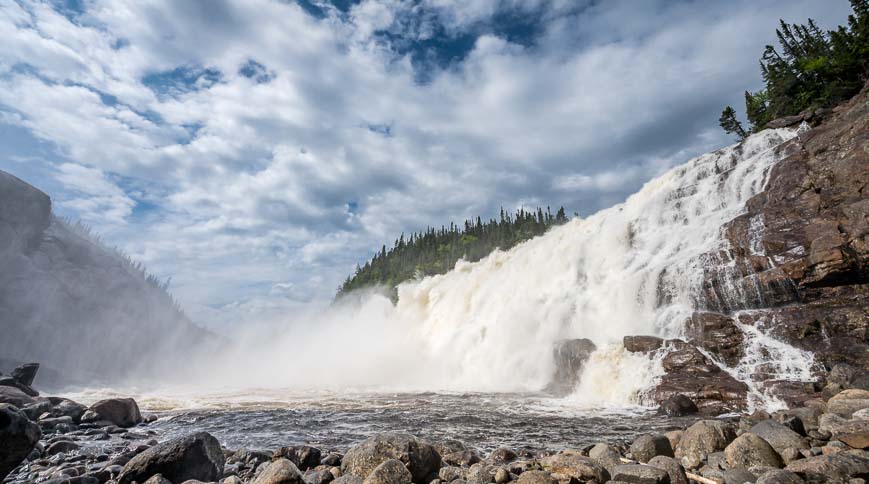
On this part of the Quebec road trip be sure to stop at the impressive 35 metre high Manitou Falls, about 35 minutes north of Sept Îles. There’s a walk from the parking lot past the upper falls – which are remarkable in themselves – down to thundering Manitou Falls. Bring a plastic bag to protect your camera as there is a lot of mist from the falls, even along the trail.

35 metre high Manitou Falls

35 metre high Manitou Falls

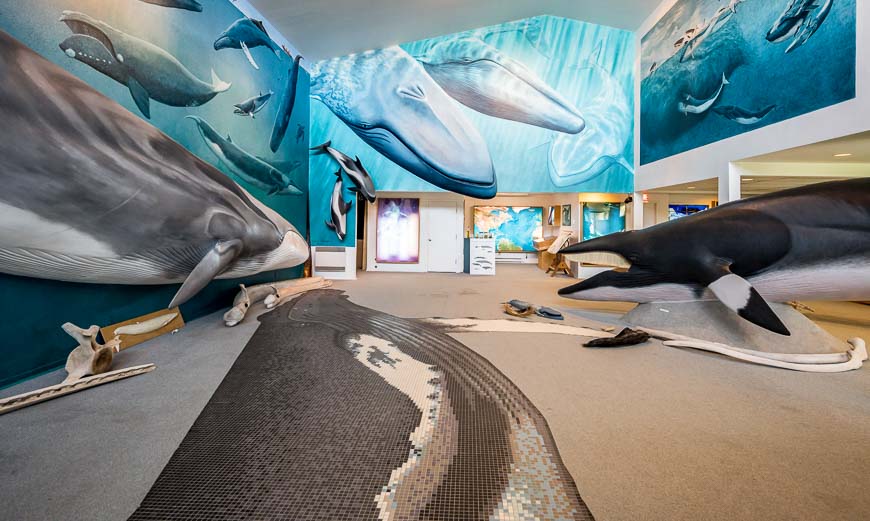
Also be sure to stop in at the Mingan Island Cetacean Centre, a research organization dedicated to studies of both marine mammals and marine ecosystems. Visit the centre to learn about the whales that live in the St. Lawrence River via several rooms with very interesting displays.

There is the opportunity on occasion to join researchers on their vessels. If that is of interest be sure to contact them well in advance of your road trip.

Mingan Island Cetacean Centre

Stop in at the Mingan Island Cetacean Centre – an interesting stop on a Quebec road trip

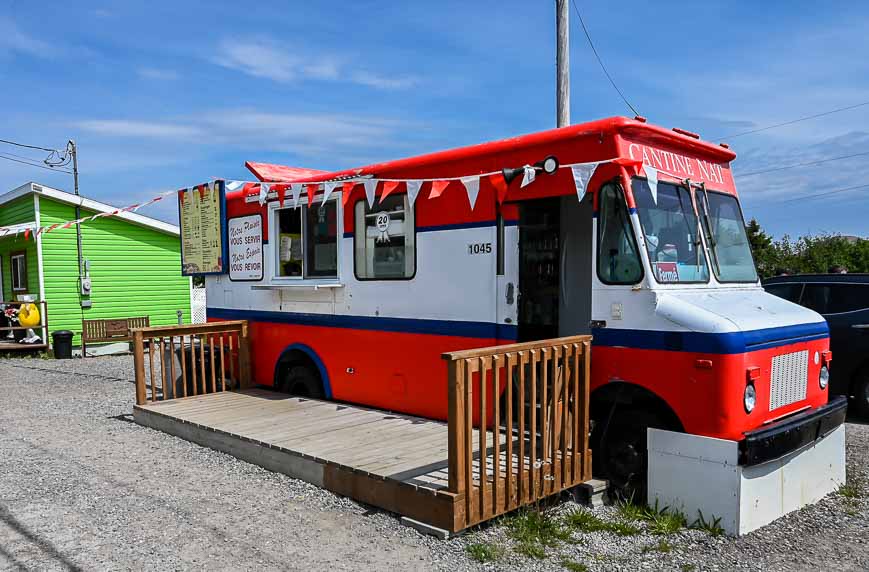
If you’re hungry – coming or going to Havre-Saint-Pierre, I’d recommend a stop at the food truck outside the cetacean centre for a delicious lobster sandwich.

On your Quebec road trip stop at Longue-Pointe-de-Mingan for lunch

On your Quebec road trip stop at Longue-Pointe-de-Mingan for lunch

Where to stay in Havre-Saint-Pierre

In town stay in Auberge Boreale.

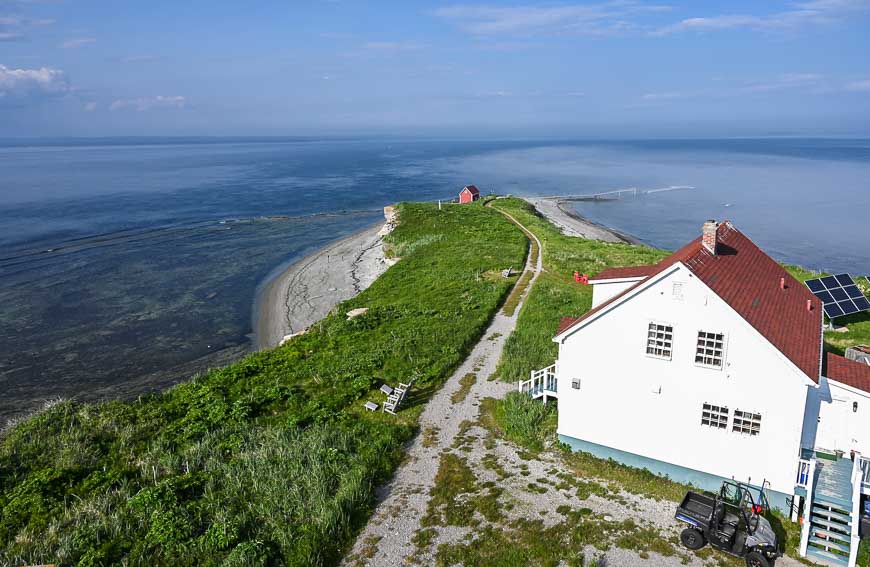
In Mingan Archipelago National Park Preserve you have three overnight options – camping on a number of the islands, an oTENTik experience or best of all – a stay in a beautiful lightkeeper’s cottage on Îles aux Perroquets. Visit the Parks Canada website to learn the details about camping and overnight stays on the islands in the Mingan Archipelago. 

Read: A Lighthouse Stay in Quebec’s Mingan Archipelago

View from the lighthouse of Ile aux Perroquets

View from the lighthouse of Ile aux Perroquets

Day 7 on the Quebec road trip: Option 1: Havre-Saint-Pierre – Kegaska – Havre-Saint-Pierre – 404 km return

I admit that I have not done the drive to Kegaska, the easternmost village at the end of Highway 138. But I’d love to. This looks like such a pretty area and for me there’s always something special to get to the end of a road. Note that the highway changes from pavement to gravel, eight kilometres east of Natashquan.

Get into exploring mode on this part of your Quebec road trip and stop where the wind blows you. Enjoy fabulous views of the St. Lawrence River as it widens. If you could see for hundreds of miles, the shore near Corner Brook, Newfoundland would pop into few. 

Here are some of the things you can do on this lonely stretch of Highway 138.

  • Stop in the small fishing village of Baie-Johan-Beetz and explore the rocky shoreline. Keep an eye out for seabirds.
  • Visit Natashquan, the birthplace of Gilles Vigneault, known for his songs and poetry.
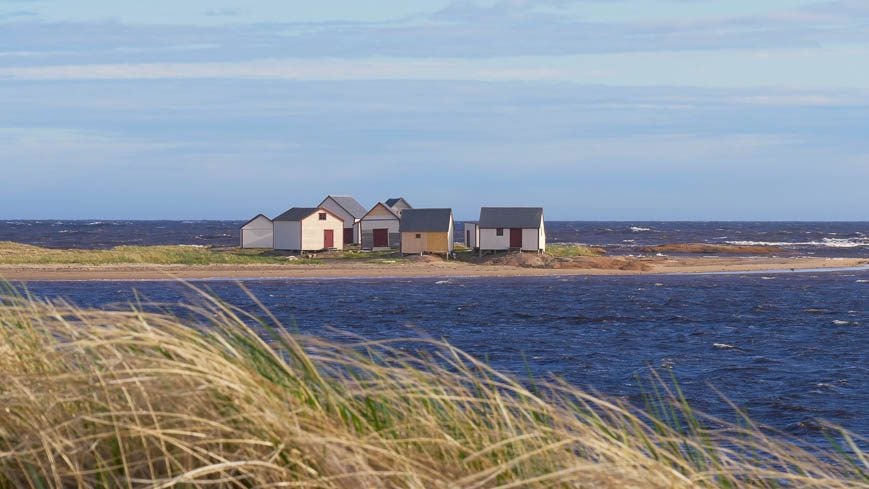
  • Admire“Les Galets” fishermen’s storehouses
  • Check out Natashquan River Falls
  • Visit the Innu village of Pointe-Parent.
  • Stop in at Le Bord du Cap interpretation center and admire the reconstruction of Natashquan’s first general store
  • Enjoy a meal at L’Échourie Café & Bistro. Try and catch one of the evening live music or storytelling performances.

Where to stay between Havre-Saint-Pierre and Kegaska 

There are places to camp and some B&B’s along the route. Check out the Cote Nord website for a full listing of campgrounds.

Visit the Quebec Original website for a listing of B&B’s in Natashquan. 

In Kegaska stay in Auberge Brion. You can find them on Facebook or call them at 418-726-3738.

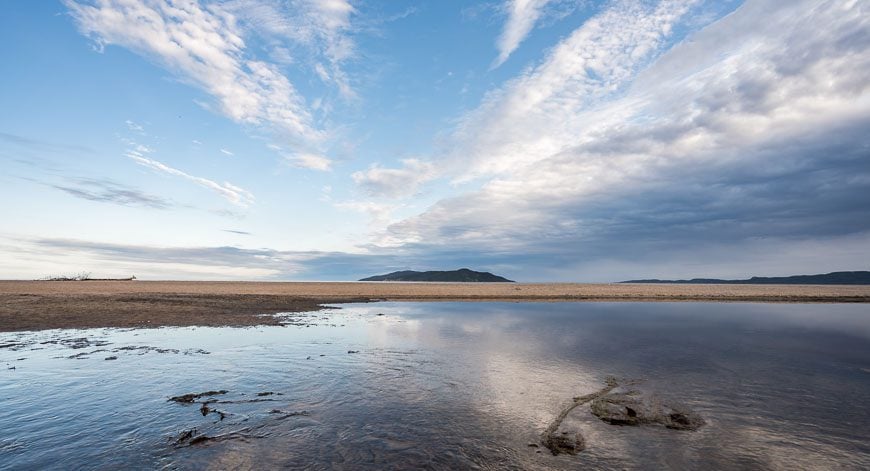
Pretty scenery around Baie Joan Beetz (between Havre-Saint-Pierre and Natashquan)

Pretty scenery around Baie Joan Beetz (between Havre-Saint-Pierre and Natashquan) – Photo credit: Mathieu Dupuis/Le Québec maritime

View of Les Galets from Natashquan

View of Les Galets from Natashquan – Photo credit: Thibault Touzeau/Le Québec maritime

Day 7 of the Quebec Road Trip: Explore Mingan Archipelago National Park Reserve

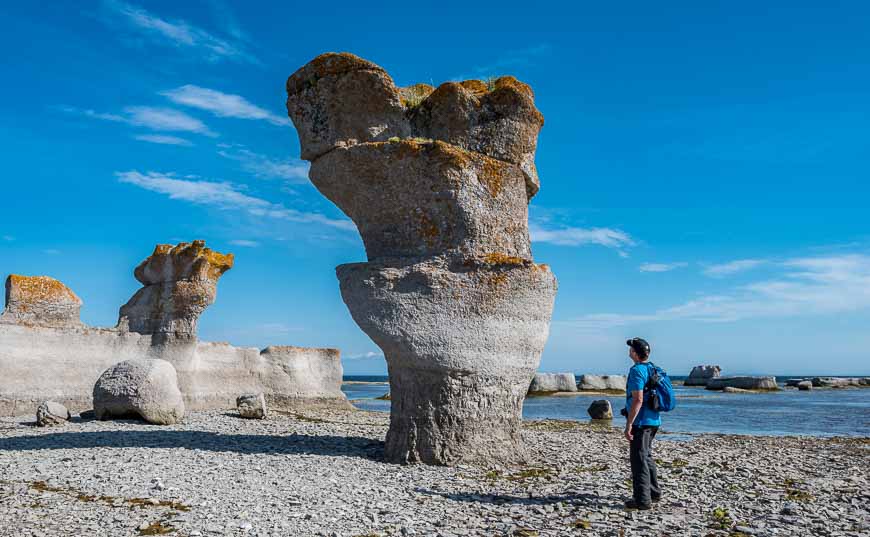
The Mingan Archipelago National Park Reserve is comprised of close to 1,000 islands and islets scattered off the coast of eastern Quebec. Look for an abundance of large limestone monoliths, some dating back 450 million years. These fantastically shaped rocks, carved by nature are a big reason to visit the park for nowhere else in Canada “will you see such an abundance of these rocky sentinels.”

Two towns provide boat access to the Mingan Archipelago – Longue-Pointe-de-Mingan and Havre-Saint-Pierre. In Longue-Pointe book a tour with Famille Loiselle. Apart from seeing whales and other marine creatures, one of the big highlights is all the puffins you’ll see especially on Île aux Perroquets.

Read: A Trip to Mingan Archipelago National Park in Quebec

Go on a boat excursion to Mingan Archipelago National Park Preserve

Go on a boat excursion to Mingan Archipelago National Park Preserve

Mingan Archipelago

Beautiful rock formations in Mingan Archipelago National Park Preserve

Day 8 – 9: Quebec road trip: Return to Quebec City – with a stop in the Saguenay Region in L’Anse-Saint Jean – 750 km

While not technically along the north shore of the St. Lawrence River, a side-trip to the Saguenay area is highly worthwhile. You can access it from Tadoussac via Highway 172. If you do that you could drive to Saguenay and return along Highway 170 to meet Highway 138. 

What to do in the Saguenay area

  • Go kayaking – for a day or longer. I highly recommend my 2 day Saguenay Fjord kayaking adventure. Even though we didn’t see a single whale, we still enjoyed incredible scenery and I had an exceptional experience – cue the divine food on the trip.
  • Hike in Parc national du Fjord-du-Saguenay
  • Bike a section of the Blueberry Route. I cycled the whole route over three days. Read about it here.
  • Check out the boardwalk in Chicoutimi.

Where to stay near Saguenay

I stayed in one of Quebec’s Most Beautiful Villages – L’Anse-Saint-Jean – and would highly recommend it. This is where my kayaking tour started. I stayed at Auberge la Fjordelaise, across from the beach and loved the ambiance of the hotel.

One of Quebec's "Most beautiful Villages" L'Anse-Saint-Jean

One of Quebec’s “Most beautiful Villages” L’Anse-Saint-Jean

Day 10: L’Anse-Saint Jean – Quebec City – 250 km

Today is an easy drive back to Quebec City. It’s time to reflect on all the places you’ve visited, the people you’ve met and the nature you’ve been privileged to see. If you’re already thinking about another Quebec road trip I’d recommend the Gaspe region. My friend’s at Offtrack Travel have written a detailed post that takes you from Montreal to the Gaspé so check them out if you’re into road-tripping.

Further reading about things to do in Quebec

Click on the photo to bookmark to your Pinterest boards.

Quebec road trip from Quebec City to Havre-Saint-Pierre

The post Quebec Road Trip: Quebec City to Havre-Saint-Pierre appeared first on Hike Bike Travel.

Quebec Road Trip: Quebec City to Havre-Saint-Pierre Read More »

12 Great Things to Do in North Vancouver, BC

It’s amazing the difference eight years can make to a place. Last time I looked, North Vancouver was a sleepy spot. The waterfront was pretty but I’d never have called it vibrant. And after 8 PM there was never a whole lot to do.

That’s completely changed with the addition of The Shipyards District at the bottom of Lower Lonsdale. Now I’d recommend you try and fit in as many of these things to do in North Vancouver as you can. It’s a destination in its own right.

Spend a few hours exploring Capilano Suspension Bridge Park 

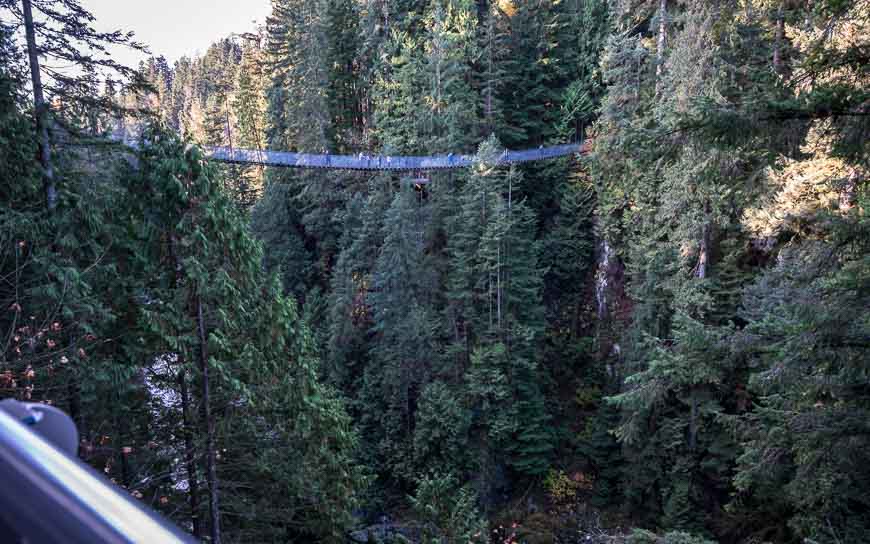
The 27 acre Capilano Suspension Bridge Park offers visitors three unique ways of interacting with the coastal forest – via the Capilano Suspension Bridge, a Cliffwalk and a Treetops Adventure. I was leery before coming thinking this was just going to be one giant tourist trap. Was I ever wrong! Certainly the company is in business to make money – but at the same time they deliver outstanding experiences you won’t find anywhere else.

There’s a high fun factor, it’s family-friendly and the few hours I spent here far exceeded my expectations. Allow time to do all activities and to walk through the forest.

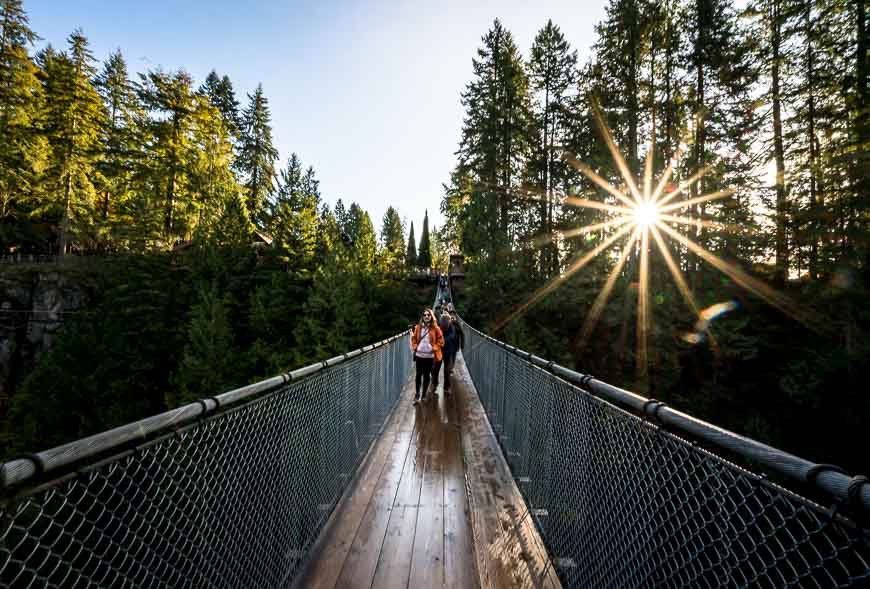
The Capilano Suspension Bridge

Walk and sway 137 metres (450) feet along the suspension bridge, 70 metres (230 feet) above the Capilano River. Go early or late in the day if you want to avoid any line-ups. From the bridge you may see bald eagles feasting on fish in the river below.

Walking the Capilano Suspension Bridge is one of the things to do in North Vancouver

The Capilano Suspension Bridge seen from the Cliffwalk

A perfect fall day to sway on the Capilano Suspension Bridge

A perfect fall day to sway on the Capilano Suspension Bridge

The suspension bridge gets crowded in short order

The suspension bridge gets crowded in short order

The Cliffwalk at Capilano 

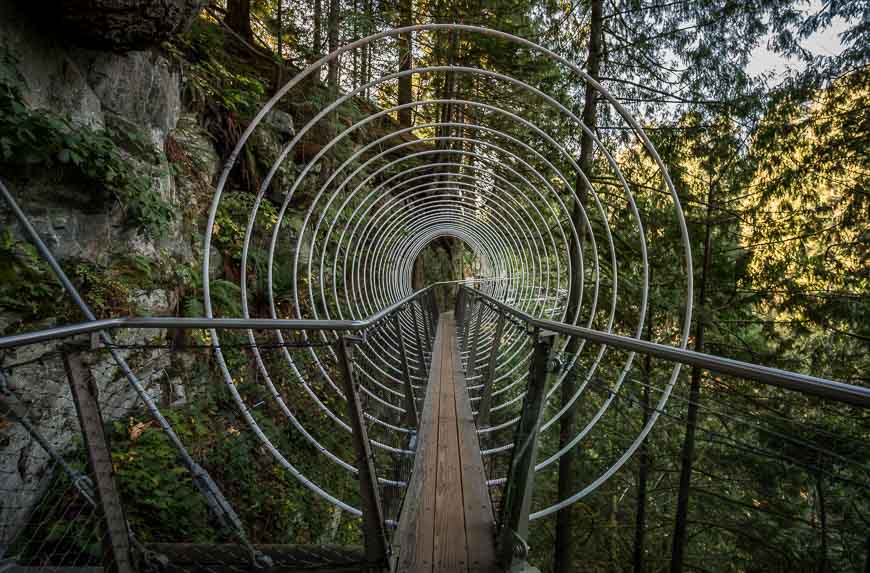
In operation since 2011, the Cliffwalk is a series of very narrow cantilevered bridges that hug a granite cliff, 110 feet above the Capilano River. There are lots of viewing platforms so people can pass – and you can get that Instagram-worthy shot. 

Interestingly only 16 anchors hold the catwalk in place – but they’ve been drilled by hand into the cliff with some going as deep as 6 metres (19 feet). To reinforce them over half a kilometre of steel rods were drilled into the cliff face.

The bottom line – this is a well-built structure that is not going anywhere – though if you’re deathly afraid of heights don’t look down.
Cool design around the Cliffwalk

Cook IG worthy design around the Cliffwalk

The Cliffwalk is supported by bolts drilled deep into the granite

The Cliffwalk is supported by bolts drilled deep into the granite

Another view of the narrow Cliffwalk - one of the things to do in North Vancouver

Another view of the narrow Cliffwalk

Don’t miss the Treetops Adventure – one of the really fun things to do in North Vancouver

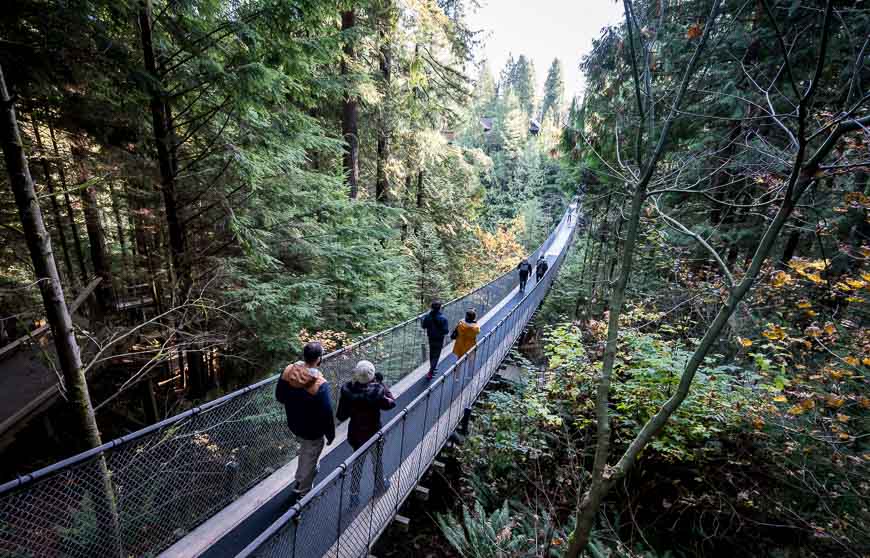
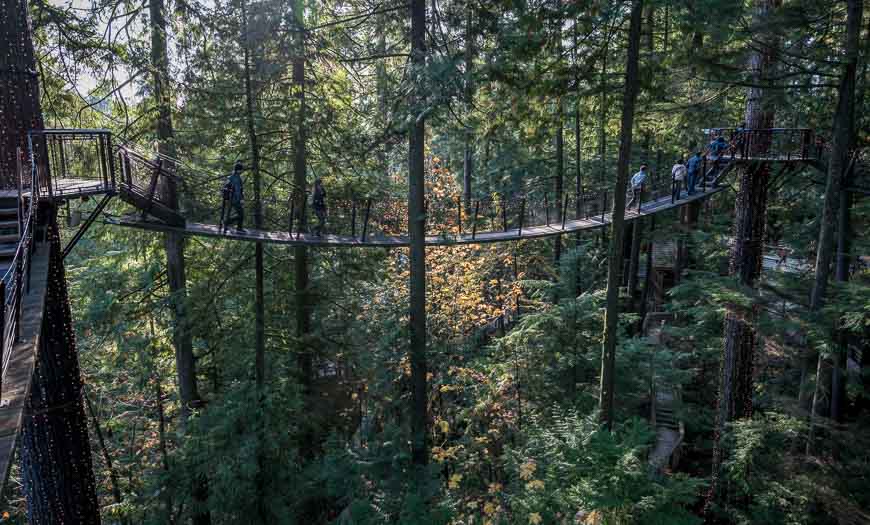
If you’re looking for a “squirrel’s eye view of a coastal forest” do the Treetops Adventure on the far side of the Capilano Suspension Bridge. Seven suspension bridges attached to eight monster – sized 250 year old Douglas fir trees weave through the forest. Beside each tree are viewing platforms – attached to the tree in such a way that nails and bolts aren’t required. In fact the platforms can move as the trees grow.

Some of the bridges are up to 110 feet above the forest floor so take your time if you’re fearful of heights. It’s a whole lot of fun and one of the top things to do in North Vancouver.

Walking through the Treetops at Capilano Suspension Bridge Park

The Treetops Adventure is fun for the whole family

Looking up at the suspension bridges

Looking up at the suspension bridges

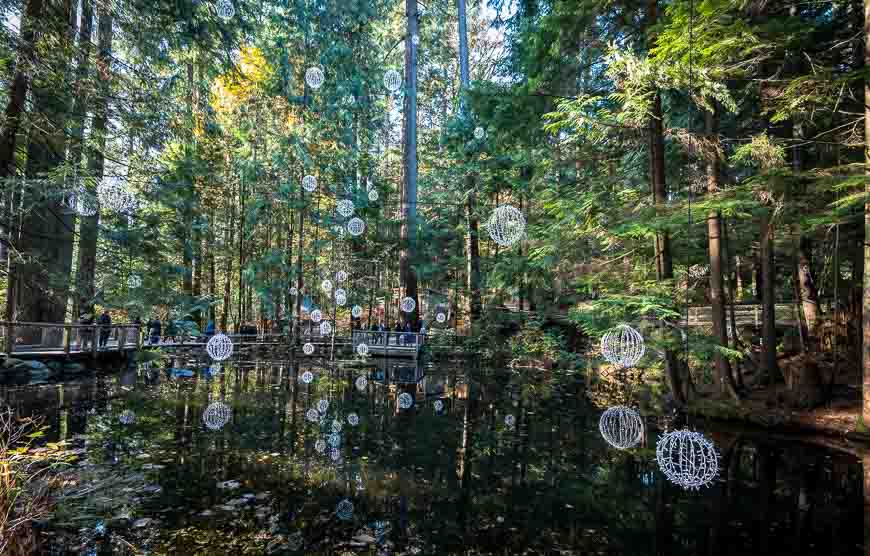
Don’t miss a walk through the forest looking for sights like the one in the photo below.

Interesting balls and reflections on a forest walk

Interesting balls and reflections on a forest walk in Capilano Suspension Bridge Park

Go kayaking out of Deep Cove

From March to September I used to paddle twice a week with my Seventh Wave dragonboat team out of Deep Cove. Returning to the area was bittersweet. It made me realize just how much I miss the ease of getting out onto the water. The Glenmore Reservoir in Calgary doesn’t offer anywhere near as pretty a backdrop.

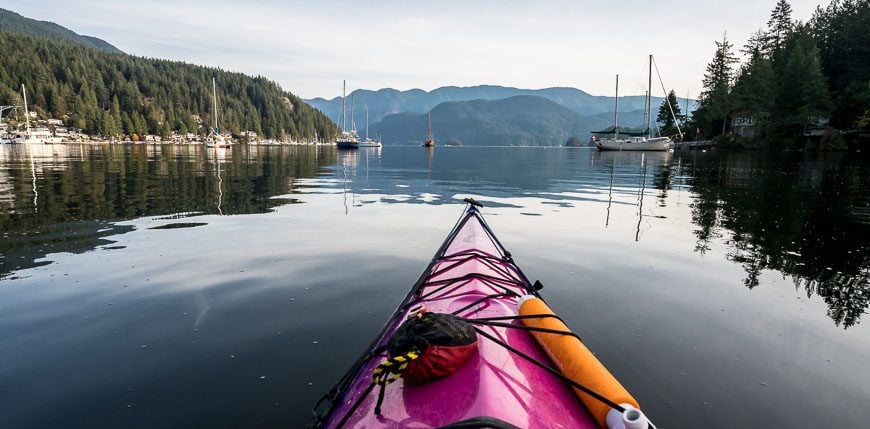
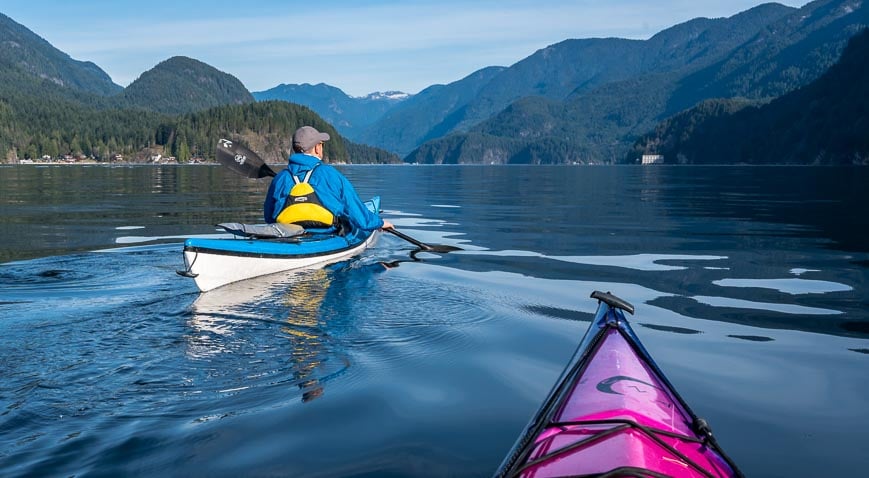
I spent a few hours one morning kayaking with a guide from the Deep Cove Kayak Centre. Together we paddled across Indian Arm to the Twin Islands – a distance of roughly five kilometres. It was as beautiful a day as you could ever get in November – with close to summer-like temperatures, calm waters and picture-perfect mountains. 

While we just did an out and back paddle, you can rent kayaks and SUPs from Deep Cove Kayak and in fact paddle all the way down Indian Arm and camp for the night. There are three campgrounds and a trip around here sure is a lovely way to appreciate the coastal mountain scenery.

In winter Deep Cove Kayak is closed for rentals but they do offer winter kayaking tours.

An unbelievable day for kayaking out of Deep Cove - one of the top things to do in North Vancouver

An unbelievable day in November for kayaking out of Deep Cove

Paddling in Indian Arm

In theory you can paddle to the far end of Indian Arm but it’s usually done as an overnight trip

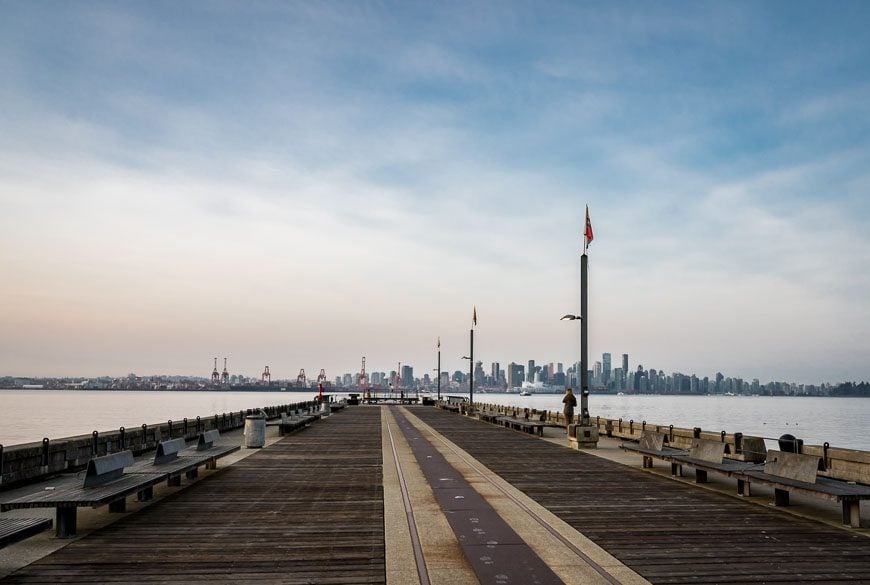
Check out the Pier at the Shipyards District Lower Lonsdale – one of the top things to do in North Vancouver

Walk out the 700 foot length of the Burrard Dry Dock Pier in Lower Lonsdale to get superlative 360 degree views of downtown Vancouver, Stanley Park and North Vancouver. If you go first thing in the the morning you might have it to yourself. On a hot summer day, you’ll have lots of company.

Walk the pier at the Shipyards - one of the fun things to do in North Vancouver

Walk The Pier at the Shipyards

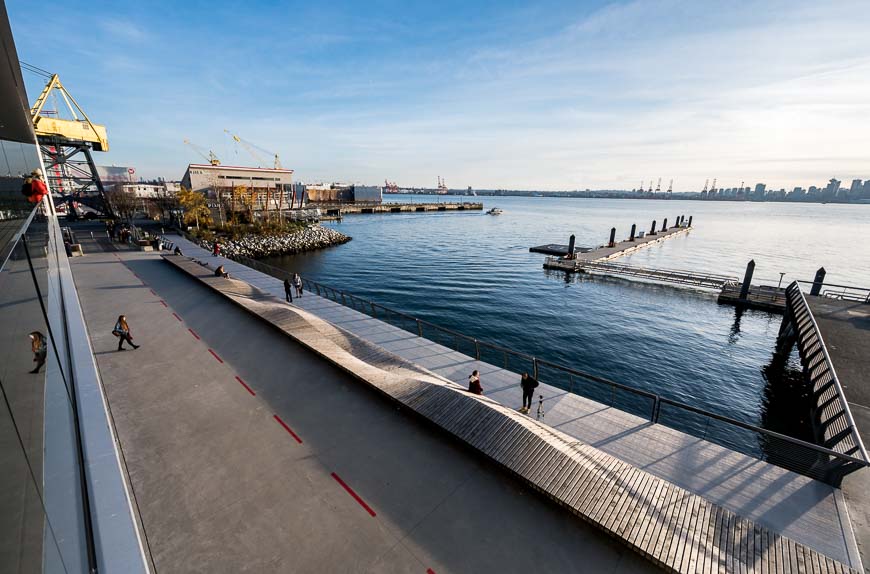
Looking at The Shipyards from The Pier

Looking at The Shipyards from The Pier

Visit the Polygon Gallery

The Polygon Gallery has been around for over 40 years though for most of its life it went by the name Presentation House Gallery with digs at Third and Chesterfield. The new gallery space at the bottom of Lower Lonsdale is stunning. Apart from the airy interior space, I especially like the wave-like action of the water running continuously in front of the gallery and the killer view from the second floor.

Visit the Polygon Gallery - one of the cultural things to do in North Vancouver

The Polygon Gallery at the end of Lonsdale

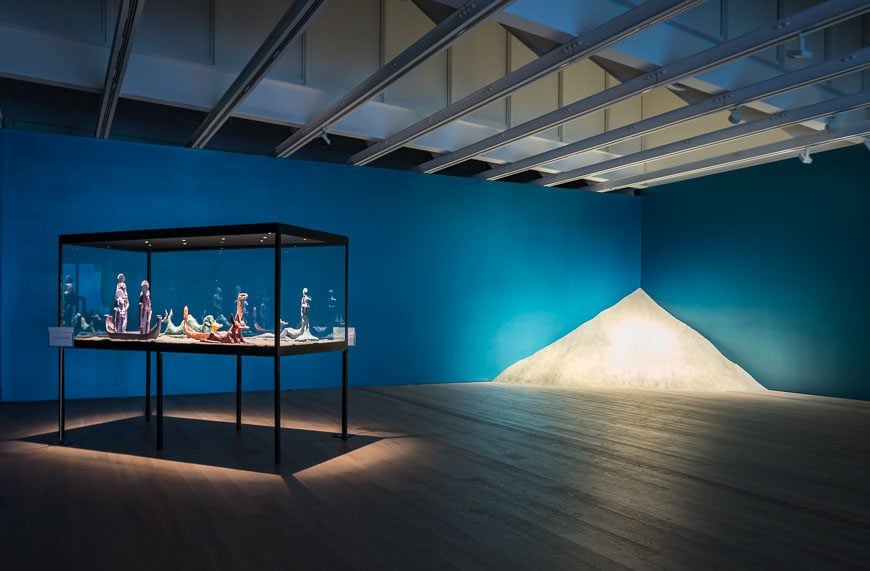
The gallery has a reputation as one of “the most adventurous public art institutions.” They have a big focus on photography and have in the past featured works by Ansel Adams. You can also expect to see thought provoking installations like the one pictured below.

The art of Wael Shawky at the Polygon Gallery

The art of Wael Shawky

Entrance is by donation. Exhibition tours are held every Saturday at 2 PM. An onsite cafe is coming soon.

Waterfront view from the Polygon Gallery

Waterfront view from the Polygon Gallery

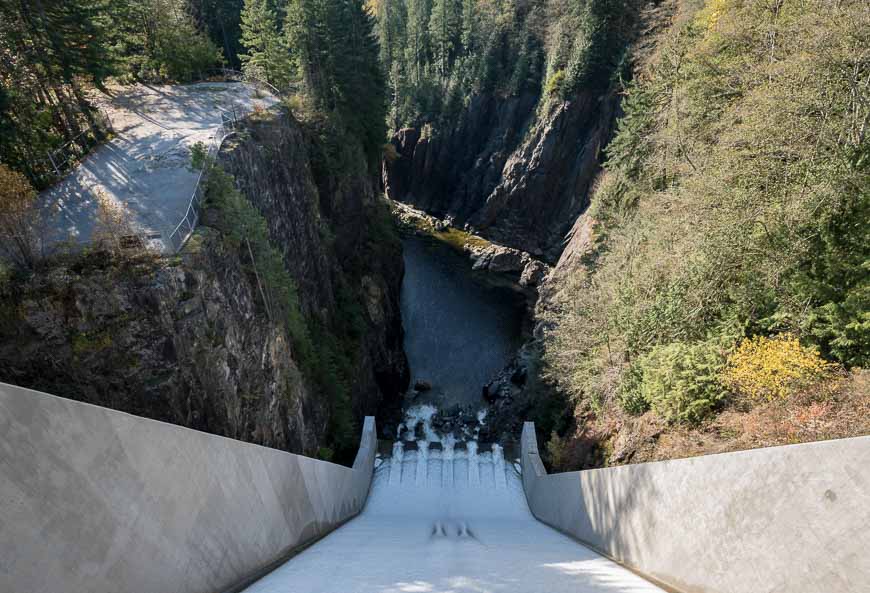
Peer over the edge of the Cleveland Dam – one of the free things to do in North Vancouver

The Cleveland Dam is a popular FREE tourist attraction that fits well with a visit to the Capilano Suspension Bridge Park. The concrete dam stands 91 metres tall at the head of the Capilano River. It’s an awe-inspiring sight to say the least – and again one of the places I never visited when I lived here.

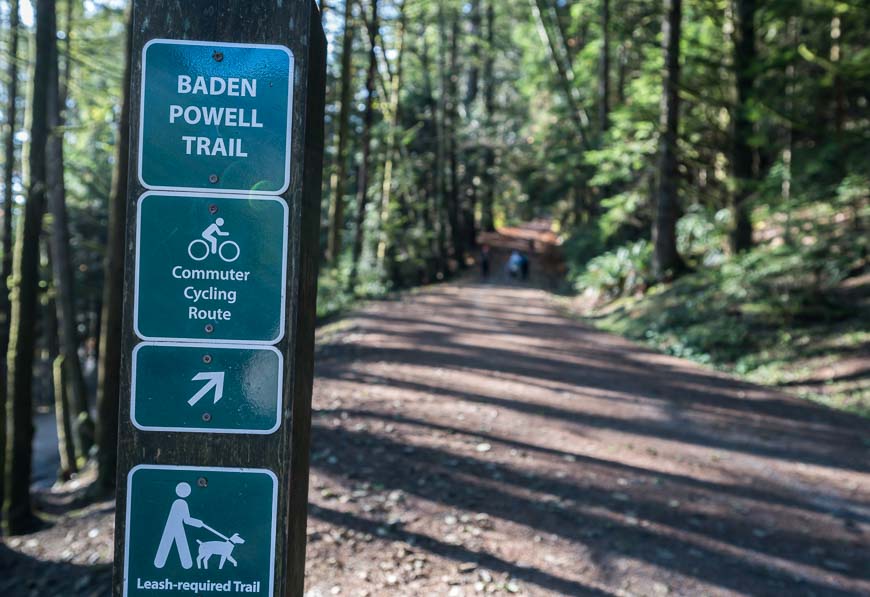
It’s definitely worth a half hour of your time. Be sure to take the trail that gives you a view of the dam from below. And then if you’re feeling energetic and adventurous head out for a hike on a section of the Baden Powell trail. 

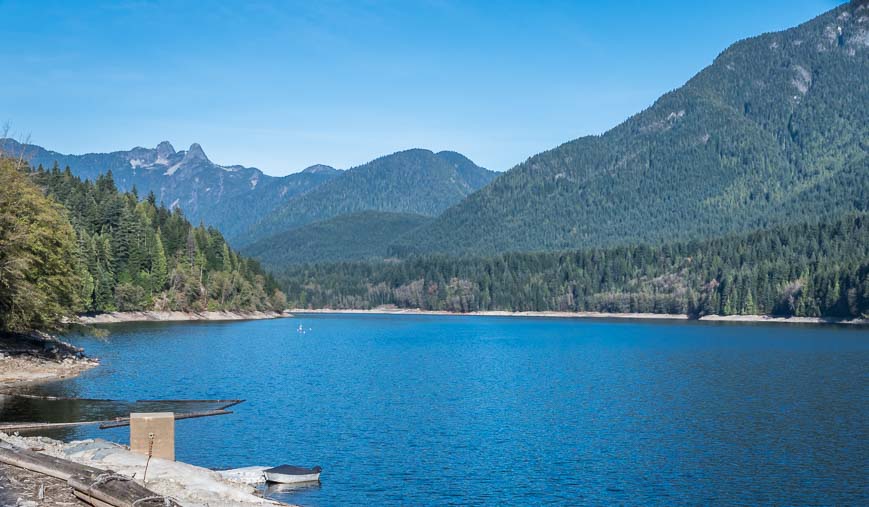
Capilano Lake or reservoir as it is also called, is a beautiful looking lake but it’s completely off limits to the public. The photo I took below was through the wire fence.

The Cleveland Dam is 91 metres high

The Cleveland Dam is 91 metres high

Hiking trails abound around the ils abound around the Cleveland Dam

Hiking trails abound around the Cleveland Dam

Looking through the fence to the off-limits Capilano Lake

Looking through the fence to the off-limits Capilano Lake

Catch a sunrise and a sunset

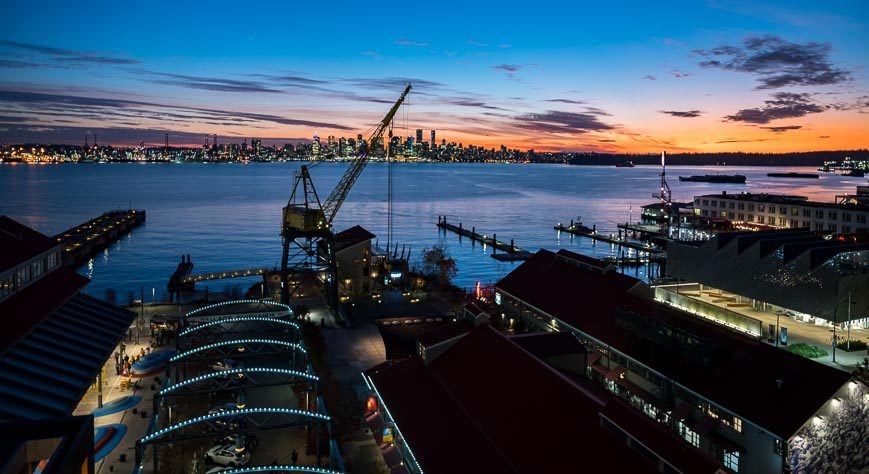
One of the things I really miss about Vancouver is the sunsets. It’s not like we don’t get them in Calgary, but I rarely get a good one with the vivid oranges where I live. It was pretty sweet to be able wander into our hotel room at the Pinnacle Hotel at the Pier and catch such a glorious sunset from our balcony.

Enjoying a sunset over Vancouver from our room at the Pinnacle Hotel at the Pier

Enjoying a sunset over Vancouver from our room at the Pinnacle Hotel at the Pier

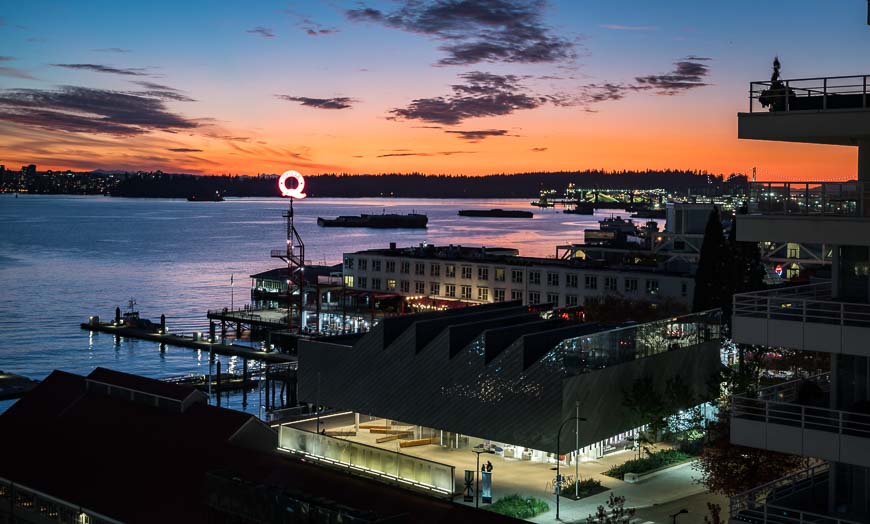
Sunset over Stanley Park

Sunset over Stanley Park – again from our hotel room at the Pinnacle Hotel at the Pier

If you want a pretty sunrise and a coffee, head first for Caffè Artigiano in the Shipyards and then you are literally steps away from The Pier. It’s a perfect place to catch a sunrise.

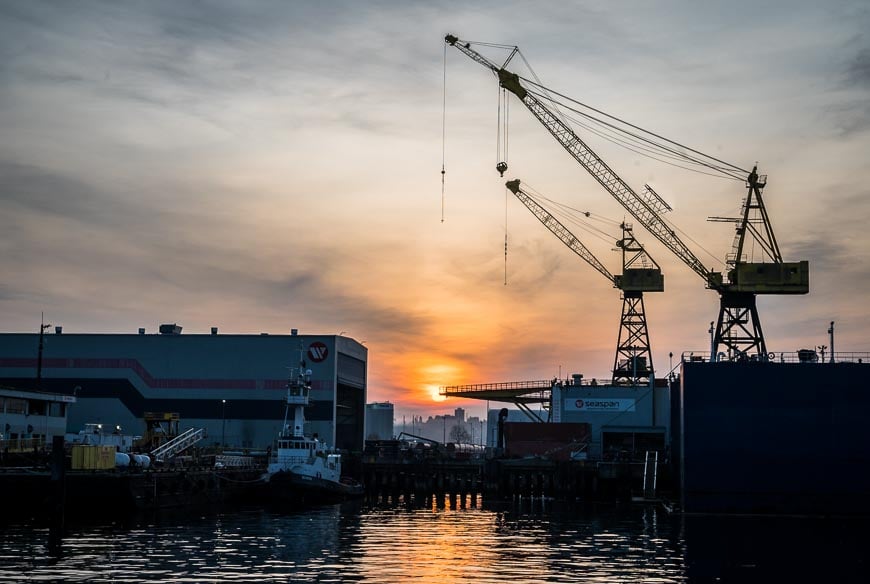
Sunrise over the shipyards

Sunrise over the shipyards

Nose about the Lonsdale Quay Market

Home to 80 locally owned businesses, the Lonsdale Quay Market sells everything from fresh produce to fish, meat, BC wines, kid’s toys and designer made clothes. You can also grab and go – picking up fresh pastries and a coffee or even a full meal.

Listen to the busker before you shop at Lonsdale Quay

Listen to the busker before you shop at Lonsdale Quay

Enjoy the café and restaurant scene at The Shipyards

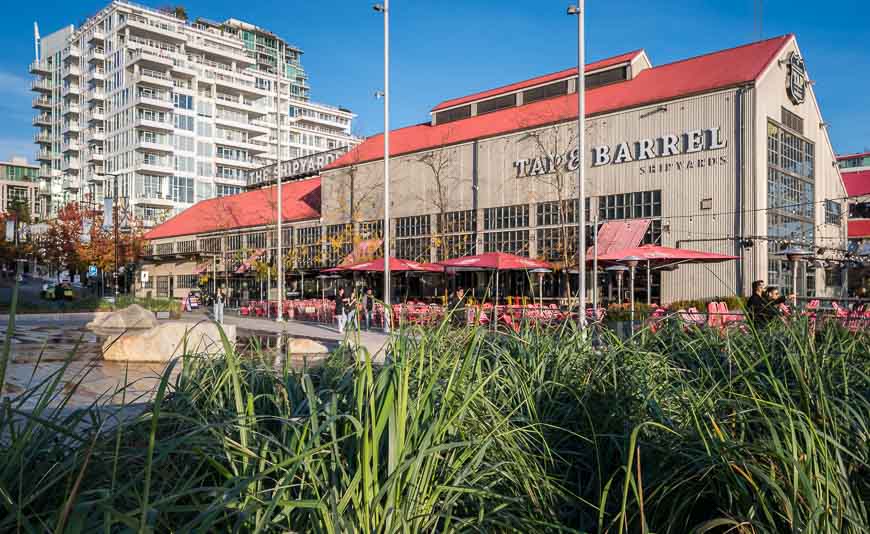
There are lots of places to eat and drink at the Shipyards. Be sure to check out Tap & Barrel – either outside on their seasonal patio with superb views of the Burrard Inlet or in their large dining room. Friendly service along with lots of easy to love meals served up with 36 BC craft beer taps and 16 BC wine taps ensure a memorable outing.

Other places of note include Jamjar Canteen for Lebanese food, Larry’s Market for takeaway food, Lift Breakfast Bakery for fresh pastries through to dinner options and Gusto di Quattro Restaurant for excellent Italian food. The Seaside Hotel and Pinnacle Hotel both have onsite restaurants.

The Tap & Barrel is a popular spot

The Tap & Barrel is a popular spot at The Shipyards

Ice skating or roller blading rink depending on the season

From Artigiano Cafe watch rollerbladers for three seasons – and ice skaters during the winter

Go hiking in North Vancouver

North Vancouver is literally criss-crossed with hiking trails. I recommend snapping a photo of the trail at the start of your hike so you have something to refer to. Some of the trails get remote in a hurry or take you into tough terrain. Always go prepared with the 10 hiking essentials.

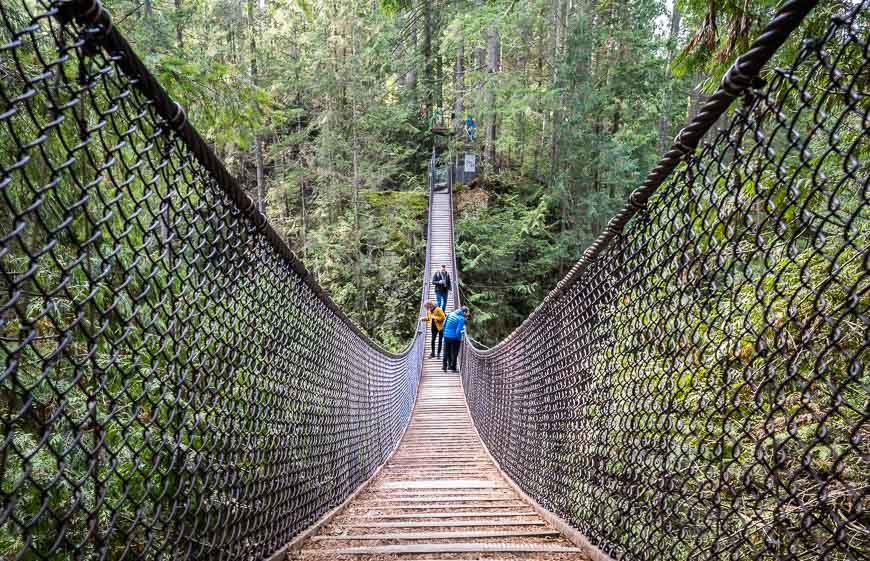
There’s a lot of hiking to be done in Lynn Canyon Park with the hike that includes the Lynn Canyon Suspension bridge one of the most popular. The bridge stretches across a pretty canyon – 50 metres above a river that boasts waterfalls and deep pools. It’s free of charge to walk this suspension bridge.

From the suspension bridge you can access loads of trails in Lynn Canyon Park including 30 Foot Pool – a popular swimming hole in summer and Twin Falls. You can even access the trail to Rice Lake and the Seymour Demonstration Forest.

Other places to hike include Lynn Headwaters Regional Park located at the north end of Lynn Valley Road. In this park I’d personally recommend Lynn Peak, the hike to Norvan Falls and the fabulous hike to Coliseum Mountain if you’re up for a long day.

I have yet to explore the myriad of trails that make up the Lower Seymour Conservation Area or the new Seymour River Suspension Bridge. I understand the climb Quarry Rock near Deep Cove is a good one for the views. And while I have done sections of the 48 kilometre Baden Powell Trail that travels from Horseshoe Bay to Deep Cove, I haven’t done the whole thing. Put that on your must-hike list too.

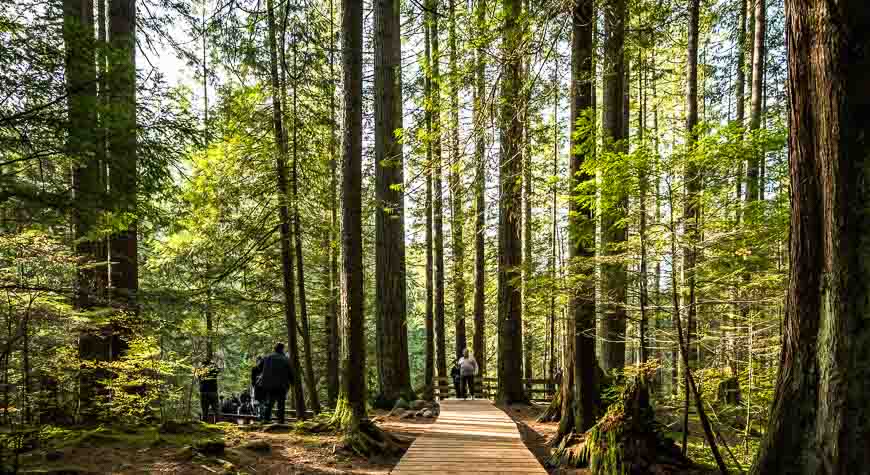
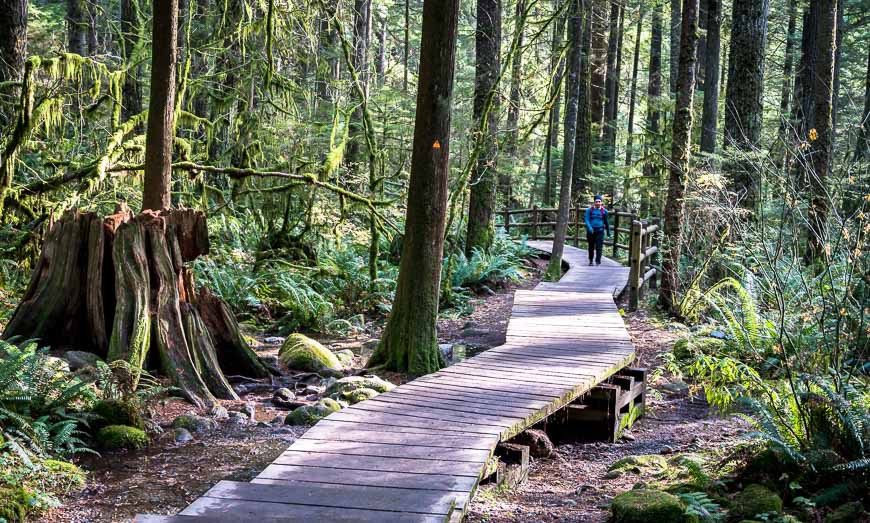
Lovely boardwalk hiking in Lynn Canyon - one of the top things to do in North Vancouver

Lovely boardwalk in Lynn Canyon

The suspension bridge in Lynn Canyon

The suspension bridge in Lynn Canyon

Beautiful hiking among tall trees in Lynn Canyon - one of the things to do in North Vancouver

Beautiful hiking among tall trees in Lynn Canyon

Climb the Grouse Grind – one of the hardest things to do in North Vancouver

I highly recommend climbing the Grouse Grind in North Vancouver for its workout qualities and the sense of accomplishment you get at the top – but not for its fun factor. I have probably climbed the Grind over a 100 times and I can’t think of one occasion where I didn’t wish I was on top – when I had just finished the only somewhat flat part of the hike at the bottom. 

If you’ve had a dearth of happy hormones pulsing through your body, do this steep 2.9 kilometre one way hike. It climbs 853 metres or 2,800 feet over that short distance. I measure the climb in my mind against every steep hike I do in the world and there are few like it.

But I and so many others go back time and time again – for the heart-pounding workout, the view from the top and the camaraderie on the trail. Did you know that over 100,000 people climb it a year? I’d suggest early in the morning or on a rainy day if you don’t want someone breathing hard behind you.

Most people ride the SkyTram down. You can buy one way tickets or a season’s pass if you’re likely to be doing it a lot.
The official course record set in 2010 by Sebastian Sales is 25:01. Mere mortals can take up to two hours to do it. The average is somewhere between 1 – 1.5 hours.

If you're going up you're on the Grouse Grind

If you’re going up you’re on the Grouse Grind

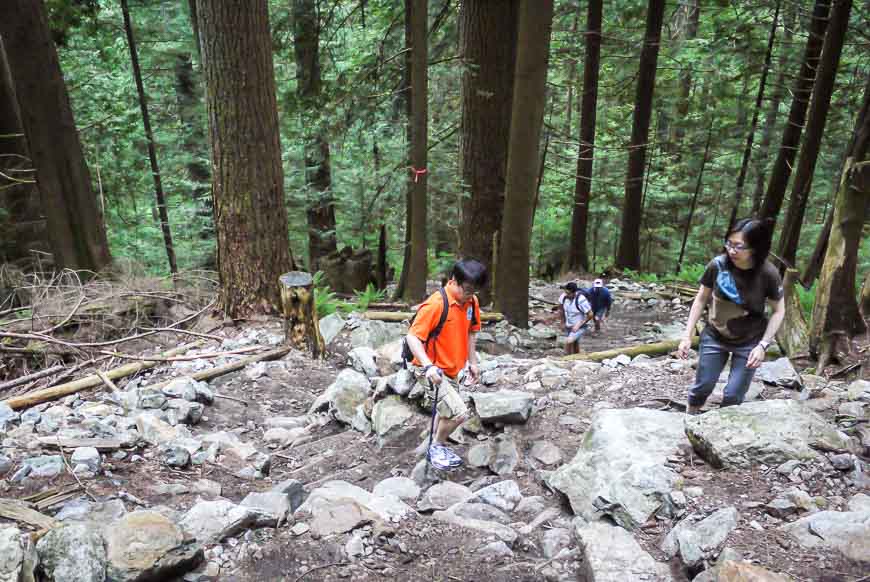
The Grouse grind is a massive stair stepper in the forest and one of the top things to do in North Vancouver

The Grouse grind is a massive stair stepper in the forest

Go for a bike ride

Mountain biking is world-renowned on Vancouver’s North Shore. While I love to mountain bike, I’m not much for the gnarly trails. But there is lots of other cycling available in North Vancouver.

One of my personal faves is the Demonstration Forest Road, part of the Lower Seymour Conservation Reserve. Enjoy a 24 kilometre return trip on a paved road with a fish hatchery at the end. It’s also perfect for families – or for people who want to go rollerblading or running.

You can rent an e-bike at Reckless Shipyards in the Shipyard District and head out for a bike ride along the Spirit Trail, a multi-use greenway that runs from Deep Cove to Horseshoe Bay in West Vancouver. In North Vancouver, the Spirit Trail is 6.5 kilometres long. You can see the map on the City of North Vancouver website.

Visit Grouse Mountain

While I’ve already suggested that you climb the Grouse Grind to the top of Grouse Mountain, I do appreciate that the majority of visitors scale the mountain via the SkyTram. At the top of Grouse Mountain you can enjoy Theatre in the Sky, Eye of the Wind, meals including a fine dining experience, a wildlife refuge, and a host of different outdoor activities depending on the season. 

I love snowshoeing from the top of Grouse Mountain out to Dam Mountain and Thunderbird Ridge. Downhill skiing and snowboarding is great fun as is the ice skating for families. There are ziplines, a sliding zone and a terrain park too. Pick your favourite thing to do and plan to spend the better part of the day at the top of North Vancouver. 

Where to stay in North Vancouver 

This post includes some affiliate links. If you make a qualifying purchase through one of these links, I may receive a small percentage of the sale at no extra cost to you. Thank you for your support.

You are so spoiled for choice in North Vancouver with a couple of top-notch hotels in the Shipyard District – both offering superb views.

I stayed in a lovely room with a balcony looking out to the water at The Pinnacle Hotel at the Pier. One of the recent additions that is sure to become a favourite is the Seaside Hotel North Vancouver.

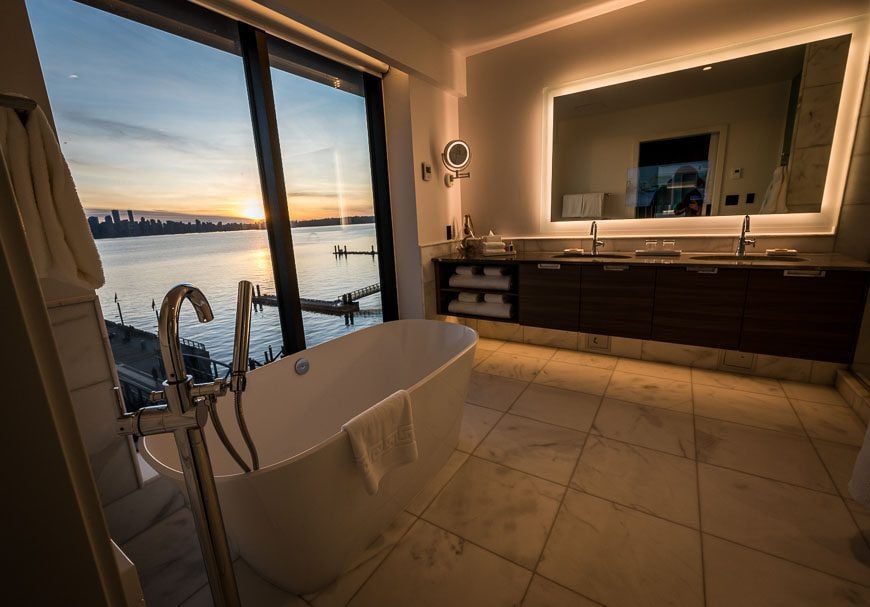
View from one of the bathrooms at the Seaside Hotel

View from one of the bathrooms in the suite at the Seaside Hotel

Further reading on things to do in the Greater Vancouver area

Thank you to Tourism Vancouver and Vancouver’s North Shore Tourism Association. They helped with organizing many of the activities I did on a recent fall weekend but all thoughts and opinions as always are my own.

Click on the photo to bookmark to your Pinterest boards.

12 great things to do in North Vancouver, BC


The post 12 Great Things to Do in North Vancouver, BC appeared first on Hike Bike Travel.

12 Great Things to Do in North Vancouver, BC Read More »

Europe Diagonal: Ireland Beara Way

Dursey head

My trip started on July 3rd with several logistical complications. In Ireland I was following the European long-distance trail E8 which starts on Dursey Island in the Southwestern part of the country. But unfortunately, there is no public transportation going there! Getting there took me several days … I flew into tiny Kerry airport with a direct flight from Berlin. Despite several low cost flights going there shuttle services to and from the airport are almost non-existent. I had pre-booked a taxi into nearby Killarney and was shocked to realize that I could hardly understand the taxi driver! Irish people do not speak the kind of English I was taught at school … Killarney turned out to be a big tourist trap. Every other house was a B&B or restaurant. Luckily there were several outdoor stores, too where I could be a gas canister before embarking onto a bizarre bus ride to Castletownberee, the closest town to Dursey Island.
Inside the cable car

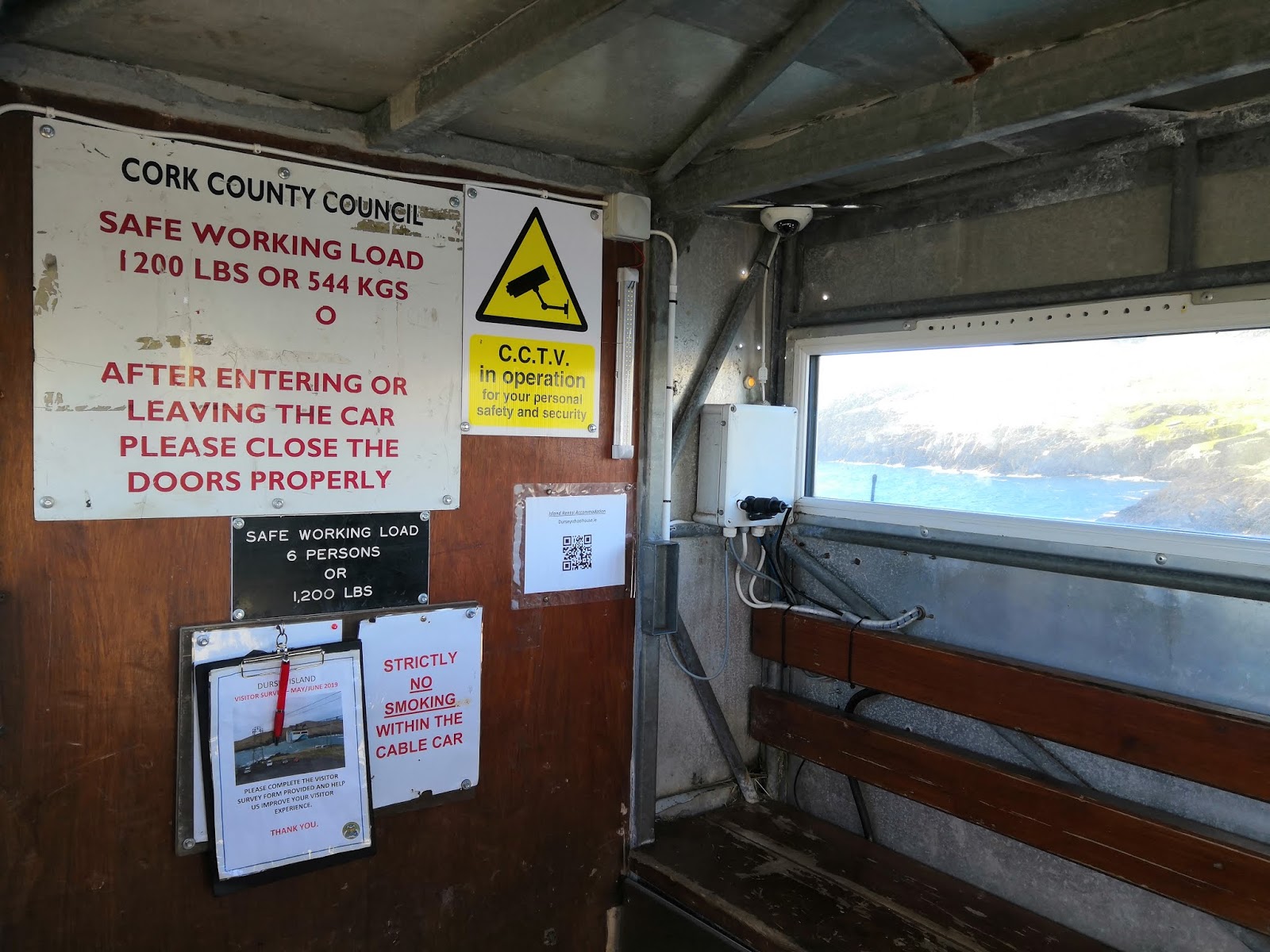
I had brought such a bad cough from Germany that the bus driver asked me if everything was ok with me … I was more worried about the narrow and winding road that led to several emergency brakings. I was very happy to get off the bus and start hiking 20 km to Dursey Island! The real adventure was still to come because the island is connected with the mainland with Ireland’s only cable-car, a construction that was built in 1969 and has a capacity of 6 passengers, 6 sheep or one cow. Cattle has priority over foot passengers … The gondola is just fixed to one steel cable and crosses 350 meters over open sea. To calm down the passengers there is a bottle with Holy Water, a psalm and an intercom.

Once on the island I hurried to Dursey Head and the official start of my hike. I had even brought a
GoPro camera to record this moment. But when I tried to get it working the SD card was broken. I cursed modern technology and took some crappy pictures with my smartphone. Then I had to run back immediately to get the last ferry back. And this is when I first met Andrea and Mike who were also hiking across Ireland and had come by taxi .. We exchanged phone numbers and I hurried on. Being the only passenger in the tiny cabin was a bit scary. I had just caught the last ride. After all this rushing around I was rewarded with a wonderful sunset and a fabulous view over the sea from my campsite – although I was covered in fog the next morning in this exposed place.

I was now hiking the Beara Way, in hindsight the nicest part of my hike through Ireland. The sea was almost always in view but I was constantly crossing fences on stiles and had to worry about cows in fields though no bull attack happened. Still, I was a bit worried about getting bothered by aggressive or just curious cattle that I ended up camping in the ditch between two meadows one night – protected from visitors by barbed wire fences on both sides. Not the most comfortable campsite and I only chose it because the forecast had predicted a dry night – elsewise I would have been flooded! Next morning I rewarded myself with a hearty breakfast on a Lidl parking lot.

Butter shelf in an Irish Lidl – a lot of variety!

After only four days of hiking I took my first zero day in Cork. Not that I needed a zero day that early in my hike but my birthday was coming up and I wanted to celebrate it showered with clean clothes in a soft bed. Therefore I had booked myself into an AirB&B whose owner was a former bank executive and excelled in AirB&B as a second career now. She loved cleaning as I could see in the sparkling clean house where I was served wine and cake as a birthday gift. Cork itself was a bit disappointing but I loved the Butter Museum where I learnt everything about Ireland’s famous export product (besides whiskey). I think they put double the amount of butter in Lidl chocolate croissants in Ireland than in Germany. I became addicted to Irish pastry!

Europe Diagonal: Ireland Beara Way Read More »