 Origin stories are always interesting. Whether the first life on earth, or the beginnings of a Super Hero, the origin story starts the character arc. In the case of a knife, for some, the origin story can be as important as the actual blade. The Bowie Knife, for instance, or the Puukko. Some like the Fairbairn-Sykes might not carry household name recognition, but anyone in the knife-know would quickly say, “Oh yes, I know that knife.”
By Doc Montana, contributing author to Survival Cache and SHTFblog
There’s another knife popularly known as the “Tracker.” It’s a unique shape, or rather combination of shapes that are baked into a single blade design. While the knife has a documented history that dates back to the 1980s, the uniqueness of the overall knife silhouette really hit the big screen, the actual real big screen in the 2003 movie “The Hunted” starring Tommy Lee Jones and Benicio del Toro. Although the knife in the movie was promoted as a combat blade, the actual Tracker was a dedicated survival knife.
 Through documentation and primary sources, the initial design of what will become the famous Tracker Knife, or more specifically, the Tom Brown Tracker, had its roots with Robb Russon whose son Mark runs Utah Knife Works and produces a Tracker variation named the Survivor. The story about Russon and Brown would make a fine Hollywood movie on its own.
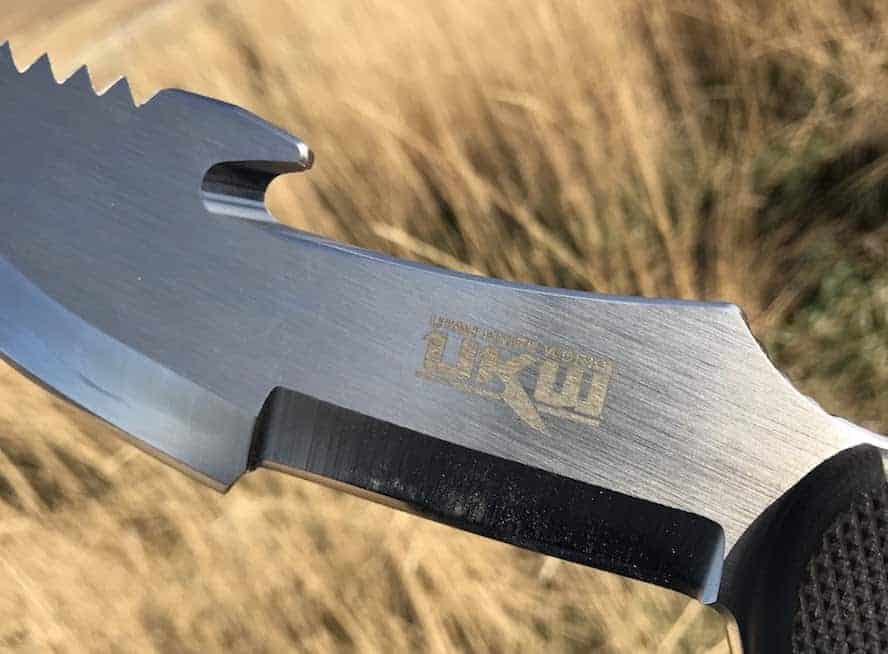
By any measure, the Survivor Knife is a beefy blade. Built of 9CR18MoV stainless steel, and almost a quarter-inch thick, the starting slab of steel of the Survivor is plenty for anything hand-operated. Six main features of the Survivor knife jump out on first view. Forward of the handle is a flat knife blade followed by a strong curved front end, The point of the spine has aggressive and offset saw teeth, and behind that is a cutting hook that doubles as both a seatbelt cutter and sharp gut hook. Rounding out the features is a distinct flat hammer face protruding from the back end of the handle.
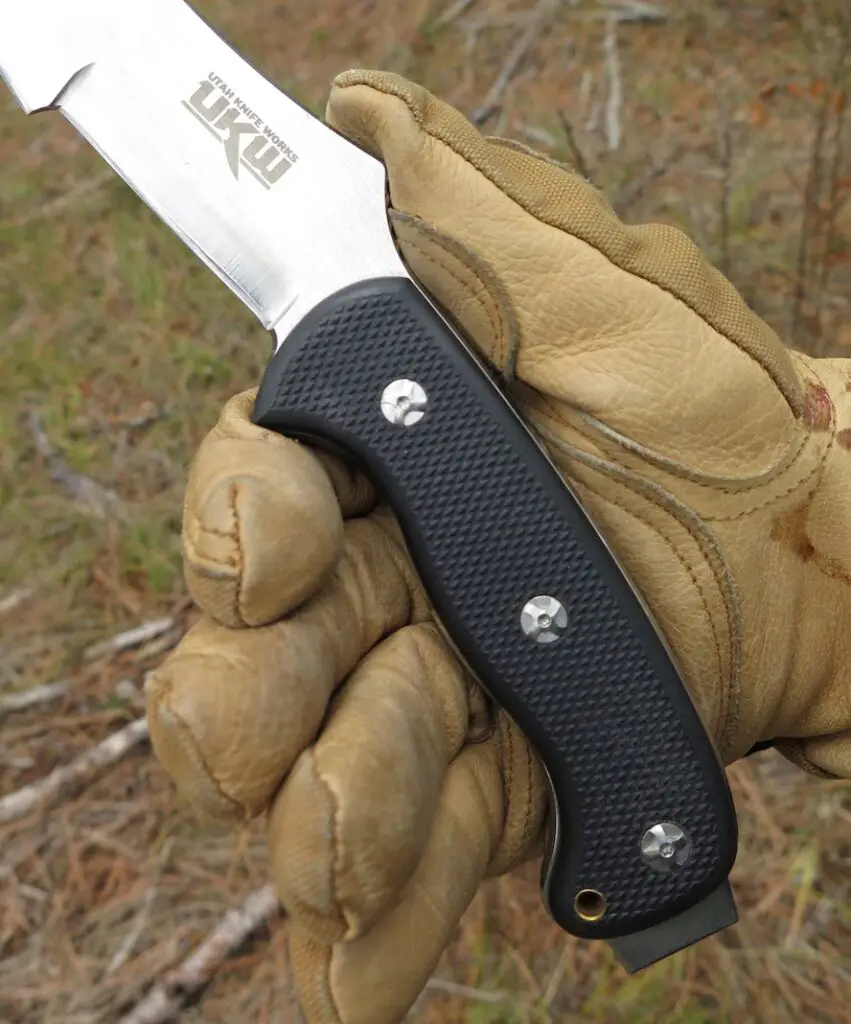
 The famous profile of the knife shape is mainly the transition from a somewhat inset flat blade to a seperate curved blade profile with saw teeth of some sort gracing the front end. In the case of this Survivor Knife, the presentation is about a foot long, and in a bright stainless with black glass-reinforced canoe-shaped nylon scales each fixed in place with three bolts.
Also Read: Survival Gear Review – Fallkniven A1Pro
 Other versions of the Tracker knife use high carbon steel, powder coated blades, and various scale choices. There are even larger and smaller versions being sold. What they all have in common besides an ancestor from Utah is an obvious shape; the shape of the Tracker.
In the field, the Utah Knife Works Survivor Knife produces results. The first thing you would notice when hefting this blade is the heft. It’s substantial at a full pound. The six-inch blade doesn’t get any thinner until the final half inch of tip. And care needs to be taken given the top of the blade also cuts both with saw and hook.
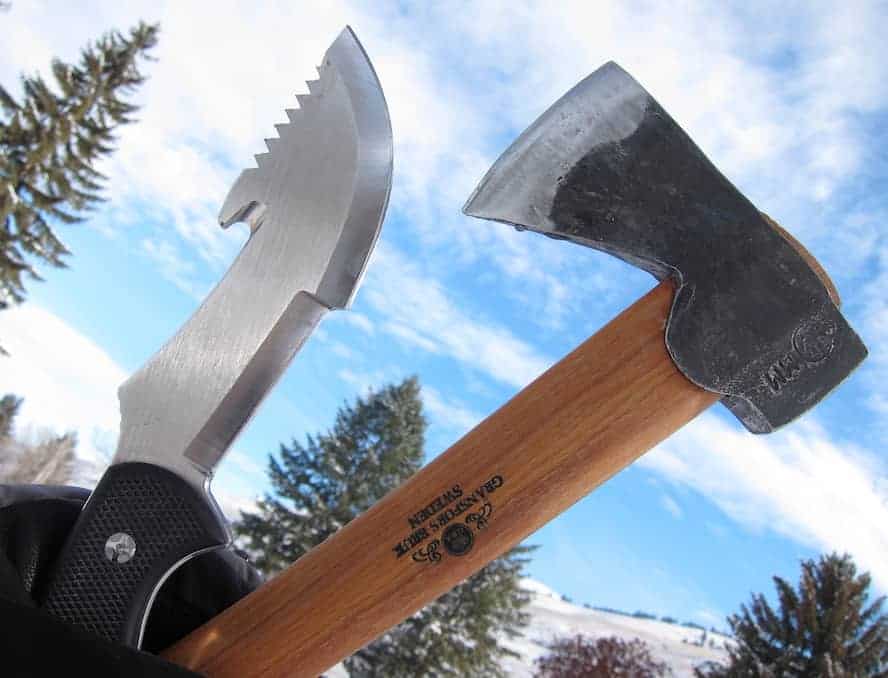 The initial two-and-a-half inches of straight blade just forward of the grip is steeper flat grind with its six covered by a solid thump ramp with melted jimping. The Survivor Knife’s flat blade works as draw knife and batoning face as well as a traditional cutting blade. And when batoning, care is needed because you don’t want to strike the saw teeth. Instead, you can go easy and aim just in front of the teeth where a small tip platform is open space, or you can strike to the rear of the gut hook on a sloping plain of steel directly above the straight blade. Of course you will quickly exceed the girth of the blade but at that point I’ve found I can often twist the knife handle counter-clockwise (right handed) further splitting the workpiece.
There’s a hard stop to the blade before it transitions into the frontend curved blade. There’s no drop on the point, and given the forthcoming safety hook as one follows the blade edge up and around, the tip of the Utah Knife Works Survivor is more of an upswept ending easily inline with the top of the grip or maybe a touch above it.
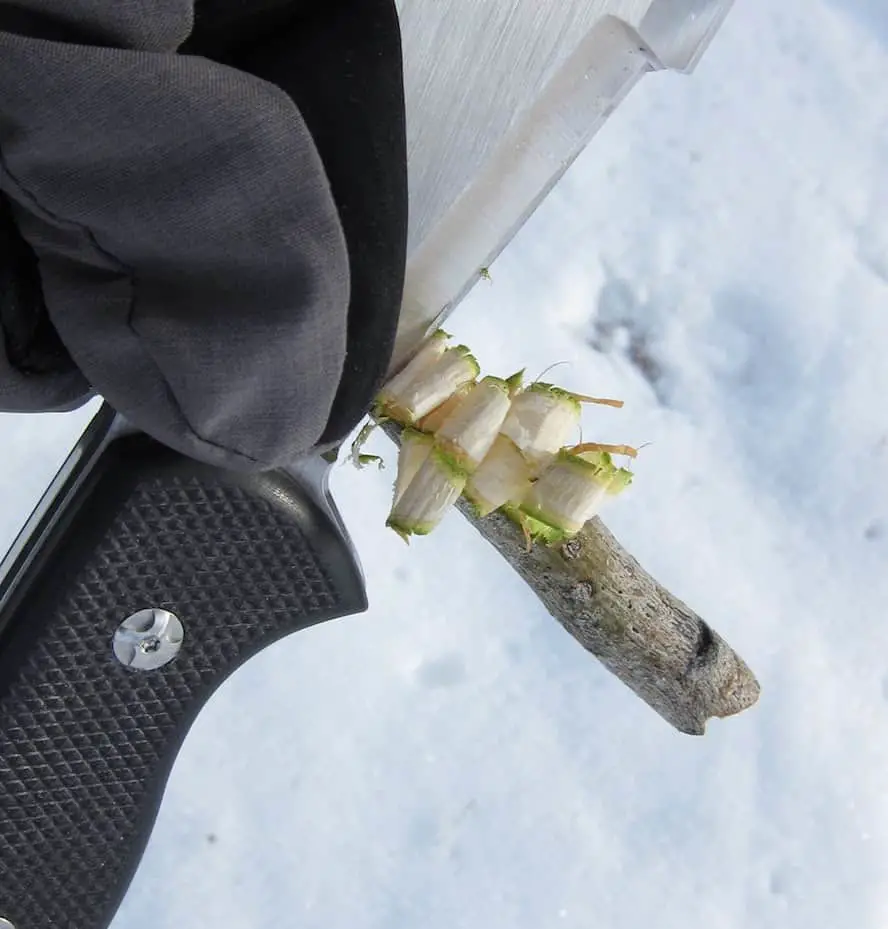 Cutting surfaces on the Utah Knife Works Survivor Knife do their job without complaint. When making feather sticks, the straight blade works wonders. And as a batoning section, it works well up to its full length. Given that it is a portion of the overall blade length, you can use it’s entire dimension to baton branches and section larger wood.
As a chopper, the Utah Knife Works Survivor Knife performs, but not at hatchet-level. The weight-forward blade has the mass and edge to hack wood, but being at the end of the blade, it also curves up rapidly leaving only an inch or two of chopping surface. Chopping with the straight portion of the blade sacrifices much of the moving mass.
 The cross-cut saw teeth address the first two inches back from the point, and they are aggressive. Making more of a grinder than a saw, the teeth are exceptional at carving notches, short-throw sawing, and producing more sparks off a fire rod than you can imagine. Trying to saw a branch with the teeth is questionable. The short throw of the saw means you have to use it more as an oscillating tool.
The cutting hook is the most factory-sharp surface on the knife. Second is the straight edge, and the third is the curved edge. The cutting hook can be used for domestic survival chores including cord and strap cutting along with linear slicing. On the homestead, the hook will quickly delimb small branches with efficiency, and provide a precision carving surface for making pointed sticks. As a gut hook it is more of a gut cutter that works great for initial skinning, and, well, gut cutting.
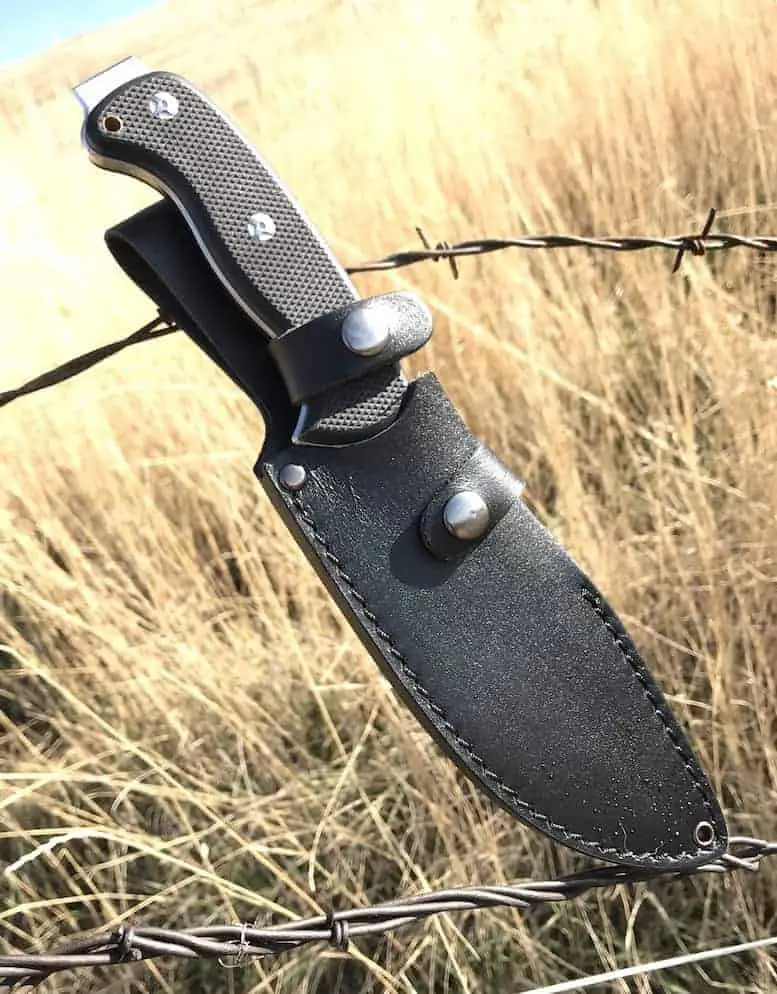 The black leather sheath is a single-stitched, two snap, belt loop design. The unique shape of the Utah Knife Works Survivor all but demands an unconventional sheath design. It works well. A nice touch in the future that would also accent the “Survivor” nature of this blade would be to sew a firesteel loop onto the sheath.
Another one of the appealing features of the Utah Knife Works Survivor Knife is its price. Retailing for $150, the knife is a strong contender for a bug out, planned or otherwise.
The post Survival Gear Review: Utah Knife Works Survivor appeared first on Survival Cache.