My trip started on July 3rd with several logistical complications. In Ireland I was following the European long-distance trail E8 which starts on Dursey Island in the Southwestern part of the country. But unfortunately, there is no public transportation going there! Getting there took me several days … I flew into tiny Kerry airport with a direct flight from Berlin. Despite several low cost flights going there shuttle services to and from the airport are almost non-existent. I had pre-booked a taxi into nearby Killarney and was shocked to realize that I could hardly understand the taxi driver! Irish people do not speak the kind of English I was taught at school … Killarney turned out to be a big tourist trap. Every other house was a B&B or restaurant. Luckily there were several outdoor stores, too where I could be a gas canister before embarking onto a bizarre bus ride to Castletownberee, the closest town to Dursey Island.
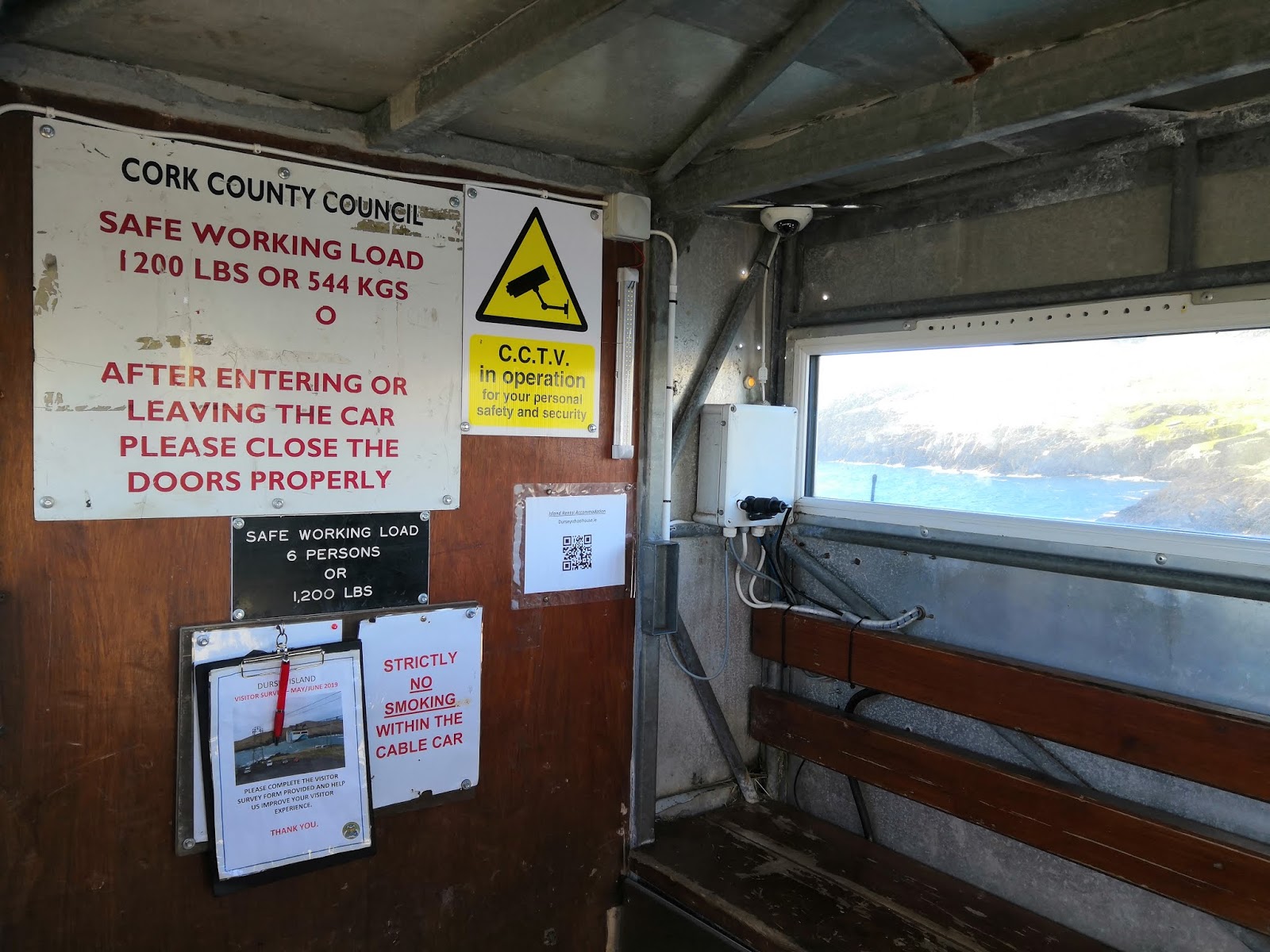
Inside the cable car
I had brought such a bad cough from Germany that the bus driver asked me if everything was ok with me … I was more worried about the narrow and winding road that led to several emergency brakings. I was very happy to get off the bus and start hiking 20 km to Dursey Island! The real adventure was still to come because the island is connected with the mainland with Ireland’s only cable-car, a construction that was built in 1969 and has a capacity of 6 passengers, 6 sheep or one cow. Cattle has priority over foot passengers … The gondola is just fixed to one steel cable and crosses 350 meters over open sea. To calm down the passengers there is a bottle with Holy Water, a psalm and an intercom.
Once on the island I hurried to Dursey Head and the official start of my hike. I had even brought a GoPro camera to record this moment. But when I tried to get it working the SD card was broken. I cursed modern technology and took some crappy pictures with my smartphone. Then I had to run back immediately to get the last ferry back. And this is when I first met Andrea and Mike who were also hiking across Ireland and had come by taxi .. We exchanged phone numbers and I hurried on. Being the only passenger in the tiny cabin was a bit scary. I had just caught the last ride. After all this rushing around I was rewarded with a wonderful sunset and a fabulous view over the sea from my campsite – although I was covered in fog the next morning in this exposed place.
I was now hiking the Beara Way, in hindsight the nicest part of my hike through Ireland. The sea was almost always in view but I was constantly crossing fences on stiles and had to worry about cows in fields though no bull attack happened. Still, I was a bit worried about getting bothered by aggressive or just curious cattle that I ended up camping in the ditch between two meadows one night – protected from visitors by barbed wire fences on both sides. Not the most comfortable campsite and I only chose it because the forecast had predicted a dry night – elsewise I would have been flooded! Next morning I rewarded myself with a hearty breakfast on a Lidl parking lot.
Butter shelf in an Irish Lidl – a lot of variety!
After only four days of hiking I took my first zero day in Cork. Not that I needed a zero day that early in my hike but my birthday was coming up and I wanted to celebrate it showered with clean clothes in a soft bed. Therefore I had booked myself into an AirB&B whose owner was a former bank executive and excelled in AirB&B as a second career now. She loved cleaning as I could see in the sparkling clean house where I was served wine and cake as a birthday gift. Cork itself was a bit disappointing but I loved the Butter Museum where I learnt everything about Ireland’s famous export product (besides whiskey). I think they put double the amount of butter in Lidl chocolate croissants in Ireland than in Germany. I became addicted to Irish pastry!
Wooden furniture provides warmth, finesses, richness, and comfort to every corner of your home. Bed frames, cupboards, shelves, tables, and chairs are all the essential benefits of wood furniture that one cannot overstate. However,...
In March 2018, I was playing volleyball and broken my 5th metatarsal, a small, weight-bearing bone in my foot. When I went into for an X-ray, the doctor told me that it was the most frequestly broken bone in the foot and that “95% of people heal up just fine in about 3 months.” I felt pretty good knowing that I just had to reduce my use of the foot, go to PT, and wait.
Three weeks later I returned to his office for another X-ray of the broken bone. My doctor looked at it for a bit, turned to me, and said, “No worries. 85% of people heal up just fine in about 3 months.”
85%? I thought it was 95% three weeks ago?
It turns out, I’m in that top 5% of people. Yay me.
Present Day
Months went by and the X-rays continued to show no healing of the bones so we scheduled surgery to put a small screw into my foot. And YES, like a true geek, I asked for the screw to be made out of Vibranium or Unobtainium so that I could get some super powers. Unfortunately, the doctor had not heard of either of these metals (sorry Marvel Universe).
I’ve used forearm crutches for years and know their pros (easy and quick) and cons (hurts arms/hands, can’t carry anything, and is exhausting). When I first broke my foot, I borrowed a knee scooter from a friend. While it worked, my thighs and back hurt from using it, I couldn’t carry anything, and I almost face-planted after taking corners too quickly several times.
The iWALK 2.0 is a knee crutch (shown below). It straps onto your leg and allows you to move around like you are on a “pirate peg leg”. I bought one and, within 5 minutes (I was a natural!), I was walking around on it.
I cruised around the office with it on but…but…it was missing something….BLING!
The Bling
The truth is that I knew I was going to be in this iWALK during the BSidesLV, BlackHat, and Defcon cyber security conferences and that I’d be around a large number of, well, geeks like me. So I wanted something technical to point at.
Some lights.
Some…sounds.
Something. Anything!
Adafruit.com is my preferred site for “electronic bling”! I have come to love their products and the helpful tutorials they have to get me started.
I wanted to add lights and other things to the iWALK but didn’t want to go full Raspberry Pi on it. I was not thrilled coding up an Arduino for the task either so I scoured the Adafruit web page hoping for inspiration. It did not disappoint.
Oh, I was in heaven. Did you see the 10 NeoPixels that are built-in to the device? Sound and light sensors. Accelerometer! Speaker! All for $25?
I was happy and resigned myself to learning the Arduino code necessary for this device…but wait. The Circuit Playground CAN be programmed using Arduino code. But it also can be programmed using CircuitPython and via a web page (https://makecode.adafruit.com/). Hmmm…. via a web page. Let’s look into this more.
See, I love Python as much as the next person, but in my creations, I love being able to explain to “normals” (non-geek people like my family and people I meet outside of work and cons) how things work. So not having to show them IDEs or Vim and long lines of text code is helpful to backing up my claim that “anyone can do this”.
The “Programming” Web Site
Let me show you how absolutely easy Adafruit has made programming these Circuit Playgrounds. In a separate tab or browser window, go to https://makecode.adafruit.com/.
Press the “New Project” button (shown below).
Now you are at the simulator screen. You don’t even need to buy a Circuit Playground Express to play around with it!
Arrow 1 below shows the simulated device that you can press the buttons on, watch the LEDs light, and listen to.
Arrow 2 shows how you drag a puzzle piece from the palette over to arrow 3 in the code area. Adafruit has a huge number of blocks that can be used. If you (or your kids) have ever used MIT’s Scratch (https://scratch.mit.edu/), then you will be right at home dragging puzzle pieces from the left to the right and putting them in loops and button press objects.
If that isn’t enough for you, you can customize what your code does using Javascript. Arrow 4 translates the blocks to Javascript code (and translates Javascript to Block code).
Oh this was not only going to be fun but easy too!!!!!! Every time I made a change to the web page code by dragging objects into the loops on the right, the simulator on the left reset and I could run the code in the virtual environment.
The Circuit Playground Express was nice as the heart/brains of my creation, but I needed other things.I wanted to be proud of this creation. I wanted LOTS of lights, sounds, WiFi, and so much more!
3D printer for the case (although later I found out that Icebreaker Mints cases are the perfect size for this!)
USB phone chargers – 4, 2600mAh (I wanted them to be able to be cycled in and then recharged)
The Plan
I figured I’d:
Mount the NeoPixel Jewel in the middle of the front of the brace.
Cut the 1m of NeoPixel strips into 2, .5m strips and run them along either side of the front of the brace.
Mount the USB power supply on top with the switch facing up so I could power on and off easily.
Mount the ESP8266 next to the USB power supply as there was nothing to really do to that aside from turn it on.
Mount the Circuit Playground Express in the 3D printed case I modified from https://www.thingiverse.com/thing:2585702. I used the tinkercad.com web site to add some holes to the walls of the case to allow for wires to pass through.
The M3 screws, bolts, and stuff were to secure the wires from the various NeoPixels up to the Circuit Playground Express.
Create a program where I could control the different light sequences and such from the buttons on the Circuit Playground Express.
The Outcome
I had so much fun playing around with this over weeks. I still tinker with pieces of it or the code. Here’s a short video with some of the features displayed.
What else does it do?
There is a sound meter that listens on the Circuit Playground Express and then graphs the sound levels down the NeoPixel strips on the legs (louder sounds go closer to the ground).
It makes the Mario Bros “cha-ching” sound that Mario makes when he collects a coin when I step (generate a G-force > 1G).
The ESP8266’s sole purpose is to broadcast a WiFi access point with a specific name. Not going to tell you what it is. Hopefully, people at the cons I’m going to will see it and come find me.
I have it configured so that the last 10 lights on each NeoPixel strip light up white to act as a headlight so I can see where I’m walking at night or in clubs.
The code for this got quite complicated but I stuck true to my “I wanna do it all in the makecode website”. Below is a picture of the code and a link to it (https://makecode.com/_by6Prk8ptioK). As I mentioned, this is a work in progress, and I’m constantly tweaking the codes. That link and the pic below are for a static set of the code.
Pictures of the project pieces are below.
The Conclusion
I’m looking forward to showing these technologies off to people over the coming 8 weeks of use. Hoping I’ve maybe inspired you to go grab a Circuit Playground Express or write some MakeCode. Let me know!
Instead of driving to the attractions on the South Rim, here’s a great easy hike that you can do instead. You’ll follow the paved Rim Trail away from the crowds at the Visitor’s Center to take in Mather Point, the Geology Museum, the Trail of Time, Verkamp’s, Hopi House, and all the Bright Angel attractions. In between the sights, the Rim Trail meanders along the South Rim, with dozens of unique vistas and viewpoints where you can take in the majesty of the Canyon. At the end of the hike, you hop on a free shuttle bus back to your car at the Visitor’s Center.
Mice are disturbing critters that ever living in your house. Mice can bring many problems in your house. Mice can chew all subtle items like electric cable, food, and even wood that will cause...
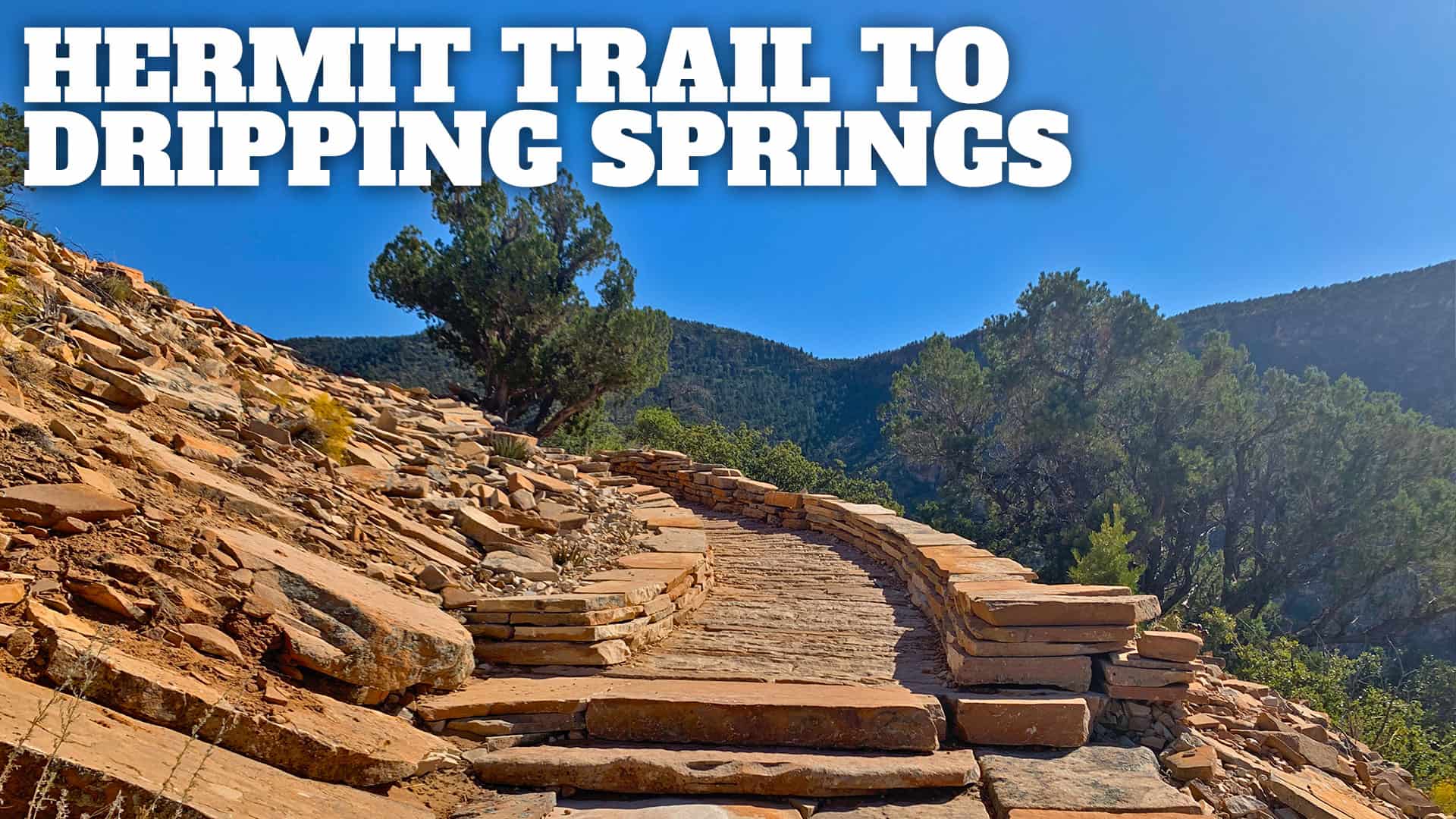
Located far away from the South Rim crowds, this hike on the Hermit Trail to Dripping Springs is one of the great Grand Canyon hiking adventures. The Hermit Trail is an engineering marvel, once paved with sandstone slabs when it was built in 1911 for tourists. At the end of the hike you reach a unique hanging garden spring, tucked into a remote corner of the Canyon. It’s not a very long hike but it’s challenging, with steep climbs and narrow sections.
Following their outstanding success in the 2018 RoSPA Health and Safety Awards (a Gold Achievement, Best New Entry and a Guardian Angel Award), the #1 global beauty company L’Oréal Group took the 2019 Awards by storm.
As well as creating with RoSPA, the popular Safe@Work-Safe@Home Award which is open to all Gold Award winners, L’Oréal also achieved 2 Gold, 2 Silver and a Bronze award as well as the Best New Entry – International trophy.
L’Oréal’s strategy is to encourage individual sites or regions/countries to apply for the RoSPA awards and then cascade the impact and pride of being recognised for their local systems and performance.
Following the success of L’Oréal sites across the Americas (or L’Oréal Americas) in 2019, we discussed with Dr Jay Harf, Vice President of Environment, Health, Safety & Sustainability, Zone Americas, the reasoning as to why they choose the RoSPA Awards programme.
Why did you enter the awards and why is achieving a RoSPA Award important for your organisation?
Consumers’ expectations are higher than ever and are increasingly supporting companies that look after people as well as the planet. To be an employer of choice, it is important to care for your employees and their health and safety. It is important that our efforts and performance be validated by others and it’s not just patting ourselves on the back. RoSPA recognition provides our employees with a sense of pride, knowing our policies and initiatives are perceived as world class.
Participating in the RoSPA Health and Safety Awards and being recognized reaffirms that we are on the right path in protecting our people but it also benchmarks us against other companies. It is vital in today’s society to be able to demonstrate to our employees and customers that the health and safety of our employees and visitors is a real core value. The RoSPA Awards and recognition that comes with it allows us to do that.
What do you think entrants could do over the year to keep drafting an awards submission simple?
The best advice that I can give is to be continually collecting relevant evidence that can be included in your RoSPA Health & Safety Award application. In doing so, you can ensure that you are keeping your submission current, and building off your baseline. This will mean that what you submit in year 1 you can build on in year 2, 3 and 4. Demonstrating day-to-day, month-to-month safety operations are important, so take notes and collect this evidence throughout the year.
I would also like to add that the careful selection of the proof provided is vital. Take the time to select the proof that supports the text you have written and please do not give more than eight pieces of proof…. the 9th and beyond will not be considered!
Have you used the reflective practice involved in drafting a submission for Career and Professional Development (CPD) purposes?
The RoSPA Awards application process is a great tool for CPD because it forces our team to step out of their routine and think clearly about where we are at in our journey towards zero accidents and even further by creating a positive safety culture. This reflective practice helps us improve processes, generate ideas and move forward. Being able to benchmark our progress through the peer-to-peer view is invaluable.
Which innovative approaches, risk assessment practices and/or control measures to manage health and safety are you particularly proud of?
Over the last few years, we have streamlined many of our processes at L’Oréal in the Americas in order to be more sustainable and digitally-minded when it comes to health and safety reporting. A key component of this is that we have moved a lot of monitoring over to apps that can capture data in real time. This allows us to make faster and more informed decisions on safety and focus on what matters and that is on the ground safety and talking to employees about their safety and their concerns.
Recently, we launched the Corporate Safe@Work-Safe@Home and LIFE programmes which we helped to develop. The former promotes spreading our culture outside of L’Oréal and we have seen our employees working in the community to promote safety more widely. In the USA, we are particularly proud of our schools’ program that has successfully passed on lessons relating to all aspects of safety (fire, road, home…). At the fire (fire safety) sessions, we have seen employees teach kids, in a fun way, how to plan an evacuation of a building and use a fire extinguisher – vital training which may very well save lives.
How has working with RoSPA, inspired you and your sites/regions to continually improve health and safety management?
Attending the RoSPA Awards ceremony in Glasgow this year was a revelation and gave my team and I a fantastic opportunity to network and learn from other health and safety professionals from a diverse range of companies. We came back from Glasgow with ideas for improvement as well as a hunger to do even better in 2020.
I am personally convinced that any organisation that wants to get the reassurance of where they are in their health and safety journey and what are the next steps of improvement should participate in the RoSPA Awards. Each year, if companies take on board the feedback on their application I am convinced that everyone will make progress and that this progress will be recognised. That has to be good for the company as well as for all the employees, contractors and visitors.
I walked out of the door at the end of a great evening and I made a single promise: we will be back! See you next year in Birmingham for the 2020 Awards.
Click here to find out more about the Safe@Work – Safe@Home Award, sponsored by L’Oréal. To read more from our RoSPA Awards ‘Meet the Winners’ series, click here.
In the event of a major collapse, there are a number of skills that most people will need to relearn in order to survive. #urbansurvivalsite #survivalskills #basicskills #shtf #collapse
The USDA Forest Service recently announced that 2019 was a historic year for America’s national forests and grasslands.
“In 2019, through Shared Stewardship agreements we forged new partnerships and built on existing ones to better collaborate and share decision space with states, partners and tribes,” said Forest Service Chief Vicki Christiansen. “We also opened hundreds of thousands of acres of national forests to visitor access and sold more timber in this year than we have in any of the past 21 years, providing a sustainable flow of forest products and supporting rural economies.”
Creating healthy, productive forests and supporting rural economies
The Forest Service surpassed expectations and sold nearly 3.3 billion board feet of timber in 2019—75 million board feet more than the 20-year high set in 2018. The agency also improved forest conditions and reduced wildfire risk on over 4 million acres through timber harvest, removing hazardous fuels like dead and downed trees, and combating disease, insect and invasive species infestations.
Timber harvest volume from projects under the Good Neighbor Authority, more than tripled in 2019 from 22 to 89 million board feet. This authority allows the Forest Service to enter into agreements with state forestry agencies to perform restoration work to improve health and productivity on national forests and grasslands. To date, projects under this authority have taken place in 38 states.
Sharing stewardship responsibilities and being better neighbors
So far, 12 states and the Western Governors Association have signed on to work alongside the Forest Service to set landscape-scale goals, as well as share resources and expertise. These Shared Stewardship agreements allow the Forest Service to better work with partners to address challenges such as wildfire, insect and disease infestations and improve forest and watershed conditions while adapting to user needs. Participating states include Arkansas, Colorado, Georgia, Idaho, Massachusetts, Montana, Nevada, New Mexico, North Carolina, Oregon, Utah, and Washington.
The Joint Chiefs’ Landscape Restoration Partnership, a combined effort of the Forest Service and the Natural Resources Conservation Service, treated 100,000 acres in 2019 to improve forest health where public and private lands meet and to protect nearby communities from wildfire.
The U.S. Endowment for Forestry and Communities, the National Forest Foundation and the Forest Service partnered to set up a $4 million grant program to improve watersheds and reduce wildfire risk.
The Forest Service launched a community-based prototype wildfire risk mapping tool in Washington State. This tool is the first of its kind and allows local, state and federal agencies to fight fire where it matters most and to build fire-adapted communities more strategically and collaboratively. A nationwide map based on the prototype will be available in 2020.
Increasing access and improving recreation experiences
More than 5.2 million hours of work were logged in 2019 as part of the 21st Century Conservation Service Corps, a private-public partnership that engages more than 25,000 returning veterans and young Americans each year to strengthen America’s infrastructure and boost local economies. Participants helped to plant trees, reduce wildfire risk and improve forest conditions through vegetation management and hazardous fuels reduction projects, valued at $128 million.
Nearly 560,000 acres of national forests and grasslands were opened for access in partnership with the National Wild Turkey Federation as part of their “Save the Habitat. Save the Hunt” initiative.
Access and recreation opportunities were improved through the National Forest and Grasslands Explorer and Digital pass applications. The Explorer app lets visitors know where to find points of interest on national forests and grasslands and how best to explore them. The Digital Pass app was developed in cooperation with Recreation.gov to make purchasing day passes easier by selling them online.
“2019 was a banner year for us,” added Chief Christiansen. “Next year, we will continue to build on these successes to improve conditions on America’s national forests and grasslands to ensure they are healthier, more resilient and more productive.” “We will keep building on the partnerships that make these successes possible and commit to increasing access to better connect people to their natural resources, so these national treasures endure for generations to come.”
For more information about the Forest Service visit www.fs.fed.us.


 Once on the island I hurried to Dursey Head and the official start of my hike. I had even brought a


 Gold Award winners, L’Oréal also achieved 2 Gold, 2 Silver and a Bronze award as well as the Best New Entry – International trophy.
 companies that look after people as well as the planet. To be an employer of choice, it is important to care for your employees and their health and safety. It is important that our efforts and performance be validated by others and it’s not just patting ourselves on the back. RoSPA recognition provides our employees with a sense of pride, knowing our policies and initiatives are perceived as world class.
 Recently, we launched the Corporate Safe@Work-Safe@Home and LIFE programmes which we helped to develop. The former promotes spreading our culture outside of L’Oréal and we have seen our employees working in the community to promote safety more widely. In the USA, we are particularly proud of our schools’ program that has successfully passed on lessons relating to all aspects of safety (fire, road, home…). At the fire (fire safety) sessions, we have seen employees teach kids, in a fun way, how to plan an evacuation of a building and use a fire extinguisher – vital training which may very well save lives.