October 1, 2025

Falke TK2 Wool Silk Trekking Socks Review

Falke TK2 Wool Silk Socks

Falke TK2 Wool Silk Socks

Socks are, without a doubt, one of the most important hiking items, and when we received activewear from German brand Falke for testing, I was delighted to see that they also included socks. Falke is known world-wide for their high-quality socks and thus I was super excited to test them on trails. I got the Falke TK2 Wool Silk socks which according to Falke provide medium cushioning. We received the package just before we headed to the Dolomites for our hiking holidays. In the Dolomites, I thoroughly tested the Falke TK2 Wool Silk socks on various hikes and alpine ascents, and below is what I learned about them.

The Falke TK2 Wool Silk socks are suitable for:

  • Hiking
  • Mountaineering
  • Backpacking
  • Trekking
  • Everyday use

Material

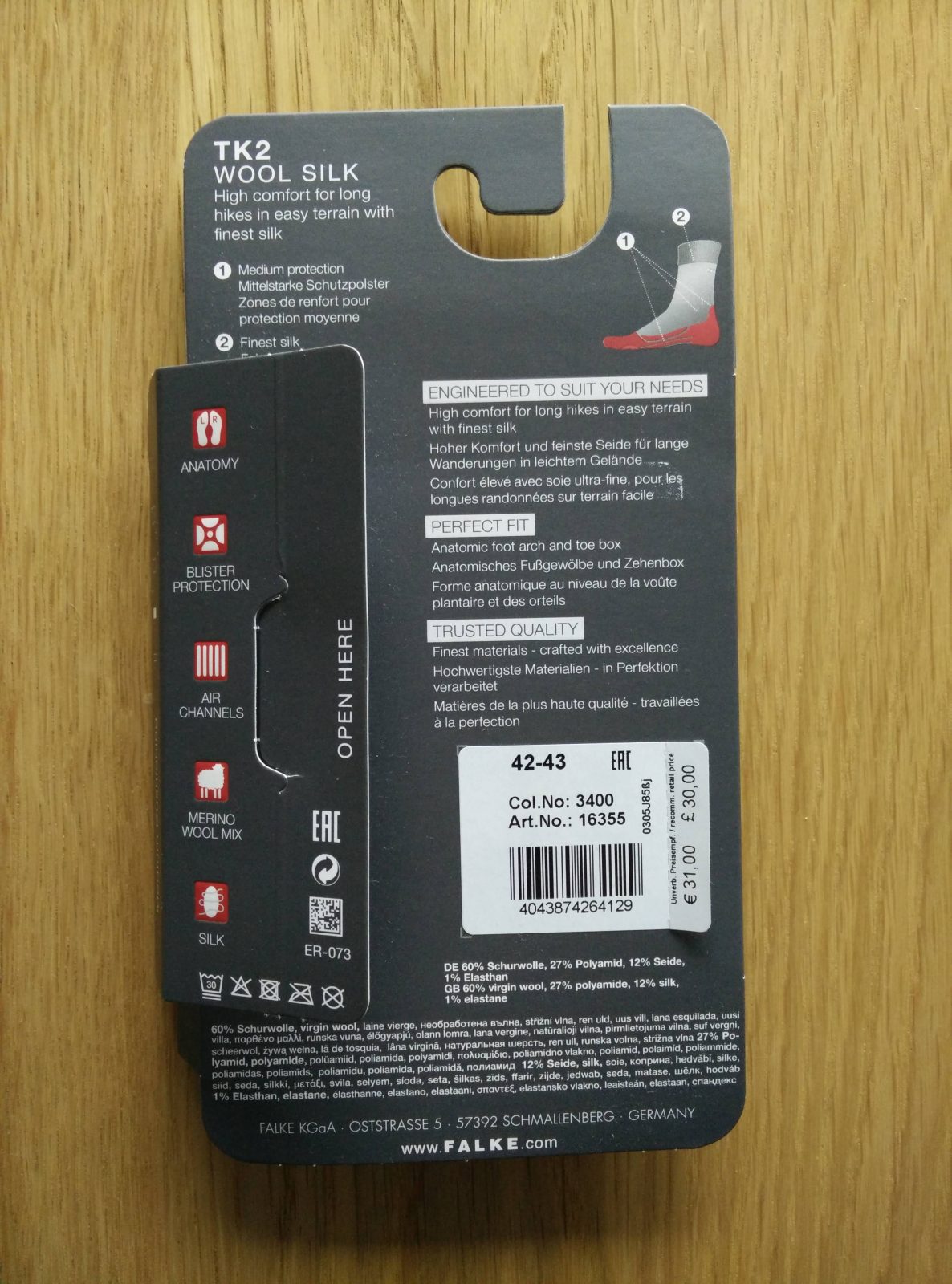
The Falke TK2 Wool Silk socks are as the name suggests made of wool and silk fibers. However, they also include nylon and elastane fibers which is a standard practice when it comes hiking socks. Nylon fibers make the socks more durable and the elastane fibers provide stretch and recovery performance. The Falke TK2 Wool Silk socks feature the following contents of fibers; 60% virgin wool, 27% nylon, 12% silk and 1% elastane.

When I put the socks on for the first time, I was really surprised how soft and comfortable they are. I have several pairs of Coolmax socks at home and I’ve always considered them as super comfy, but I must say that the Falke TK2 socks feel even better against the skin. So, why is it important that the material of hiking socks is soft? In my experience socks made of rougher materials often cause blisters, especially when you are hiking downhill. The rough fabric starts chafing the skin on your toes and consequently blisters can form. I think that socks in general play a big role in preventing blisters. You can read more abut this is in my blog post How to prevent blisters when hiking.

When I was testing the Falke TK2 Wool Silk socks on trails in the Dolomites I focused on breathability, drying time, odor resistance, durability and moisture-wicking properties. These are in my opinion the most important qualities when it comes to hiking socks besides the softness of the fabric.

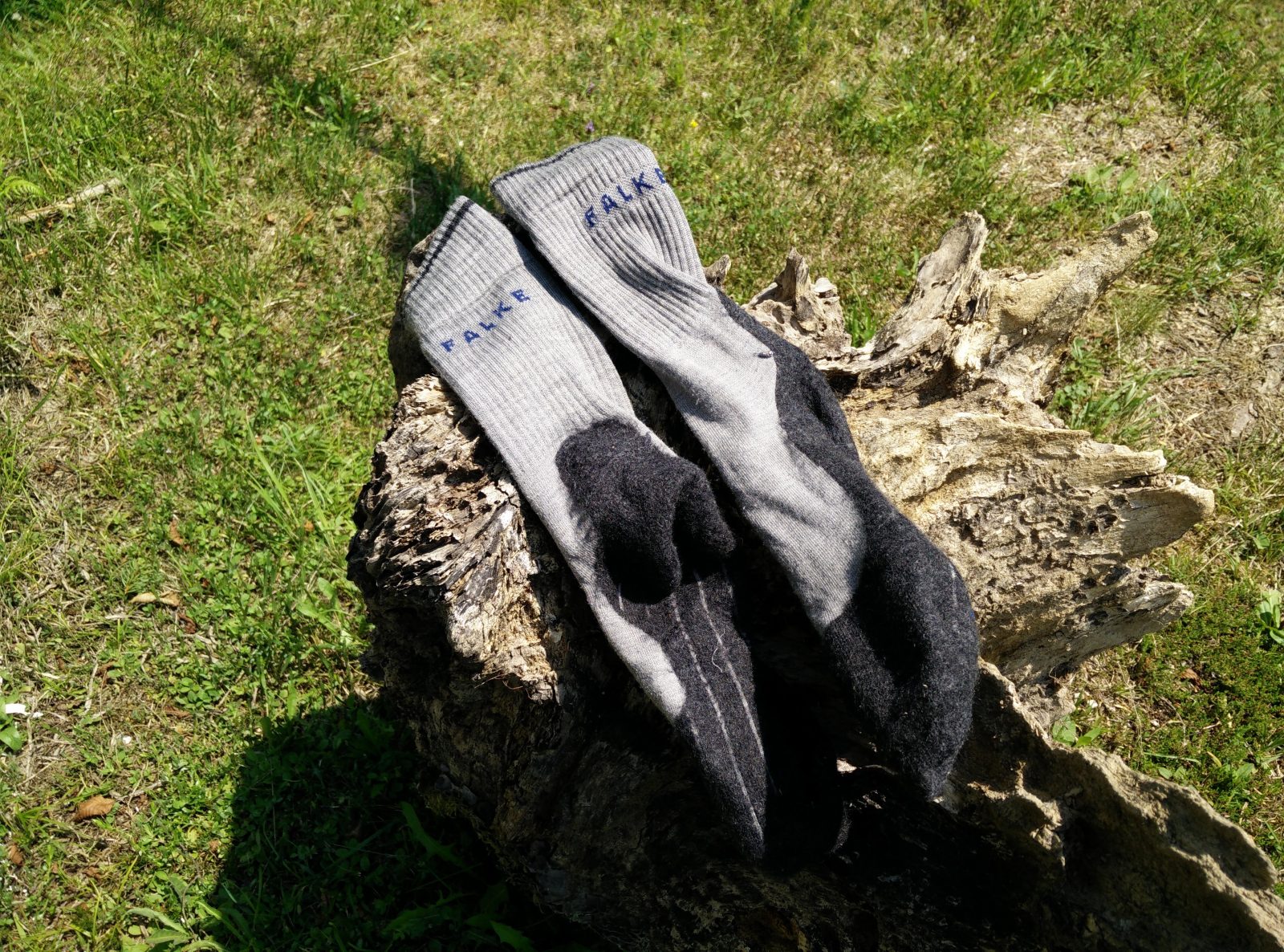
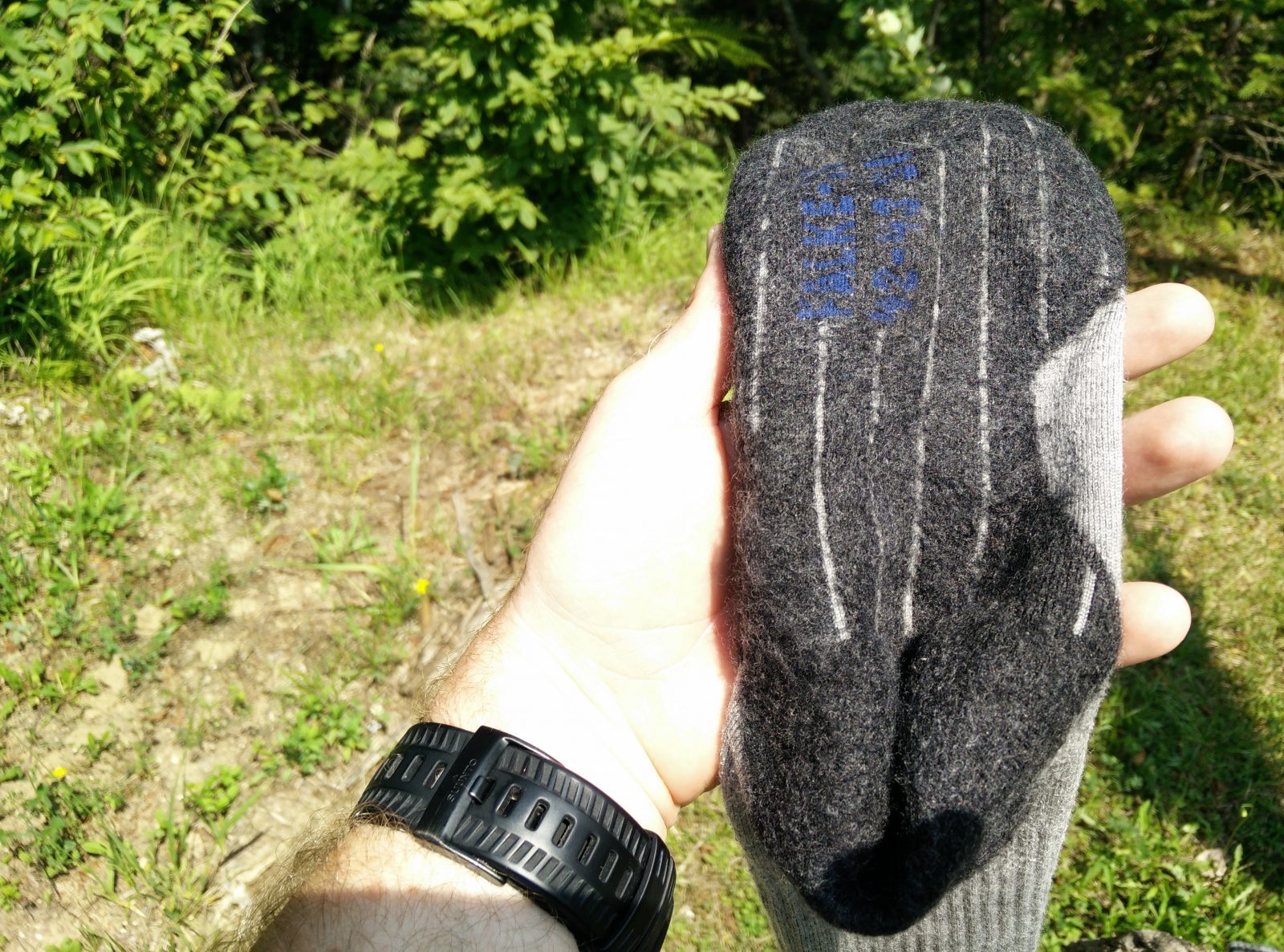
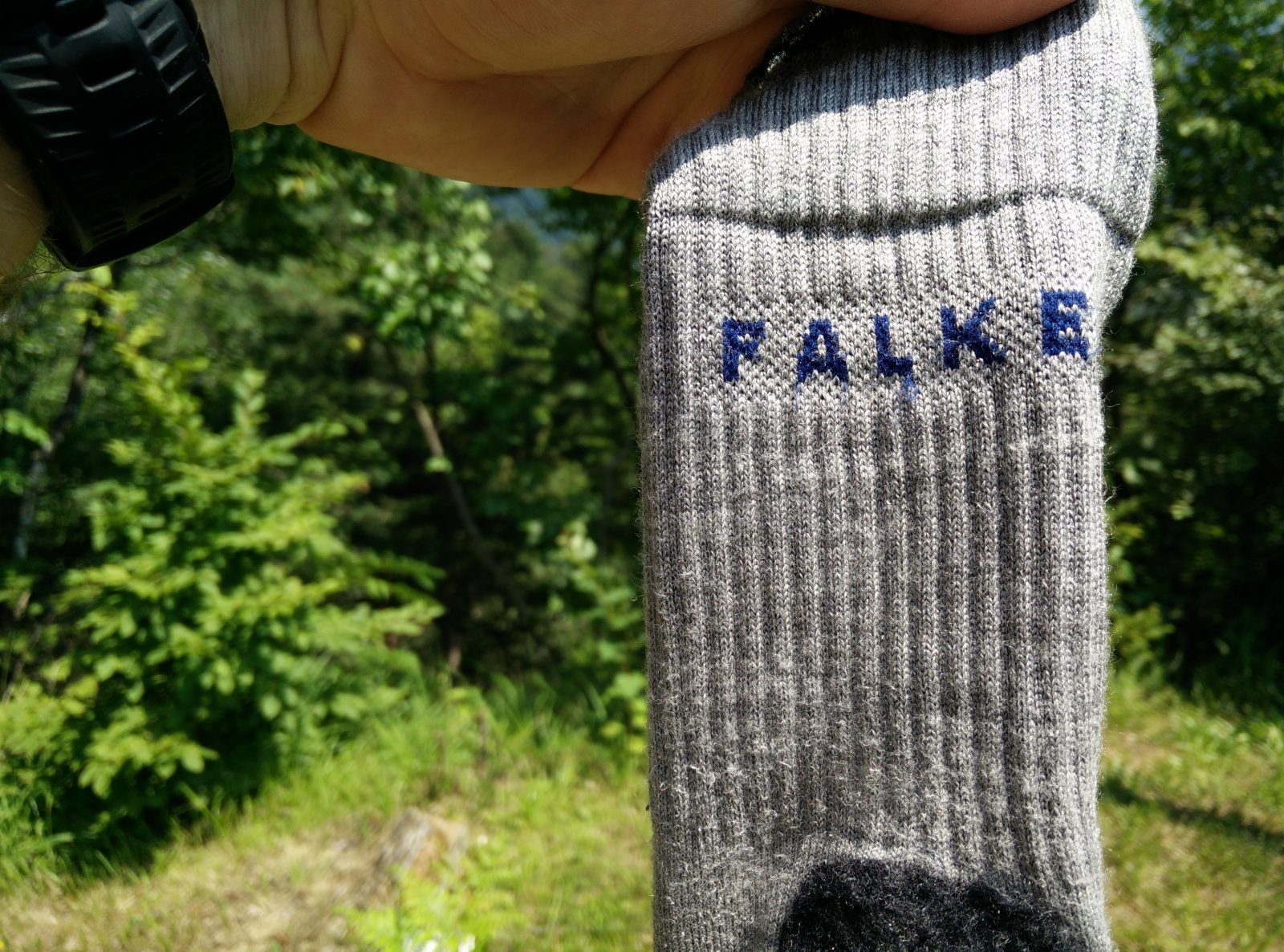
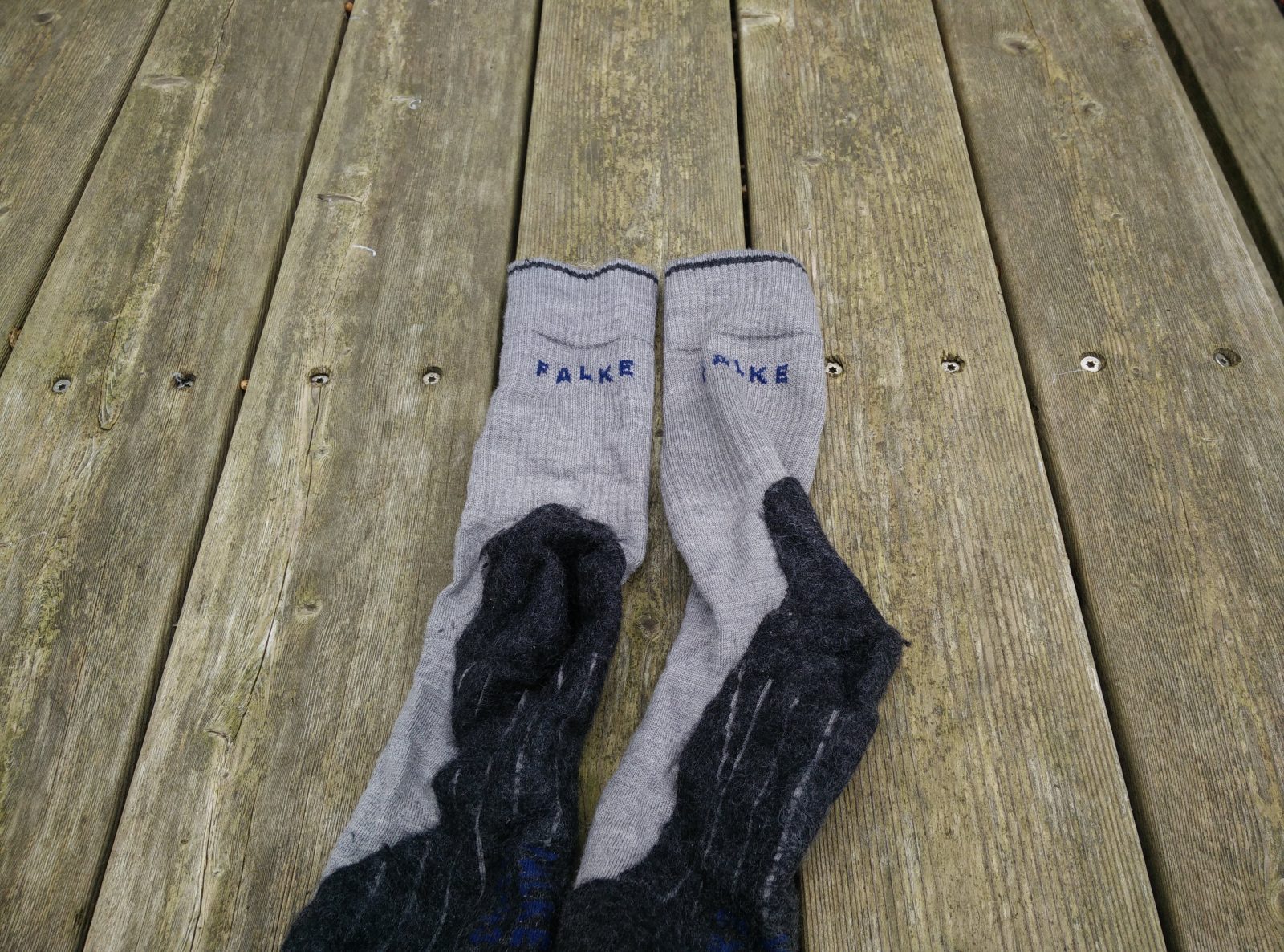
After wearing the socks on quite some trails in the Dolomites, I can certainly say that they are breathable and moisture-wicking. The fabric is thinner on the upper side which allows the moisture to easily escape to the lining of the boots while the bottom part of the sock and the heel area are made of thicker more woolen fabric for good cushioning. The legs and cuffs are made of relatively thin material (silk/nylon) which is very breathable and moisture-wicking.  I was also surprised how fast the socks dried. Often, they were completely dry before the end of a hike in spite having been soaked in sweat during the most intense climbs. As the socks have a high content of wool fibers, they are also odor-resistant (wool is naturally antimicrobial). I wore the socks on four different hikes without washing them in between and they didn’t become particularly smelly.

Now, socks are typically not the most durable garments and in my experience they rarely last for more than two years. Nevertheless, the material of Falke TK2 socks seems pretty robust. So far, I haven’t noticed any durability issues, but I will of course update this post in case I do.

Functionality, fit and sizing

The Falke TK2 socks, are according to Falke, designed for long hikes on easy terrain. I was, however, testing these socks mostly on rocky trails in the Dolomites which probably can’t be classified as “easy terrain”. Nevertheless, I was satisfied with the performance of Falke TK2 socks on such trails and I do think that the socks provide enough cushioning also for more complicated alpine ascents. Ultimately, the suitability of any hiking socks for a certain type of terrain also depends on your footwear. I wear relatively lightweight Salewa Mountain Trainer Mid boots which work well with thinner socks.

In the Dolomites the temperatures were quite low this summer (5° – 15° C) and the Falke TK2 socks were perfect for this temperature range. I’m planning to wear these socks also at higher temperatures, but for very cold conditions, I might consider the Falke TK1 socks which seem to be thicker and warmer.

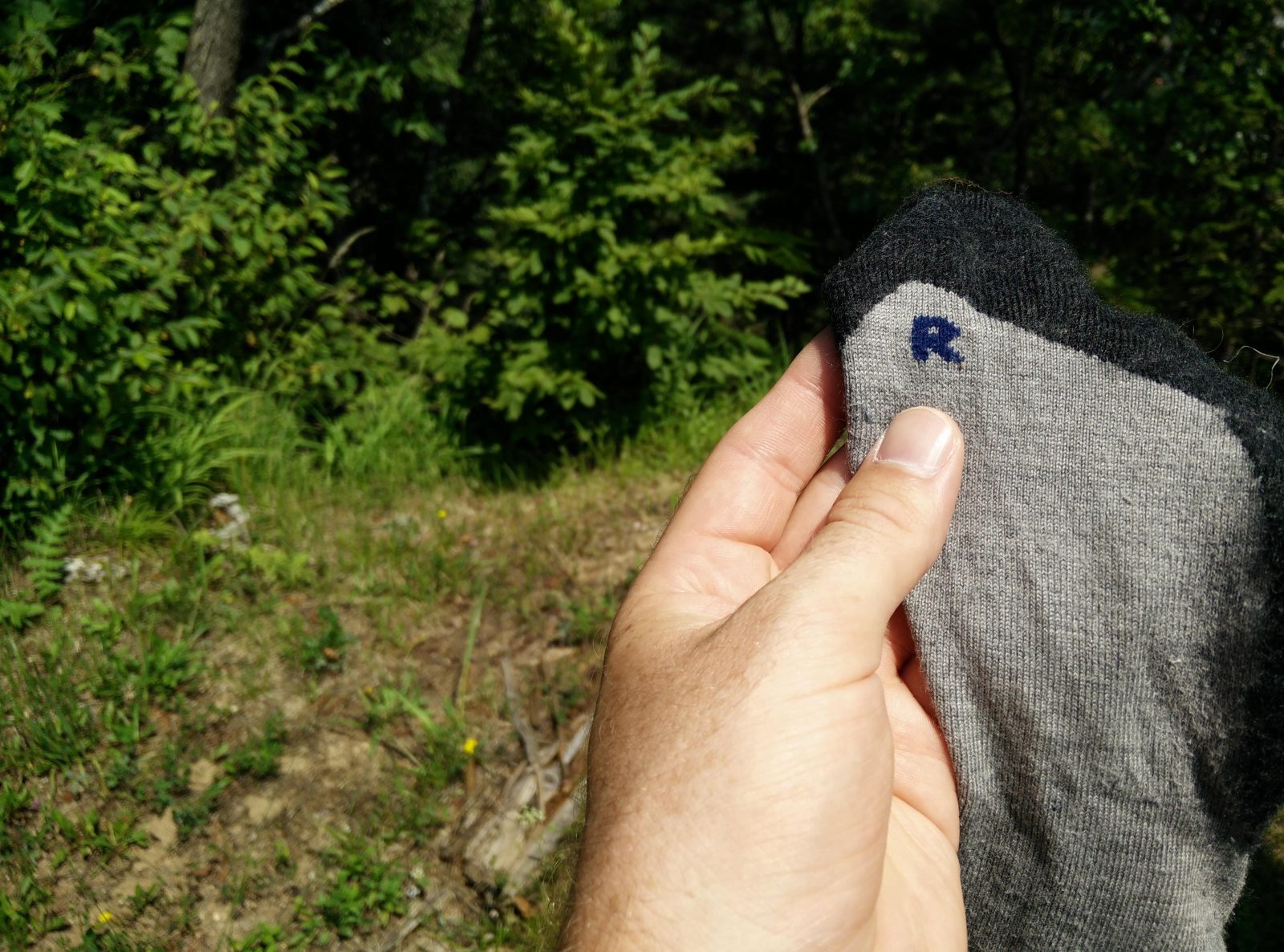
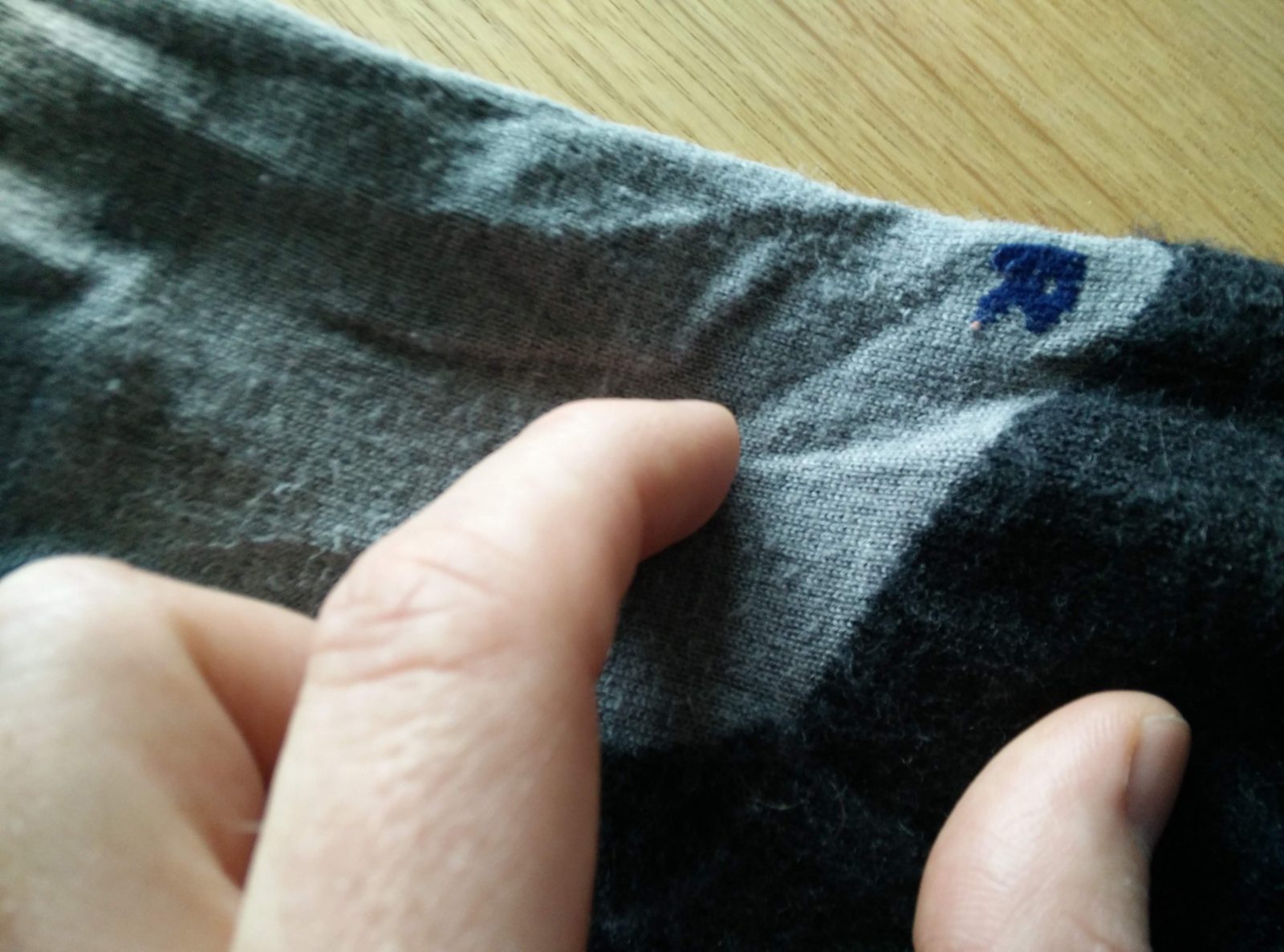
The Falke TK2 socks fit me perfectly and so far, I haven’t encountered any chafing or skin irritation while wearing them. The stitching is minimal. There are no seams in the toe area and all other seams are either hidden or super smooth. The socks are also left and right foot specific for optimal fit. I got the socks in EU size 42-43 while my Salewa boots are size 44.  The socks thus seem to run slightly big.

Washing and drying

The socks can be machine washed at 40 C, but you should steer clear of softener or bleach. Like most other activewear, they shouldn’t be tumble-dried. Due to high content of wool, the socks can be washed less frequently than 100% synthetic socks which will help them last longer.

Falke Tk2 Wool Silk Socks - Construction; the bottom part is made of wool while other parts are made of silk and nylon

Falke Tk2 Wool Silk Socks – Construction; the bottom part is made of wool while other parts are made of silk and nylon

Falke Tk2 Wool Silk Socks - The bottom part is made of wool and provides good cushioning

Falke Tk2 Wool Silk Socks – The bottom part is made of wool and provides good cushioning

Falke Tk2 Wool Silk Socks - Legs and Cuffs

Falke Tk2 Wool Silk Socks – Legs and Cuffs

Falke Tk2 Wool Silk Socks - The socks are right and left foot specific for optimal fit

Falke Tk2 Wool Silk Socks – The socks are right and left foot specific for optimal fit

Falke TK2 Wool Silk Socks - Different layers

Falke TK2 Wool Silk Socks – Different layers

Falke Wool Silk Socks

Falke Wool Silk Socks

Falke TK2 Wool Silk Socks Packaging

Falke TK2 Wool Silk Socks Packaging

Verdict

The more I wore these socks, the more I liked them. The best thing about them is the fabric which is super soft and incredibly comfortable against the skin. Therefore, I would be very surprised if the socks caused discomfort, skin irritation or blisters to anyone. The socks also excel at breathability, moisture-wicking properties, drying time and odor resistance. The fit and cushioning are great, not least because the socks are left and right foot specific. I also really liked that the socks are thinner at the top for increased breathability. As hard as I try, I simply can’t say a single bad thing about these socks. So, if you are looking for a pair of good hiking socks, look no further than the Falke TK2 Wool Silk socks.

If you have any questions about this product, drop me a line in the comments below.

Rating

Design
Quality
Comfort
Functionality

About Rating

Pros:

  • Comfortable
  • Breathable
  • Moisture-wicking
  • Odor resistant
  • Quick drying
  • Perfect fit

Cons:

  • /


Details

Tested by: Blaz

Review date: 2019-10-17

Product: Falke TK2 Wool Silk Trekking Socks

Final rating: 5 out of 5

{
“@context”: “http://schema.org”,
“@type”: “Product”,
“brand”: {
“@type”: “Organization”,
“name”: “”
},
“image”: “https://besthiking.net/wp-content/uploads/2019/10/Falke-Tk2-Wool-Silk-Socks-Legs-and-Cuffs.jpg”,
“name”: “Falke TK2 Wool Silk Trekking Socks”,
“review”: {
“@context”: “http://schema.org”,
“@type”: “Review”,
“author”: {
“@type”: “Person”,
“name”: “Blaz”
},
“creator”: {
“@type”: “Person”,
“name”: “Blaz”
},
“publisher”: {
“@type”: “Organization”,
“name”: “Best Hiking”
},
“reviewRating”: {
“@type”: “Rating”,
“ratingValue”: “5”,
“bestRating”: 5,
“worstRating”: 0
},
“datePublished”: “2019-10-17”,
“name”: “Falke TK2 Wool Silk Trekking Socks Review”,
“headline”: “Falke TK2 Wool Silk Trekking Socks Review”,
“itemReviewed”: {
“@type”: “Thing”,
“name”: “Falke TK2 Wool Silk Trekking Socks”
}
}
}

How helpful was this post?

Click a star to rate it!

1 vote(s) so far. Average rating 5 out of 5.

Post Author

Post Author

Blaz

Outdoor enthusiast with experience in all types of hiking and mountaineering. Hiked in the Alps, Iceland and other countries. In love with via ferrata trails and snow-covered slopes. Check out my hikes.

You may also like…

The post Falke TK2 Wool Silk Trekking Socks Review appeared first on Best Hiking.

Falke TK2 Wool Silk Trekking Socks Review Read More »

Cravat Bandaging: Series Post 2

This is a Guest Blog post by Jim Ausfahl .

Disclaimer: This material has been modified from the public domain US Military field manual, FM 5-80.

Last week, we looked at using a
triangle, or cravat, bandage for a tourniquet, splints and slings.  As a reminder, the triangle bandage is a
piece of cloth, often unbleached muslin, that is a right triangle with legs about
40″ (102 cm) long, and a hypotenuse, or long side, around 56.6″ (144
cm).  It is folded on itself three times
to make a cravat bandage.  Remember: for
all wounds, the first thing to do is to control the bleeding, clean and cover
the wound with gauze padding, and if it is available, some antibiotic ointment.
The bandage is used to lock the gauze in place. 
In looking at the bandaging below, it will be assumed that has already
been done. This week, let’s look at bandaging parts of the arm, starting with
the hand.

THE HAND

Start by laying out the triangle
bandage with the long side toward the person to be bandaged.  Place the wounded hand, usually with the hand
on top of the gauze, so that the edge of the triangle bandage is a about one to
two inches past the wrist toward the elbow. 
The long finger of the hand should point to the right angle of the
bandage.  The diagram below will make
this clearer.

Bandaging of the Hand

Bring the point of the right
triangle back over the hand, then tuck the sides, clear to the points of the
triangle, which will narrow the two bits of cloth going to the sides; again,
the diagram should clarify this.  With
that done, wrap one side over the hand and under the wrist, being careful to
keep a bit of pressure on the gauze without disturbing it.  Do the same thing with the other one, gently
tighten things up and then tie the two loose ends over the wrist with a square
knot.  If there is a bit of the bandage
sticking out from under the knot, it can be wrapped over the knot and tucked
under it.

Sometimes, however, it is not
necessary to bandage the fingers and desirable to keep them free.  There is an alternative bandaging to permit that.  Fold the triangle bandage into a cravat, then
lay the middle portion of the cravat on the gauze padding.  Bring the free ends under and over the hand
then back under the wrist and over the hand. 
Finally, loop the free ends under the wrist again, bring them back over
and fix in place with a simple square knot. 
The diagram below makes this much clearer.

Alternate Bandaging of the Hand

THE ELBOW and ARM

Bandaging the elbow also starts
with folding the triangle bandage into a cravat.  The injured elbow needs to be positioned to about
90 degrees, and the middle of the cravat placed at the point of the elbow.  One side of the cravat is wound once or
twice, overlapping about an inch, over the upper arm; the other one, over the
part of the arm below the elbow.  The
free ends of the bandage are tied in a square knot on the inside of the bend of
the elbow.  The diagram of this procedure
is below.

Bandaging of the Elbow

A nearly identical procedure will
work to bandage the forearm or upper arm. 
The middle of the cravat goes over the gauze, then one end is wound
around the arm going upward, overlapping an inch or more, with the other going
around and down.  The free ends are tied,
diagonally across the bandage, in a square knot.

Next time, the topic will be bandaging parts of the leg.

Jim Ausfahl is a physician in active medical practice, in Peoria Heights, Illinois, studying the art of surviving in a challenging environment and sharing what he knows.

The post Cravat Bandaging: Series Post 2 appeared first on WillowHavenOutdoor Survival Skills.

Cravat Bandaging: Series Post 2 Read More »

White Child Brutally beaten and hospitalized in Violent Hate Crime on School Bus over a Trump Hat

White Child Brutally beaten and hospitalized in Violent Hate Crime on School Bus over a Trump Hat

In yet the latest hate crime ignored by the mainstream media, a white 14-year-old child was brutally beaten by 8 black thugs on his school bus. […]

This Article White Child Brutally beaten and hospitalized in Violent Hate Crime on School Bus over a Trump Hat is an original article from OFFGRID Survival If it is appearing on any other site but OFFGRID Survival, that site does not have our permission to use our copyrighted content!

White Child Brutally beaten and hospitalized in Violent Hate Crime on School Bus over a Trump Hat Read More »

Europe Diagonal: Great Britain Coast to Coast

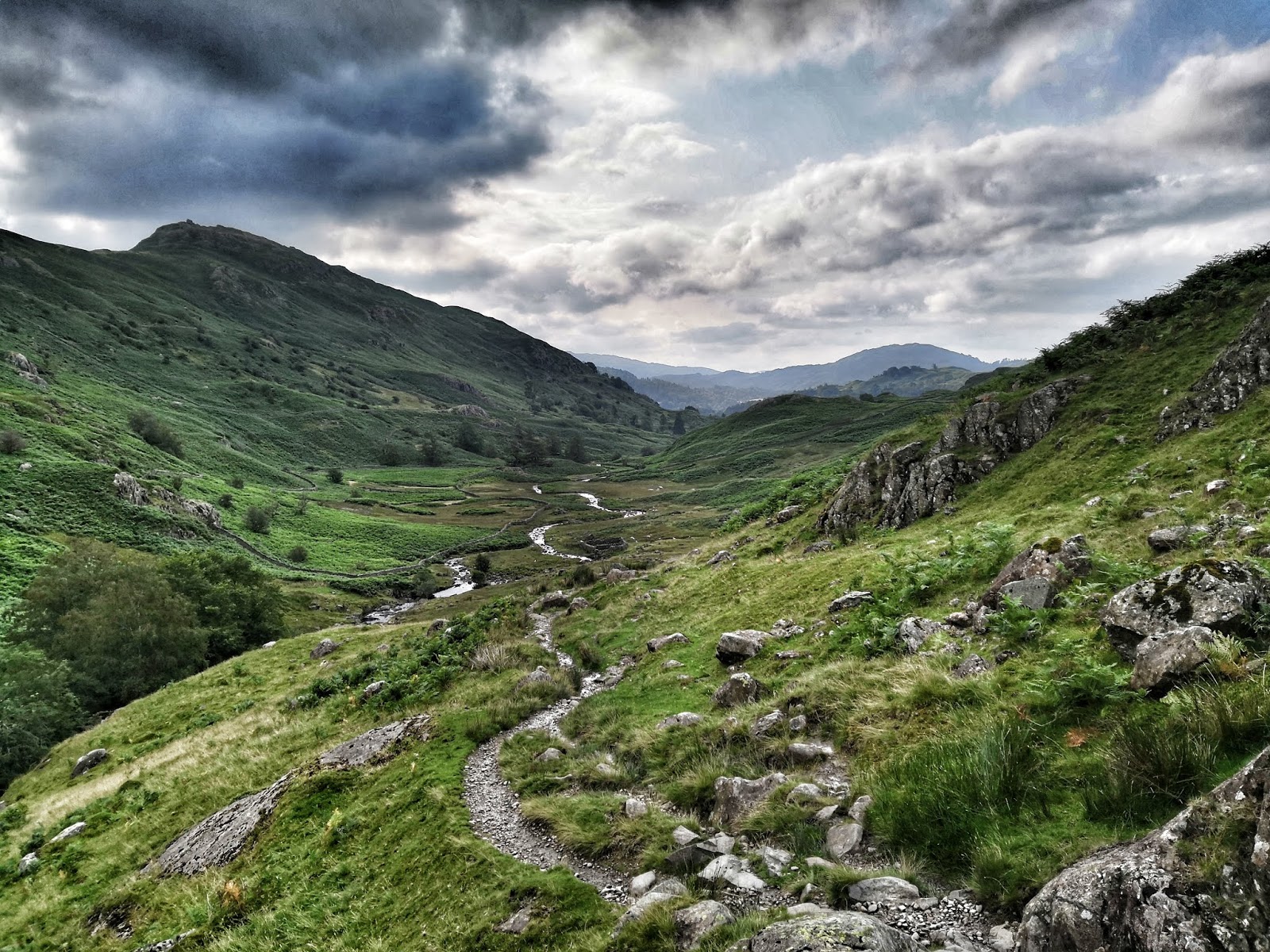
The European long-distance path E8 continues through Great Britain as the Transpennine Way. When I had a close look at this trail preparing this trip I discovered that this is not a very scenic route. Always close to civilization and mostly on concrete. Therefore I decided to hike Wainwright’s Coast to Coast instead which is a bit further north but the exact same length. Right from the start this turned out to be the right decision. After a hearty  English breakfast in a traditional B&B I started with a walk along spectacular coastline – alas in rainy weather. The couple in the picture could not believe that I was camping: “Your backpack is so much smaller than ours and we don’t camp!” Well, they had not heard about ultralight backpacking yet.

This mostly unmarked trail then continued through the Lake District, a real gem! Despite a lot of rain this stretch was a real highlight and I could not take enough pictures. Unfortunately, in on of the most beautiful places I got so soaked in a cloud burst that I could hardly take any pictures any more. The touchscreen of my smartphone was wet and I did not have any dry cloth to clean it. Plus my fingers were so wet and frozen … It was still a wonderful day despite the fact that I had to put on soaking wet and cold clothes the following morning. I rewarded myself with a breakfast of champions outside the little supermarket in Grasmere and ate an entire package of chocolate trifle.

Idyllic campsite with unexpected visitors

One night I arrived at a spectacular lake with no one else around. Apparantly this was a popular campsite and as wild camping is usually tolerated in this National Park I set up my tent at this fantastic site despite the fact that there was goose shit all around. I soon regretted this: In the middle of the night I heard some crackling noises right outside my tent and I just see some small animal runnig away. Closer inspection revealed that a fox had dragged a bag of nachos and my trash bag out of the front pocket of my backpack! It was too dark to see what had happened to both but in the morning I had to collect empty wrappers and used toilet paper that was lying around. The nachos of course were completely gone … A British friend told me later that something similar had happened to him at the exact same spot.

After a sort of connecting day I was in the Yorkshire Dales National Park and had reached the Pennines. More spectacular scenery, a lot of sheep and cattle – but unfortunately only chocolate brown drinking water that slightly tasted of iron but looked colorwise like peach ice tea. There were a lot of industrial remnants in this area which was a mining centre in the 18th and 19th  century. What looks almost like wilderness now was a busy industrial area once. Coast to Coast (C2C) is a popular trail and I came across several churches that offered drinks and snacks at cost price for hikers and there was even some trail magic boxes along the way. Very welcome in the rainy weather!

Drinking chocolate brown swamp water

One morning I was shocked to discover that my charging cable was gone with my phone only 20% charged up! A horror scenario for me whose smartphone is my backup navigational device. I found it half an hour later when packing 10 metres away. It had fallen out of my backpack when setting up the tent in the dark. I had my one and only rest day on the C2C in Richmond where I had booked myself into a rather posh B&B. The owner’s husband was more than delighted by German native speaker because he had been forced to apply for a German tax number and could not figure out the application form. I ended up spending almost two hours translating and explaining it to him … He rewarded my with a very substantial discount on the room price …

Paragliders in the North York Moors

After another connecting day I arrived at North York Moors National Park where paragliders were taking advantage of the nice weather – which unfortunately turned very bad the next day. In fact so bad, that a lady walking her dog told me that even her dog did not want to go outside this day. I desperately tried to find some kind of accommodation for that night but every place I called was already fully booked. I was so distressed that I even went into a pub and ordered a cup of tea and something to eat. I was the first customer of the day and my backback left a huge puddle on the floor. Eventually I managed to find a room, but the landlady asked me: “When does your luggage arrive?” I had visions of my backpack walking on its own, but she just referred to the fact that most hikers have their luggage transported for them by commercial providers.

The place turned out to be a palace but unfortunately a very dusty one. She only rents out rooms occassionally and therefore the room really smelled as old as the house was. At least weather was a bit better on my last day when I reached the coast at Robin Hood’s Bay. I had just reached the little village when I saw the bus rounding the corner – and even caught it. Therefore my hike on the C2C ended kind of abruptly … Before I left Britain I met up with Colin, an old hiking friend of mine who gave me some new hiking ideas – as if I did not have enough of them already …. Then I had to return to Germany for a brief stint as a best woman at my best friend’s wedding before resuming my hike.

Coast to Coast was the real highlight of this hike and I can highly recommend it!!!! I had hiked across Britain before from John O’Groats to Land’s End and had not liked it a lot. With that experience I did not have high expectations for the Coast to Coast but I was literally overwhelmed by how great it was. One of the big advantages of the C2C is how easy wild camping is!!! It is tolerated in the three national parks and wasn’t a problem in the connecting stretches in between. Although C2C is a popular trail I did not meet a lot of other hikers probably due to the fact that I had started on a Monday and mostly camped wheras most hikers stay in town.

Europe Diagonal: Great Britain Coast to Coast Read More »

Intro to Intelligence for Preppers

Tornadoes, flooding, and wildfires are just three examples of localized and very personal SHTF events that we’ve seen in the past year, and they illustrate the devastation of an event for which there is immediate early warning. We can be alerted to a tornado warning and seek cover. We can vacate our homes in case of flooding or an approaching wildfire. As we deal in the likelihood of SHTF scenarios, Mother Nature is 100%.


But on a regional or national scale, we’re looking at more unpredictable events for which there is little to no early warning: an electromagnetic pulse, or perhaps a cyber attack on critical infrastructure, or a financial or monetary breakdown that plunges millions into a very real SHTF scenario. The cyber attack on the New York Stock Exchange will have no direct effect on you, but the second- and thirdorder effects will be felt on every level and generate threats to your community. So what we should be preparing for is not the cyber attack itself, but for the follow-on effects of that cyber attack that will affect your community.


Regardless of the event, we need to be able to collect information to support decision making so we can keep our families safe. Should we bug in or bug out? If bugging out, which route should we take? If bugging in, how can we get early warning of approaching threats?


How to Remain At Ease in a SHTF Situation


I’m going to break down a few ways that we can reduce the uncertainty in an SHTF situation. I spent three years in Iraq and Afghanistan, and both of those countries were real life or death, 24/7 SHTF situations. As an intelligence analyst, my job was to keep the commander informed on the security situation and threat environment. His responsibility was to make decisions based on the intelligence we provided. If we had no incoming information, then we couldn’t produce intelligence. And this is why information is the basic building block of community security. If we want security in an SHTF scneario, then we need to know more about the threats. What we need is real-time intelligence.


In 2014, a small group of volunteers and I battle tracked the Ferguson riots. The first step of battle tracking began with a process I call Intelligence Preparation of the Community. (You can watch the entire webinar here.) We analyzed the strength, disposition, and capabilities of local security forces. Knowing what equipment they had enabled us to better understand how they would react to unrest. We similarly analyzed the protest groups and identified associated individuals.


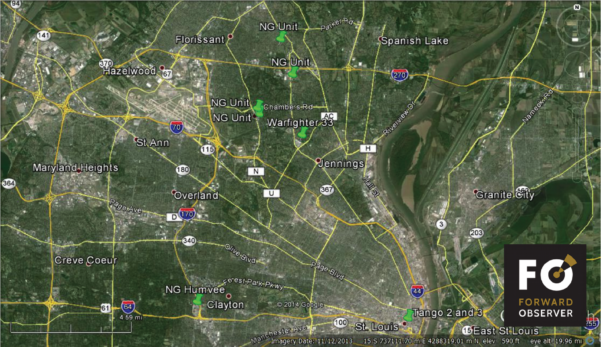
What both of these groups had in common is that they were both producing information of intelligence value. Through something as simple as listening to the police scanner, our team was able to plot out the current reported locations of law enforcement and the National Guard. Meanwhile on Twitter, we scanned the accounts of known protestors for real-time information.


In the image below, we took information reported on local emergency frequencies and potted those locations on the map using Google Earth.’Warfighter 33′ was the callsign for the National Guard Tactical Operations Center, which was set up in the Target parking lot. We also pinned several National Guard posts as they reported their locations. It wasn’t rocket science, but it started to help us understand the security situation. This is a very rudimentary form of signals intelligence, or SIGINT.
 

forwardobserver

Through the night, we continued to use photographs uploaded into social media and news articles in order to identify the photos’ locations. Then we plotted them on a map. Pretty soon, we have a very good idea of which areas were generally safe and which areas had the most activity as the riots progressed and eventually burnt out. Had we lived in Ferguson, we could have used this intelligence to navigate our way to friends and family, or to help friends and family navigate away from the threats. All this information was publicly available, so we call it Open Source Intelligence, or OSINT.


So what do I do if there’s a grid-down situation?


That certainly complicates things. Before I answer that question, I want to ask you one: on a scale of 1 to 10, how important is intelligence in a SHTF situation? (I would say 10, but I am admittedly a bit biased.)


First understand that there may still be electricity in a grid-down environment. As long as there are generators, and given that there’s not been an EMP, then someone somewhere will have electricity. My local law enforcement agency claims to have enough fuel for two weeks of backup power were things were to go sideways. That’s good to know, and is the benefit of intelligence collection before an SHTF event, as opposed to a post-SHTF scramble. If they’re powered up and communicating in a SHTF situation, or perhaps some ham radio operators are, then we still need the capabilities to listen in. Otherwise, we’re going to be at a severe disadvantage.


If there’s no power, then we’ll have to rely on Human Intelligence, called HUMINT. That means getting out and talking to people. It could mean a reconnaissance patrol. The horse-mounted cavalry were the eyes and ears of the commander before collection technology. Snipers and forward observers sitting in hide sides, whose responsibility it is to observe and report enemy activity, are often excellent intelligence collectors. An observation post equipped with a field phone, sending back intelligence information is another example.


While these are all military examples, there are similar community equivalents. Consider this: technology is a force multiplier. With SIGINT or OSINT, we can be very wide and very deep in our intelligence gathering. That’s a 1:n ratio. We have one collection platform, in this case a radio receiver, and we can scan a very wide band to collect information from anyone who’s transmitting. But when we deal with human intelligence, we’re often on a 1:1 ratio; that is, one collector speaking to one source at any given time. That’s a very slow and difficult way to do business.


So instead of 1:1, I want you to consider the scalability of that ratio. If one person is limited to gathering intelligence information from one person at at time, wouldn’t it makes sense to scale that ratio to 10:10 or 100:100? It absolutely would. Every set of eyes and ears is a sensor, so we as an intelligence element tasked with providing intelligence for community security should absolutely be interested in encouraging community members to passively collect lots of information. All that information is reported back to us, and then we’re engaged in the arduous task of compiling and evaluating that information in order to create intelligence.


Intelligence doesn’t produce itself, so it’s incumbent on us to build that capability. The more accurate information we have, the more wellinformed we can be. Without first being well-informed, making high-risk, time-sensitive decisions just got a whole lot more complicated.


Samuel Culper is the director of Forward Observer, a threat intelligence service that focuses on domestic SHTF issues. He’s a former military and contract intelligence analyst, and author of SHTF Intelligence: An Intelligence Analyst’s Guide to Community Security. You can find out more about the SHTF Intelligence Center at his website.

Intro to Intelligence for Preppers Read More »

Pizza Man Delivers Hot Lead To Two Teens After They Try To Rob Him At Gunpoint!

A pizza delivery driver shot and killed one teen and injured the other after they tried to rob him at gun point. There may even be speculation that the teens lured the driver into a trap using the address at a nearby apartment. FoxNewsHouston reports that a grand jury will decide if a pizza delivery driver […]

The post Pizza Man Delivers Hot Lead To Two Teens After They Try To Rob Him At Gunpoint! appeared first on Tactical Sh*t.

Pizza Man Delivers Hot Lead To Two Teens After They Try To Rob Him At Gunpoint! Read More »