canadian-carbine: US Special Forces in Afghanistan.

canadian-carbine: US Special Forces in Afghanistan. Read More »


When I was about 10 years old, my Grandfather made my brother and I each a gift – a wooden maul for splitting wood. It’s made from a large 8″ diameter x 4-foot hickory log. I remember when I could barely lift it. It was a practical gift and a true working man’s tool. While I didn’t appreciate the work that went into carving it at the time, it was the perfect tool for crushing the enemies of my favorite GI Joe and He-Man warriors. Almost 35 years later, I still have that maul. It’s as good now as the day I received it. It’s stained and a little beat up, but it’s a great tool that reminds me that all gifts don’t have to be bought. Some of the best ones are made.
So today, my gift to you is to show you how to make a wooden mallet or maul of your own or for a gift.

From driving in tent stakes to pounding a wedge for splitting wood, a solid wooden hand mallet has countless uses around base camp. Not only is it useful, it’s a really fun project. Besides, having a mallet on hand is always a good idea and packing in a hammer isn’t fun. You can make your own in just a few minutes, while the bread is rising in the dutch oven. While these can be made as large as you’d want, the tutorial below shows one that is a perfect size for light duty pounding.
Start with a solid, seasoned log that is approximately 3-4″ in diameter x 12-15″ long. The first step is to saw in what’s called a “stop cut” to form the head of the mallet. Saw all the way around the log and leave the center of the log untouched. This untouched area will ultimately form the handle of the mallet. The excess will be trimmed or batoned away in the following steps. Remember, you can always make the stop cut deeper but you can never put wood back in. Start by making the stop cut a little more shallow than you think you will need, especially if this is your first mallet.

Next, begin to trim away the excess wood from the handle portion of the mallet. The stop cut will prevent you from accidentally splitting off the head portion of the mallet.

Continue to split and carve away wood from around the handle until it’s the desired diameter.


Once the handle is close to the diameter you’re wanting, simply finish it off by carving away any rough edges or splinters. A final coat of linseed oil or beeswax will protect the wood and keep your mallet in working order for years to come.

What uses can you think of for a wooden maul or mallet in the woods?
Remember, it’s not IF but WHEN,
Creek

The post How to make a Wooden Mallet for Bushcraft & Survival appeared first on WillowHavenOutdoor Survival Skills.
How to make a Wooden Mallet for Bushcraft & Survival Read More »

When I was getting ready to leave Lonquimay after one night in a hotel I encountered two other GPT hikers in the supermarket. Big surprise for both parties and of course we both delayed our departure and chatted quite a while. Although this Swiss couple with hiking my direction I would not meet them again because they were behind me – and I was now taking a huge detour! On the upcoming trail section there had been a big landslide last year and every hiker had complained how dangerous it was to get around it. And I had realised that in order to enjoy this difficult trail I wanted to avoid any risks if possible. And as there existed a detour around this section I decided to take it!
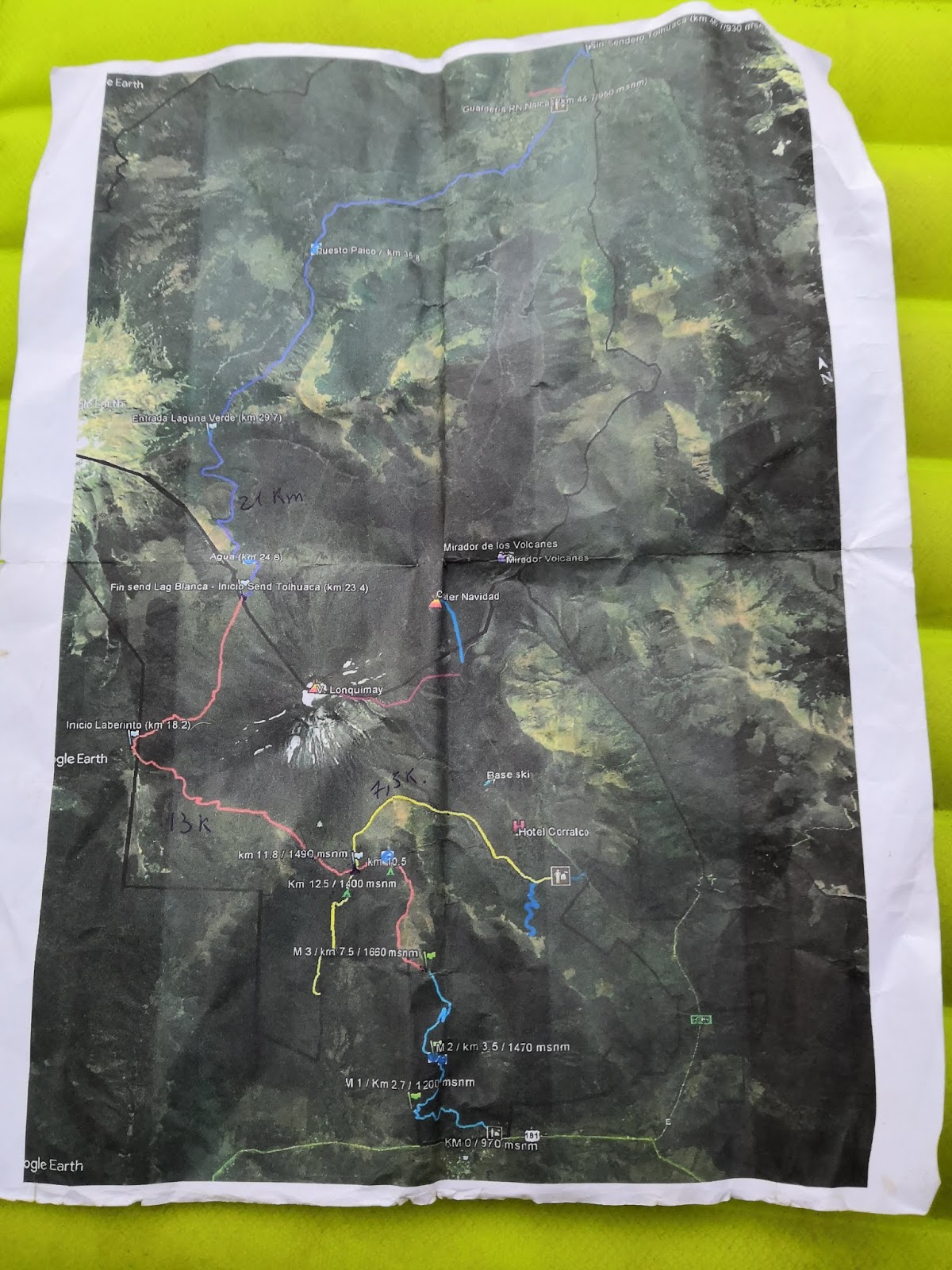
Problem was that nobody had ever hiked the entire length of this long detour before! It involved a lot of road walking – and two bridges which I could not confirm 100% on google earth. This was going to be an adventure … The section started with a long road walk and first impressions of the volcano Lonquimay. When I turned onto the paved road accessing the National Reserve I was surprised by the amount of tourist traffic. My plan was to continue hiking on that road that would soon turn into dirt. But when I arrived at the entrance of the reserve a very friendly female ranger more or less talked me into taking an even longer hike into the reserve … In hindsight I can’t believe I took that risk because I had no gpx track of this route, there was no official map of it – there only was a small one page color photocopy of google earth. But the ranger praised this route so much and swore that her colleagues had only recently blazed it that changed my mind and embarked on this 45 km route through the reserve. According to the ranger it would take 4 days ….
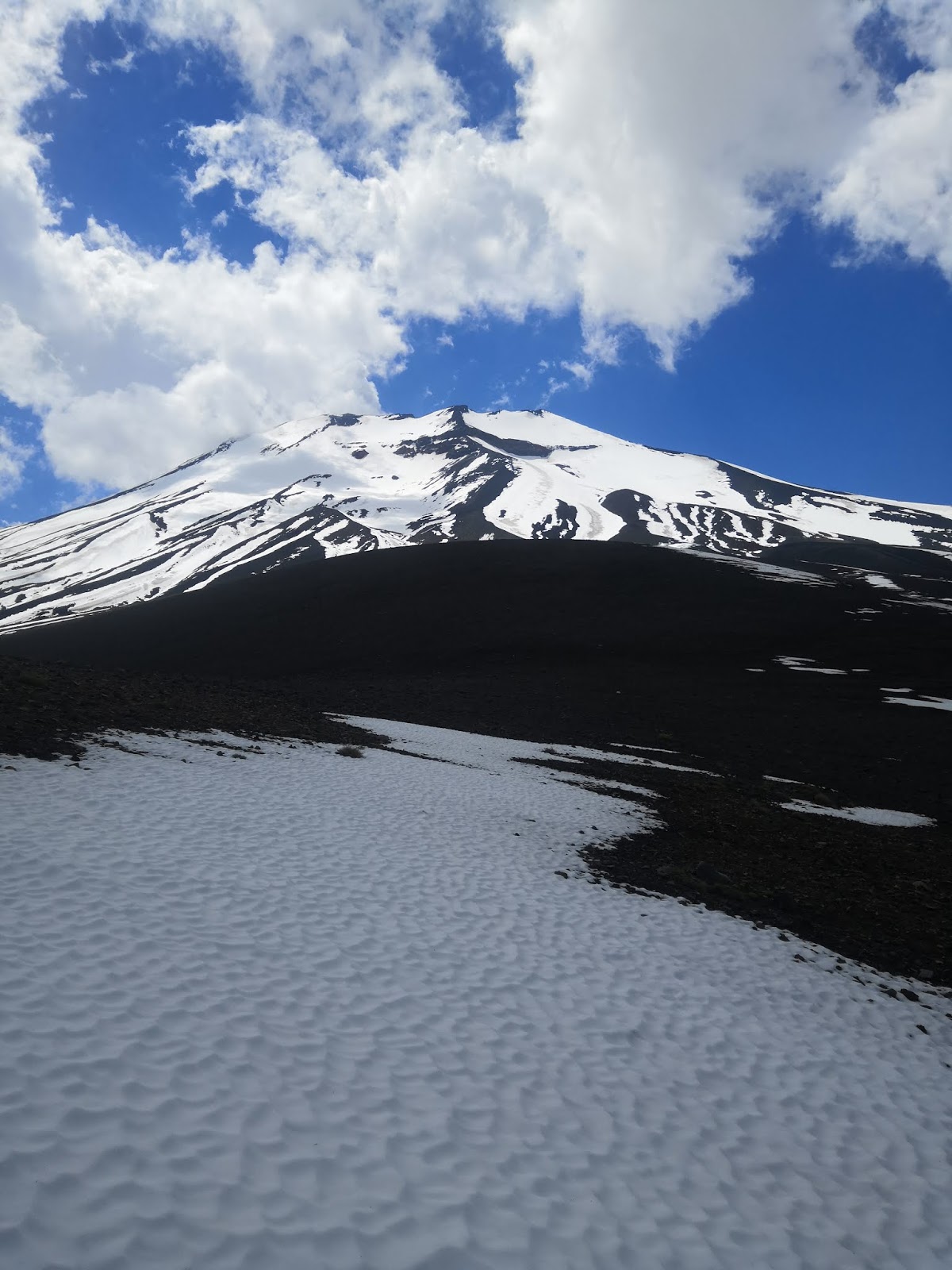
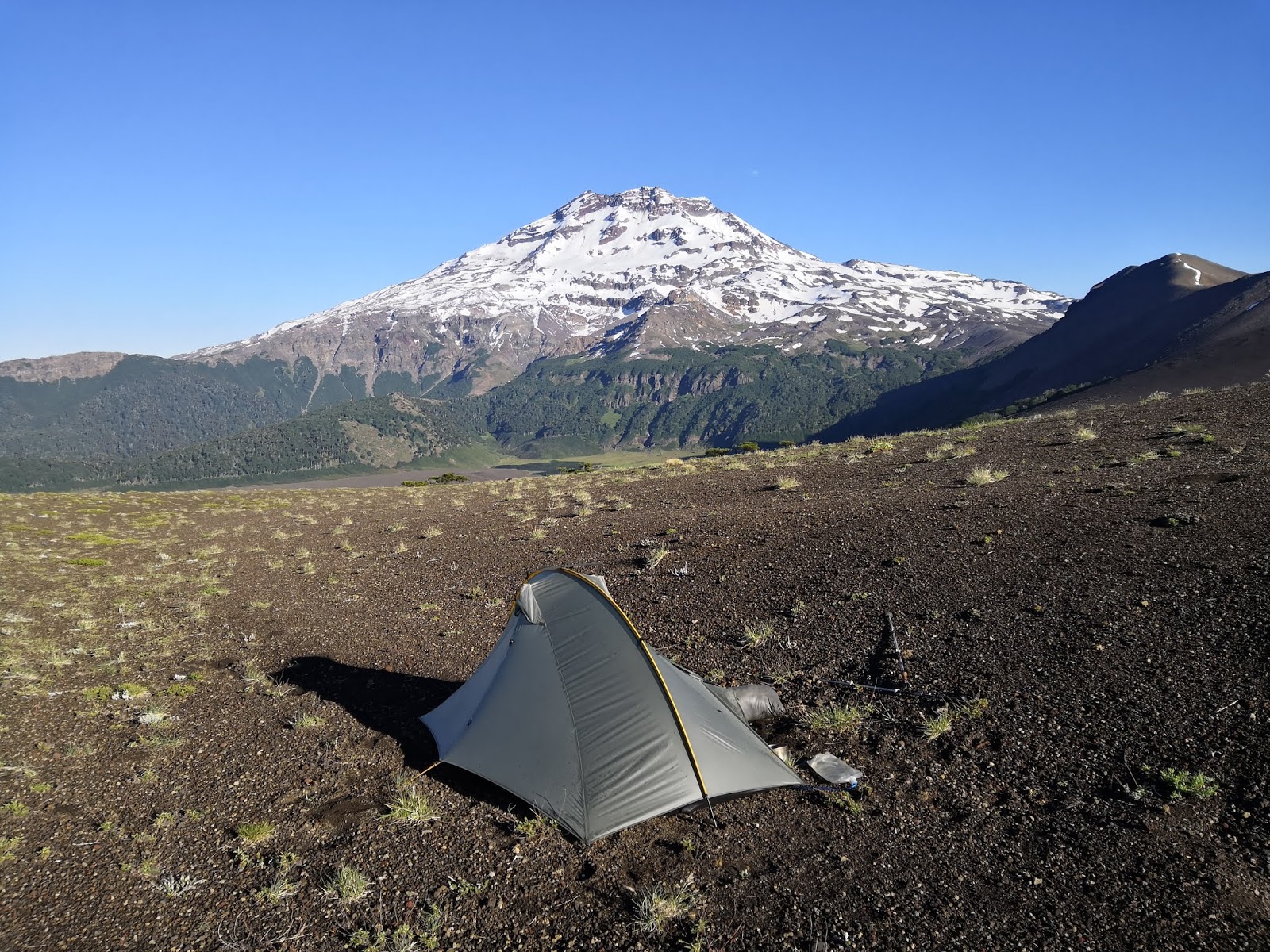
To my delight the trail marking was indeed fantastic! I had never seen anything similar before. There were wooden posts and painted blazes on rocks the entire way. The views were outright spectacular and not too much snow was left. I even found a great water source that was not marked on my “map”. But instead of camping there I made the mistake of continuing. My “map” called the next kilometers the “labyrinth” and I was soon to find out why. I had to traverse a huge lava field and the trail zig-zagged through sharp lava outcrops. It was very strenous hiking but the waymarking was excellent! I was reluctant to camp in this lava field because it was so high up and completely exposed and pressed on until almost sunset. Despite my fears the night was completely calm with no wind and it was not as cold as expected. The view in the morning was incredibly: I was camped between two snow covered volcanoes under a completely blue sky!
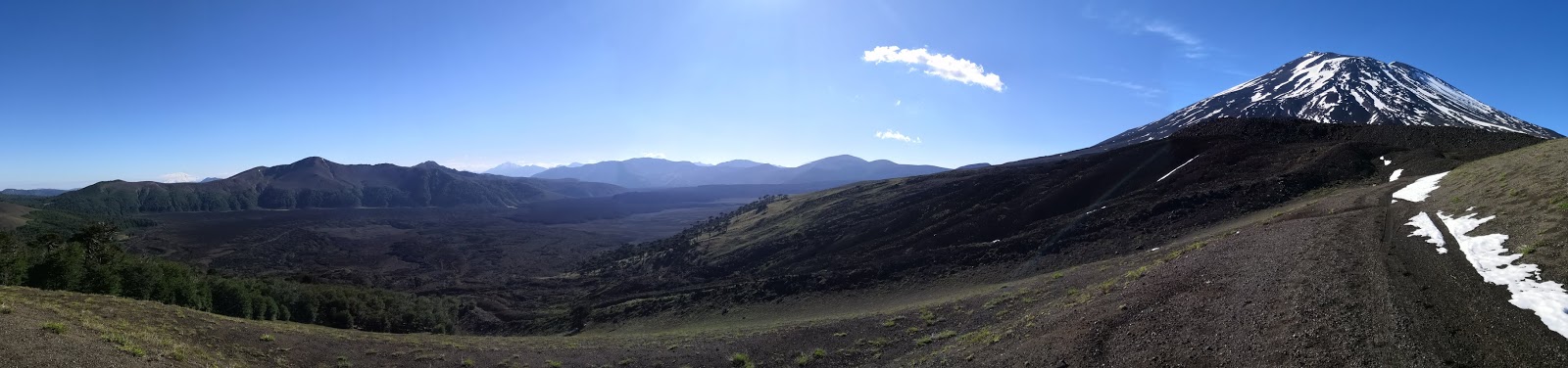
Trail marking continued to be great and a water source appeared just in time. Soon I was descending below tree line again. On a steep slope a whole herd of cows was walking in front of me because the trail was so narrow that they could not let me pass …
It took me only two days to hike this traverse and I did not see a single soul during that time. In hindsight this was one of the most beautiful sections of the GPT – although it is not even the main route! Finally I had found the perfect mix of great landscape, good trail and trail marking. I sent an email to the ranger to de-register and embarked on the upcoming long road walk to rejoin the main GPT route.
 The road walk turned out to be much nicer than expected. It was pure dirt and hardly any traffic – expect this French cyclist. He was not making a lot more kilometers cycling than I was hiking! Coming from where I was going to he assured me that the two bridges really existed – a great relief for me! He also told me that there was tunnel! Tunnel? I could not believe that but sure enough the next day I had to walk through a 400 meter long tunnel. There was no pavement and lots of horse droppings inside because there were more riders than drivers using it … Of course there was no lighting either ….
I camped close to the dirt road and was convinced that it was so bad that cars did not use it any more. In the morning I learnt that I was completely wrong: not only a car, but a small bus fought its way up the mountain …
I even passed an abandoned orchard full of cherry trees. I enjoyed the unexpected vitamins a lot …
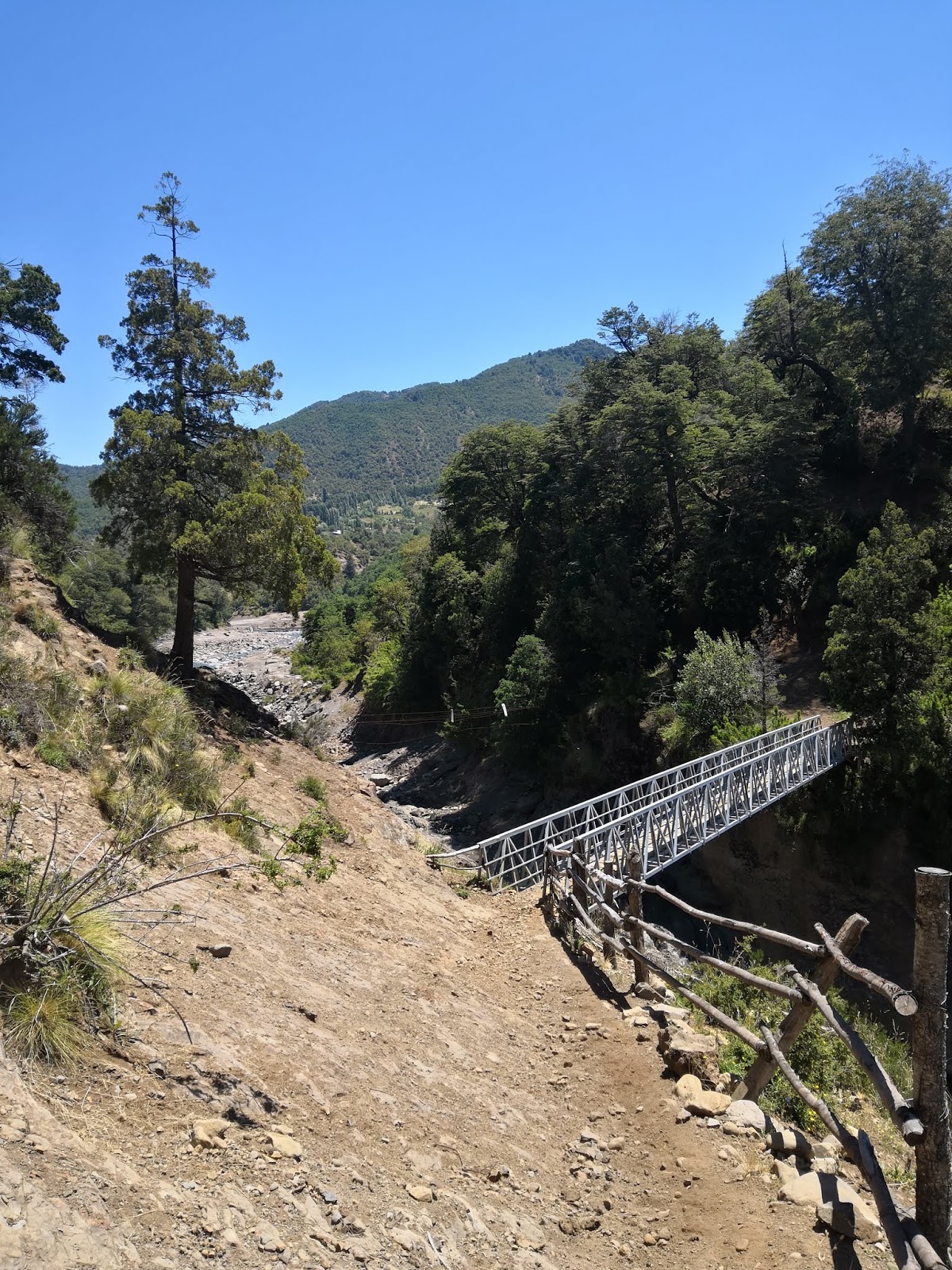
The second bridge was a narrow metal construction over a deep river gorge with plenty of horse droppings on it. I cannot understand how the cowboys manage to drive cattle over such a bridge where even I felt uncomfortable looking down. There was a well stocked minimarket on the other side where I had a very long lunch break before finally joining the main GPT route again. I had made a detour of over 100 kilometers but I have enjoyed it a lot. In hindsight this has been one of my favourite stretches of the entire GPT! Even the road walk has been pleasant …
Greater Patagonian Trail GPT 11 Read More »
Rule #1 Something is better than nothing. This applies to all levels of pandemic supplies. It has come to my attention that a lot of supplies like N-95 or N-100 disposable masks and hand sanitizers are running out. I wanted … Continued
Pandemic Supplies and Alternatives For When Stores Are Sold Out Read More »
Whether you’re a returning entrant, or brand new to the RoSPA Health & Safety Awards, going through the entry process can seem a little daunting… but don’t panic! We have a highly dedicated team at RoSPA to help.
We caught up with two members of the RoSPA team, Dr Karen McDonnell and Matt Cryer, to find out how they can help entrants on their awards journey.
Dr Karen McDonnell, CFIOSH, Chartered FCIPD
OHS Policy Adviser, Head of RoSPA Scotland, Past President IOSH
As a highly motivated advocate for safety and health, Karen is skilled in partnership working, with a track record of working with and through key stakeholders across the UK’s health and safety network. Karen has a broad range of strategic and operational experience gained over 25 years whilst working for RoSPA. Karen can help award entrants in a number of ways…

Matt Cryer, TechIOSH
Awards Standards Manager
Matt is the Award Standards Manager for RoSPA’s Health and Safety Awards scheme, responsible for developing and overseeing the assessment process, judging panels and question sets. During Matt’s time at RoSPA he has gained the NEBOSH General Certificate and TechIOSH status. With his wealth of awards experience, Matt can assist award entrants from the start, right through to the end of your awards journey…

As well as support from our team, we also offer a Free Mentoring Scheme, where we put you in touch with an experienced, high achieving award winner, to help you maximise your entry.
January is all about setting goals and planning for the year ahead. With the next RoSPA Awards deadline a mere four months away (April 30 to be precise), we’re asking organisations across the globe; could you become a #rospawinner?
Find out how to get involved by visiting www.rospa.com/awards before April 30 to be part of the 2020 Awards.
We’re with you every step of the way! Read More »
Newark, NJ — Head and neck injuries related to cellphone use increased “steeply” over a recent 20-year period – with distraction a significant factor, say researchers from Rutgers University.
Researchers link distraction to rise in cellphone-related head and neck injuries Read More »
Hello Pack. We had one heck of a prepping week. There is nothing better to test your preps than a short-term disaster situation. I KNEW that when I said out loud to myself and the Blue Heelers trailing along with me when out riding the fence line that it was such a glorious day that I had likely jinxed it. Just a few short hours later we went from 70 degree weather in January to a storm that…
What I Did To Prep This Week: January 19th – 25th 2020 Read More »

Australia’s conservative Prime Minister, Scott Morrison, spoke at the National Press Club yesterday and his speech showed that if occupational health and safety (OHS) is to progress over his term of government, economic arguments will be the most persuasive.
On safety, the PM says it’s all about the economy Read More »
Ever wonder where some knife designs come from? At Big D Custom Knives, the maker is also a user. And his competition credentials are very impressive.
Knife review and video: Donavon Phillips Drop Point Kephart Read More »
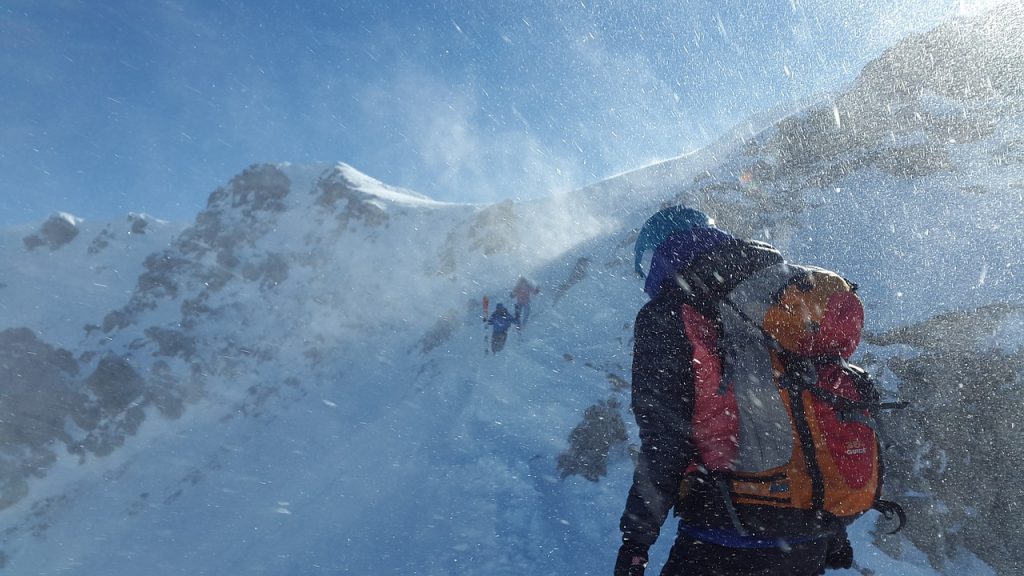
As we move into Fall in the northern hemisphere, it’s time to unpack the thermals and get out your winter gear. There’s recently been some buzz surrounding synthetic insulated jackets, such as the Patagonia Nano-Air Hoodie or the Arc’tyrex Atom, Arc’tyrex Proton LT and whether these are a suitable replacement for winter down or fleece
Best Winter Jackets for Extreme Cold Read More »