Fire Safety

Your Complete Beginner’s Guide to Tactical Gear

Your Complete Beginner’s Guide to Tactical Gear Primarily used by military members and law enforcement personnel, tactical gear has broadened its scope in terms of utility. The popularity of tactical gear has mushroomed among survivalists, hunters and even private citizens interested in improving their security. Questions are building on topics such as what makes a […]

Your Complete Beginner’s Guide to Tactical Gear Read More »

SHT Blue Blaze Blitz

Our weekend on the Superior Hiking Trail.
2019 #BlueBlazeBlitz
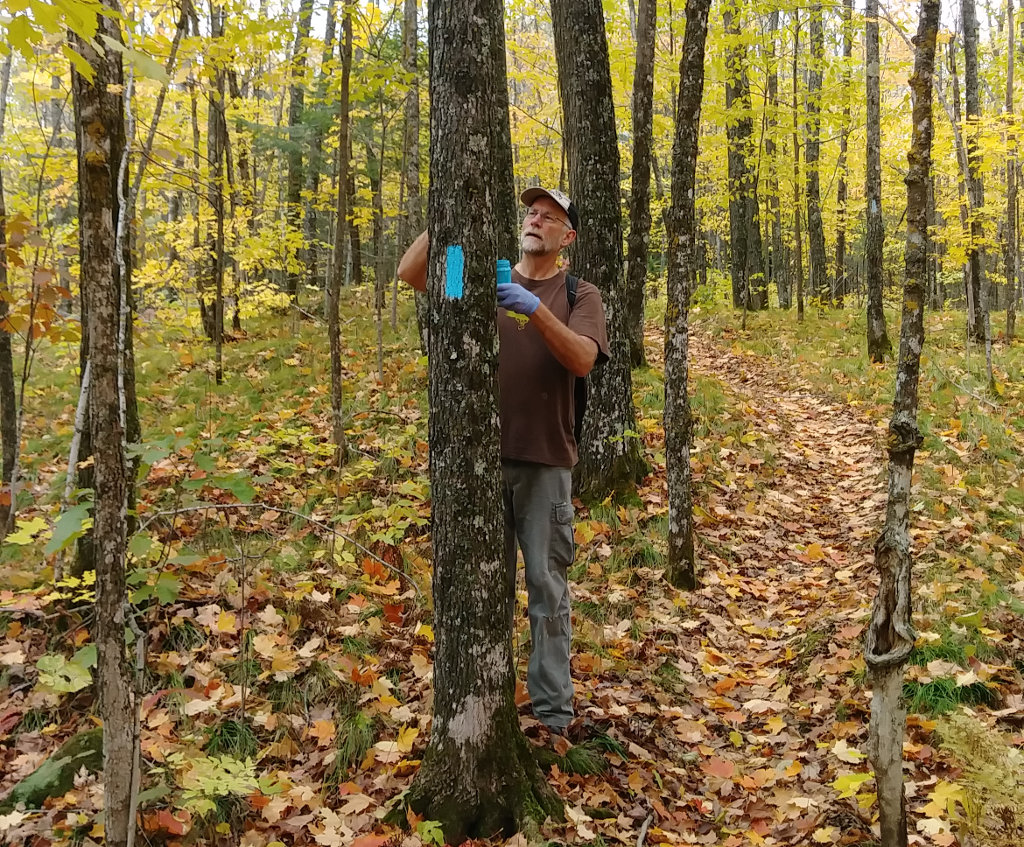
We had a wonderful weekend doing trail volunteer work on the Superior Hiking Trail this weekend. We painted blazes on about 17 miles of trail as our part of the #BlueBlazeBlitz that saw pairs of volunteers blazing the majority of the 300+ trail miles along the north shore of Lake Superior.

The trail was completely blazed in 2006-2007 by two people contracted by the SHT Association. At that time, the standard of a vertical blue blaze measuring 2-inch by 6-inch and positioned about 6 feet from the ground every 1/10th mile was set. Over the past dozen years, those blazes have faded, or the trees they were on have fallen. On my thru-hike, I joked that the SHTA should use a paint that wouldn’t kill the trees since I saw so many on the ground. 🙂

Our blazes in 2019 are still blue, and about the size of a dollar bill, but we were instructed to place them about every 100 yards, so they are about half the distance apart as the originals.

#HikeThatSHT
The process is pretty simple.
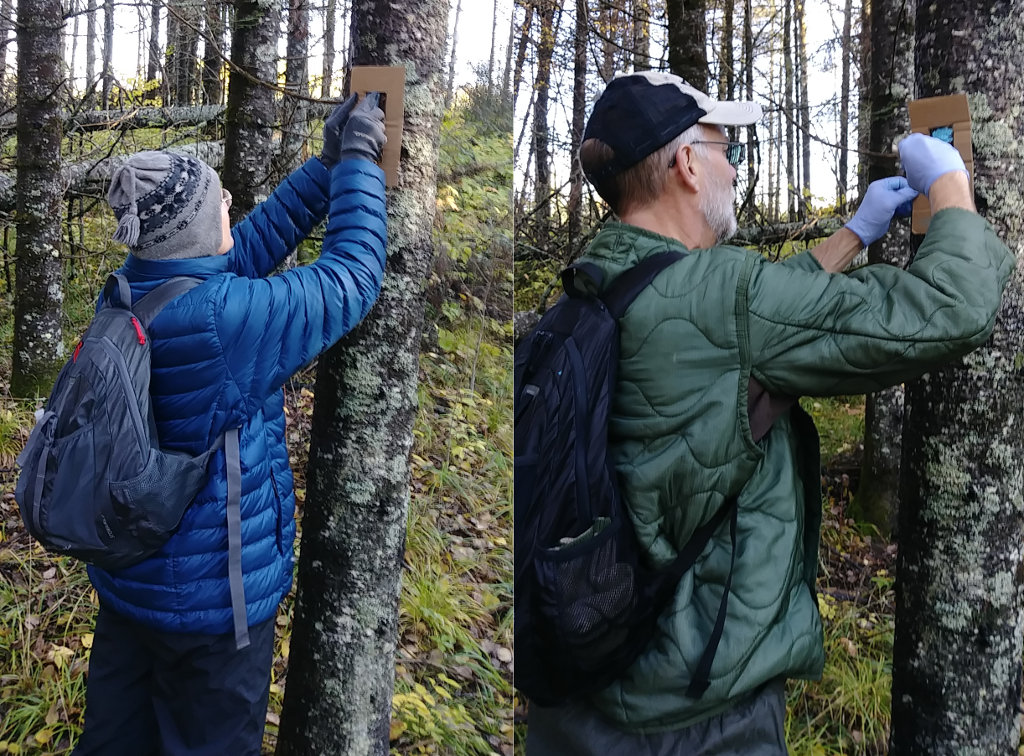
Count 100 steps and find a tree for a blaze. Clean an area 6 feet up. Paint the blaze. Repeat 20 times every mile. But, there are some things to learn to make ‘good’ blazes.

  • A Good Tree is large enough to fit a blaze on, not a spindly sapling. Birch and White Pine should be avoided because their bark peels or flakes and won’t hold the blaze long. A tree that is visible from far down the trail works well, rather than one just around a corner, or covered by brush.
  • Scraping off lichen, moss, and debris to create a smooth canvas makes for a better blaze. We were given a template and scraper to define the blaze location.
  • Using a small amount of paint and brushing up from the bottom reduces newbie drips.
  • If there’s an old blaze in the general area that would work, just repainting it is the thing to do.


2019 Superior Hiking Trail Blue Blaze Blitz
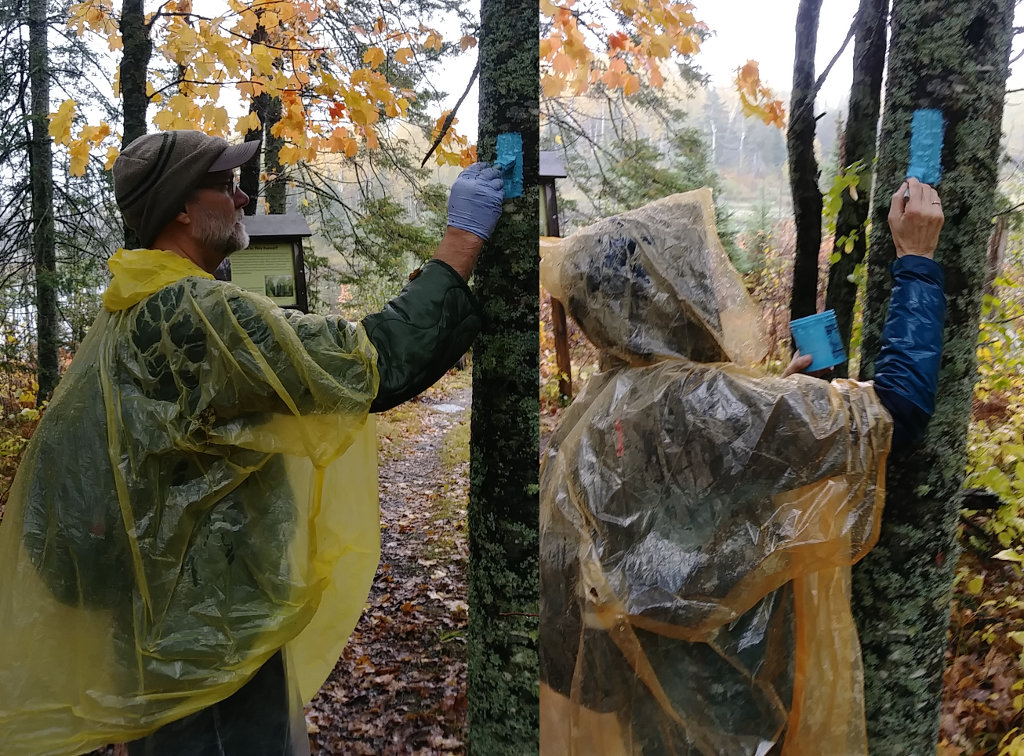
For our volunteering, we blazed on both Saturday and Sunday. Our longest assigned section was on Saturday and it rained the entire day, non-stop. But, we were told the blazing would go on ‘rain or shine’, so we successfully covered the 5 miles out and 5 miles back in about 7 hours. After we finished, we learned that some groups chose to not blaze due to the rain, so now we hope our blazes hold up. We did meet another blazer leaving the trail and she had done her section – Good Job!
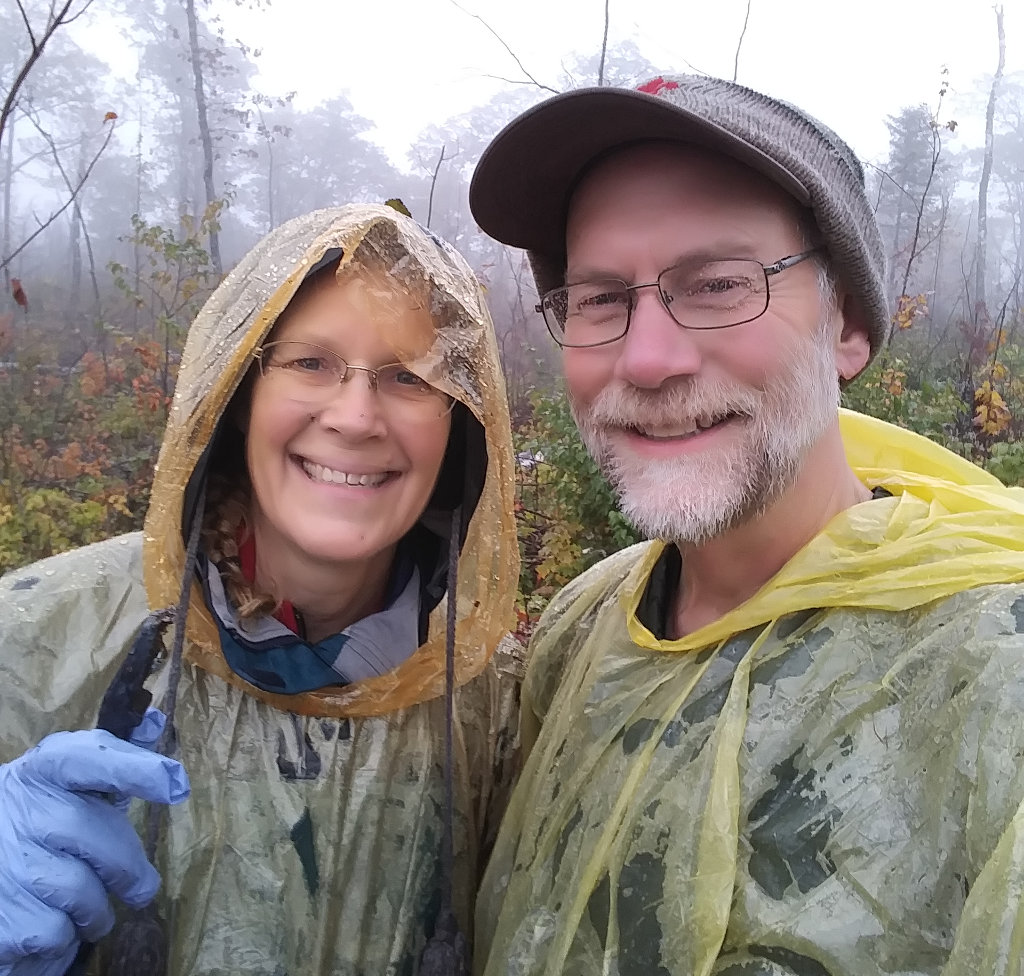
You can see we are wet under our disposable rain ponchos. Most of that was from perspiration being trapped and we were plenty warm the entire time. The only time I cooled off was when we stopped for a quick lunch in a very convenient snowmobile shelter along the trail. As long as we were walking along, it was comfortable – wet, windy, and cool, but still comfortable.


SHT hike report
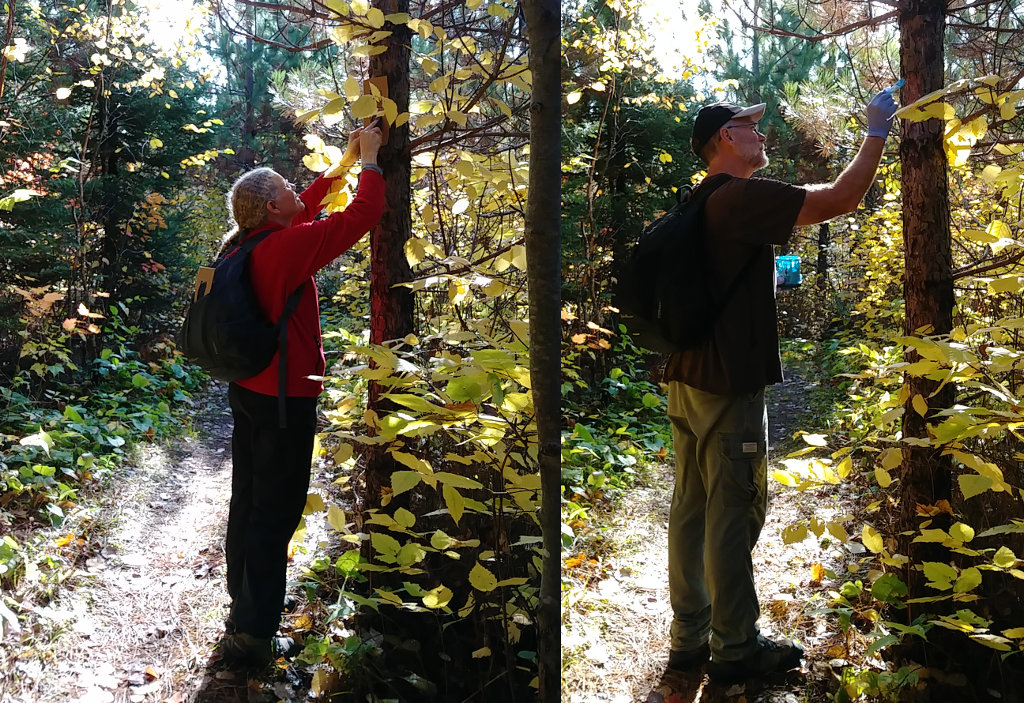
Sunday’s hike was so much more fun! The sun was out and it was a perfect fall day. Our second section was 7 miles round-trip and the blazes were much easier to paint without rainwater to deal with.

We tromped through a lot of water left over from the storm, but stayed dry overall. A nice lunch at the Big Bend campsite at our halfway point was our only rest in the 5 hour hike.


2019 SHT #BlueBlazeBlitz
It was nice to be out in the woods at this time of year. Lots of colors changing, cool temps, and no bugs. These were just a few of the beautiful trees we passed. My favorite part was walking through a maple forest with a canopy of orange and red lit by sunshine.

If you take advantage of hiking on trails, please consider contributing to their maintenance. The SHT is volunteer maintained, as are many trails across the country. It takes many hours of commitment by many people to keep trails open and available for you.

2019 Superior Hiking Trail Hiking Dude
Hike On

SHT Blue Blaze Blitz Read More »

Making Decisions Under Stress: The OODA Loop

This is a Guest Blog Post by Adam A. Lawrence

We
all know that if it can go wrong, it will go wrong. How would you make
effective decisions when your emergency plan falls apart around you?

Remember this acronym: OODA.

Massive wave from a storm surge overtaking a boat dock.

What is OODA?

OODA stands for Observe-Orient-Decide-Act.
The concept of the OODA Loop was created by United States Air Force Colonel
John Boyd. It is a decision making tool used to make effective decisions based
on the current circumstances of a given situation. The first step is to Observe
your surroundings and take into account the conditions around you. The second
step is to Orient yourself within these circumstances and understand how
they are or can affect you. The thirds step is to Determine the best course
of action to improve your current situation. Finally, the last step is to Act
on your current analysis. This process repeats until the crisis has passed.

            Like most tools that we have at our disposals, the benefits of the OODA Loop are best determined when put into action. So let us examine some real world examples of how I have applied it during emergencies.

Superstorm Sandy

In late October of 2012,
Superstorm Sandy slammed into the East Coast of the United States, killing 285
people and causing $68.7 billion in damages. I was living and working in the
path of the storm. Though I did not experience property damage due to the storm,
my home was without power for 13 days. I had filled my gas tank prior to
landfall, but after a week of commuting and navigating detours and traffic, I needed
gas. When I went out to fill up, I saw lines at the gas stations over a mile
long and witnessed fistfights as restrictions were put in place, and stations
were selling out.

            I had to decide what to do. Observe – I saw the long lines and fights at the stations at
every local gas stations. Orient
– I had a quarter tank left, and all local stations were plagued by these problems.
My state has very strict self-defense laws, and I didn’t have anything to get
myself out of a violent situation, if it occurred. Determine – I had family who lived about 30 miles south, in
an area that had not been as damaged. With my level of gasoline and the hazards
of waiting in line in my current area, I decided that my best course of action
was to drive south. Act – I
drove south, found a gas station with a line that was only ¼ mile long and
filled up.

In anticipation of an impending natural disaster, gas stations will be overrun with people eager to fuel up and drive great distances to safety.

Winter Storms

            In 2017, I moved closer to family members. Since then,
there have been many winter storms and sub-zero temperature dips. During these,
family members have lost power and my old furnace stopped working. No power and
no heat can be dangerous in mild weather, let alone during extreme conditions.

            Observe – My family and I would monitor weather forecasts and expected conditions. Orient – My home is the only home that has a wood burning fireplace. Additionally, we have a stock of firewood. Determine – We decided that as homes lost power and heat, everyone would come to me. The fireplace would be unaffected by a power loss. Act – Family members would pack overnight bags to have ready if they had to move out.

A warm fire never fails–even when the power goes out.

Severe Windstorm

In July, my town
experienced a severe windstorm. I was on the road at the time, and could feel
my vehicle shaking against the gusts. Hanging traffic lights were held
horizontal as the sustained winds tore by. When I arrived home, I found a large
portion of one of our two chestnut trees had ripped free and had narrowly
missed my home. Though this is a small-scale emergency, I applied the OODA
Loop.

            Observe – I looked at the damage that the tree had caused. Luckily, it had missed the incoming power line. Additionally, the winds were still blowing strong. Orient – I quickly realized I had parked under the second chestnut tree. Tree branches were blowing close to the power lines and power lost could occur at any minute. Determine – I needed to move my vehicle, get inside to avoid falling and flying debris and preemptively retrieve my blackout kit. Act – I moved my vehicle to an area free of trees and went inside to avoid debris and retrieved my blackout kit.

Fallen tree

Most emergencies that we
experience in our lives are not widespread. The ones close to home are the ones
we need to deal with the most. There are benefits in preparing for the worst
however, and the tools to help prepare for large-scale disasters should be able
to be applied to our everyday crises as well. The OODA Loop is just like any
tool. We should know how to use it, we should practice it and it should be able
to be applied to most situations. There is also the benefit that knowledge
weighs nothing and knowing how to make decisions effectively can be the
difference between surviving and thriving.

Adam A. Lawrence is an author, web content writer in the fields of emergency management and emergency preparedness and private sector security and safety professional with over 10 years of experience. Visit his Facebook page at https://www.facebook.com/adamalawrencewriter/ for more information.

The post Making Decisions Under Stress: The OODA Loop appeared first on WillowHavenOutdoor Survival Skills.

Making Decisions Under Stress: The OODA Loop Read More »

Finding Your Perfect Everyday Carry (EDC) Lighter

This is a Guest Post by Jeremy Rogers

EDC lighters I have carried over the years.

If you’re like me, you probably have a lighter
as part of your EDC. It’s hard to imagine life without one. I’d like to briefly
discuss the ones I’ve used in the past, as well as my current EDC lighter.
Moisture resistance, fuel retention, and durability are the main attributes I
look for in an EDC survival lighter. Other features are nice, but these are the
most fundamental and important aspects, in my opinion. I’ve used the standard
BIC, BIC Mini, Zippo, QIMEI Peanut Lighter, and the Anodized XL Maratac Peanut
Lighter.

BIC is the first lighter I carried for a long
time. I still use them around the house, at camp, and for survival kits. Water
and leak proofing a BIC has been challenging. I always worried about fuel
leakage if the ignition button became held down in my pocket. I put a zip tie
under the ignition button to prevent this from happening. Unfortunately, this
makes the lighter inconvenient to use if it’s needed quickly. Also, because the
zip tie has to be cut off to use the lighter, replacement zip ties have to be
carried.

I started using a Zippo about three years ago.
Zippo has an optional belt pouch with a metal clip and a fuel canister that I
purchased. My Zippo hasn’t failed me yet. I fretted over the case getting bent
because I’ve heard of this happening. However, the main issue I’ve had is fuel
evaporation. I used a piece of bicycle inner tube to prevent this. It helped,
but it didn’t eliminate the problem. Plus, the inner tube made the lighter
inconvenient to deploy and it tore easily.

While searching for something better, I ran across peanut lighters. The QIMEI was my first one. It came with a spare O-ring, flints, and a wick. It’s durable, leakproof, and waterproof. The only problem I’ve had is that its tiny size makes it difficult to hold and it gets hot fast. Other than that, I liked the design better than anything I’d found until that point. I later obtained a Maratac Peanut Lighter as a replacement for my QIMEI. The Anodized XL Maratac Peanut Lighter is my current EDC survival lighter. I’ve carried it on my keychain for almost a year now. I’ve never had a single problem with the Maratac. Its larger size makes it a lot easier to grip and light. Spare flints, wicks, and O-rings are sold separately

THE MARATAC PEANUT LIGHTER IS WATERPROOF

The Maratac Peanut Lighter comes with a rubber
O-ring to seal out dirt and moisture. Neither one of these has affected my
Maratac. I put a small amount of lip balm or Vaseline on the O-ring and threads
as an extra precautionary measure against moisture. The aluminum case also
makes this lighter impervious to the elements.

The Maratac Peanut Lighter is a strong option for a dependable EDC lighter.

THE MARATAC IS LEAKPROOF THANKS TO THE O-RING

I have not been able to note any fuel evaporation for the long length of time that I have carried this lighter. I’ve also never had a skin burn from fuel leakage while carrying the Maratac in my pocket. Skin burn from fuel evaporation is a reason that I carried my Zippo in a belt pouch. 

THE MARATAC IS DURABLE

It’s built like a tank due to the robust aluminum case. The case is considerably thicker than a Zippo’s. It can be used as a waterproof container for small items by removing the brass insert. My Maratac has some cosmetic wear, which I expect.

Aluminum casing for the Maratac is durable and can double as a watertight container to store other items, like tinder.

The Maratac peanut lighter will hold five extra flints at the bottom of the brass insert. I still carry my Zippo fuel canister along with my Maratac lighter. I’ve carried the fuel canister for a long time and it’s never leaked. I can use the extra fuel as a firestarter in poor conditions. I keep a spare wick coiled inside the cap of my fuel can. I’ve been very pleased with my Maratac lighter. I can no doubt make it last a very long time if I had to.

I still carry my Zippo fuel canister along with my Maratac lighter.

I hope you’ll find something useful in this article. I’d love to hear your thoughts and thanks for reading.  

Jeremy Rogers is an up and coming freelance writer. His blog address is http://www.heritageoutdoors.net.

Finding Your Perfect Everyday Carry (EDC) Lighter Read More »

Gear Review: Epic Water Filters Nano Pitcher and Nalgene OG

We should all take a moment to appreciate that here in the US, most of us have access to clean drinking water. Not everyone is so fortunate. When I was growing up, we didn’t have city water. Occasionally the well would go dry, and we’d have to gather up some quarters and haul water from the water tower. Even when the well was dry, we could still get water easily. The upside of that was whenever there was a boil advisory, or zebra mussels invaded the water tower, it didn’t affect us.

By J. Bridger, contributing author to SHTFblog and Survival Cache

My hometown has great drinking water, and frequently places in the top 5 for tap water worldwide.  I bet you didn’t know there were world championships for tap water taste, did you? I am spoiled when it comes to drinking water. So, when Epic Water Filters sent me their new Nano Water Filter Pitcher ($59.95) and a 32 oz. Nalgene OG Filtration System ($34.95 with Nalgene bottle included!), I was really pumped. The tap water here in Las Vegas sucks. I don’t like buying plastic bottles, so I’m stuck drinking water that tastes like someone collected runoff from Bigfoot’s butt crack.

The Nano pitcher has a 3.5L capacity, and water trickles through its filter in 5-10 minutes. According to Epic Water Filters, it filters out all kinds of things – some I’d never even considered. Microorganisms don’t stand a chance. It removes 99.999% (Sometimes you get another 9 tacked onto the end of that, or “log 6” removal) of: Pseudomonas, Giardia, Cryptosporidium, E. coli, and Klebsiella. (See the full report of all contaminants the Nano removes here) If you haven’t heard of the 1993 Milwaukee Cryptosporidium outbreak, you should read about it. Over 400,000 people developed gastroenteritis-like symptoms due to drinking water contamination. The point is, bad water can and will happen in modern times. The Epic Water Filters Nano Pitcher also removes heavy metals, fluoride (not sure if that’s good or bad, depends who you ask I suppose), nearly 50 pesticides, herbicides, nearly 100 organic compounds, and pharmaceuticals. One interesting thing to note is the filter removes testosterone and progesterone. There are a lot of studies out there about exogenous hormones, and how they affect infants and children. Infants have very sensitive androgen receptors, and excess hormones can cause them to grow excess breast tissue (males too!). Children in the US are experiencing puberty earlier, and they think hormones in the environment could be why. Sounds like hippy shit, I know, but there’s a lot of compelling data out there (Check out “The sensitivity of the child to sex steroids: possible impact of exogenous estrogens” (by the University Department of Growth and Reproduction, Rigshospitalet, Copenhagen, Denmark). Bottom line is, this filter removes tons of things you don’t want in your water.  

Despite my hometown’s top tier tap water, its infrastructure is aging, and water line breaks are common. When the summer months come around, you can bet there will be issues. Often, there are boil advisories. Most of the time this is nothing more than a nuisance, but you never know. If there is a boil advisory, sometimes you may not know before you’ve guzzled your morning liter. If you’re sipping clean water from the Epic Water Filters Nano pitcher, you don’t have to worry. Filling this is much more convenient and efficient than boiling water and waiting for it to cool. Obviously, this won’t provide good water if it isn’t flowing, like when a 20” raw water main broke in 2014, and brought the entire county to a halt:  When this happened, restaurants closed, businesses lost money, gas stations jacked up the price of bottled water, and even the local hospital wasn’t able to provide water for their cooling system. Luckily there were no structure fires or grass fires, or the county could’ve had a huge problem. You should keep this in mind and have plans in place should you need to source water from somewhere other than your tap and purify it. This might be a swimming pool, rainwater collection system, or nearby reservoir. This was a stark reminder that the amenities we enjoy are artificial and fragile. No one was bringing bottled water to my door, but that was fine with me. We had a well. 

Also read: Survival Gear Review: Epic Water Filters The Answer Nalgene Filter

How does the water taste through the Epic Nano pitcher? A hell of a lot better than it did before it went through. It makes off putting Las Vegas water taste fresh and clean. One of my favorite features is the filter indicator. It shows you how much life is left in the filter (based on a 90-day estimate. It filters 150 gallons). One filter lasts two people 3-4 months. The last pitcher filter I had didn’t have this. You knew the filter needed to be changed when the water developed an acidic taste, almost like someone had put lemon juice in it. There is a flip top on the lid you can open with your thumb, so you don’t have to remove the entire lid. It’s a small detail, but one I appreciate. Taking into account how often boil advisories occurred back home, the lackluster drinking water here (mostly due to my refined palate, I’ll admit),  and my own paranoia, this pitcher is a home run. I’ll be purchasing a replacement filter when the time comes. You can even set it up to receive filters automatically. If that isn’t enough, it comes with a lifetime warranty and is made in the USA. Epic!

Portable Filtration, OG Style!

Epic Water Filters also makes a wide mouth Nalgene OG filtration bottle. These bottles hold 1 liter (about 32 ounces) and are nearly indestructible. The filter cartridges come in two flavors: the black-colored Urban (75-gallon life, comes standard with the Nalgene OG) and optional orange Outdoor (100-gallon life, also $27.95). Like the pitcher, the Epic Nalgene OG carries a lifetime warranty and is made in the USA.

I took the Epic Water Filters Nalgene OG with the orange Outdoor filter on a day hike in the Spring Mountains. Right away, its strengths were obvious. The flip-up mouthpiece in the OG’s lid doesn’t leak, but I’d still store it in your pack right side up. Because my hike was along a running stream, I didn’t have to carry any water. Water is the heaviest thing in my pack, so that was a huge plus. Whenever I got thirsty, I just scooped up some water, drank as much as I wanted, and dumped the rest. It was convenient and made the hike much more enjoyable. It takes some effort to get water out of the straw, but it’s not terrible. If a spring is shallow, it can be difficult to fill your bladder or bottle. You should consider this and pack a collapsible cup or something similar so you can scoop or suck water from the source to treat.

In my opinion, the best thing about the Epic Nalgene OG filter is how convenient it is. No boiling, no waiting, no chemical taste. Just scoop and go. It really shines when you are near a water source, like a stream or lake. If watering holes were a little more scarce, you would want to consider something with a higher capacity you could fill and transfer over to this bottle (though Epic Water Filters makes the Nalgene OG Grande with the larger 48 oz. bottle if you need more capacity) Don’t underestimate how much water you may need if you are working hard, or if it’s hot outside. I recently completed a 19-mile trail with about 6,000’ of elevation change. Elevation varied between 7,400’ and 10,400’. It wasn’t hot, but it was dry; I drank six liters of water between 7am and 7pm. There was only one spring and thank goodness it was flowing.

Listen! The Survival Cache Podcast – EDC

If you have a bugout location, you should study the route for water sources. If you live in a rural area and work away from home, you should study your route home. If water sources are abundant, this would be a great option for your bag or vehicle. Too many people are guilty of throwing a LifeStraw in their bug out bag and considering it an adequate treatment strategy. You need a way to carry water, and at least one back up treatment method. Pairing this bottle with a bladder and some tablets or drops would set you up well in the water department. If you EDC a backpack or messenger style bag and regularly carry a water bottle, you could use this bottle and stow the filter away for “just in case” scenarios. You could have clean water wherever you are, at a very tiny weight expense.

 The biggest drawback is lack of gravity flow. If you want to use filtered water to cook or wash, this won’t work. If you could squeeze water out of this bottle into a bladder or cooking pot, it would be perfect. Despite that, this filter and bottle combo has a place in my pack. The convenience and simplicity of the Epic Water Filters Nalgene OG filter make it a home run for any EDC, bug out bag, or hiking kit. 

 

Gear Review: Epic Water Filters Nano Pitcher and Nalgene OG Read More »

Consumer Reports Article on Privacy

I worked with a writer/editor at the Consumer Reports magazine to help them understand OSINT and cyber security risks from old, unused online accounts. They wrote a great, easy-to-digest article that you can find https://www.consumerreports.org/digital-security/how-to-find-old-online-accounts/

Also noted this article on my company’s Spotlight Infosec web site https://www.spotlight-infosec.com.

Consumer Reports Article on Privacy Read More »

A festival of pie.

Tomorrow we’re attending a Thanksgiving celebration hosted by DF’s son and daughter-in-law, and we’re not going empty-handed. He’ll be doing a turkey in the oven plus prime rib on the Weber, and I’m bringing three pies.

Not just any pies, mind you. These are Alaska pies, made with fillings grown less than three miles from where they’ll be consumed.

Specifically, they were grown in our own dirt. The apple pie filling was made mostly by DF over many days in August and September. He sliced the Nordland apples and mixed them with sugar, cinnamon, and a dash of ginger and nutmeg, then froze the result in pie-sized portions.

Lots of pie-sized portions: We have enough filling for more than two dozen desserts. Although the trees are less than five years old, the weirdly warm summer had them producing like gangbusters.

The second pie will be raspberry and rhubarb, with a hint of cinnamon. The berries went nuts this year, too, producing nearly three dozen quarts for the freezer, a bunch eaten fresh, and still more picked by family members. (Especially DF’s granddaughters, who love eating a path through the patch.)

And the last pie will be the best pie: pumpkin. It’s one of my favorite flavors anyway, and this one is special because it was the first year we tried to grow pumpkins. Although it was a jack o’ lantern cultivar rather than a pie pumpkin, that didn’t seem to matter much. Frankly, I had my doubts when I made a test pie a couple of weeks ago, since the pulp was a bright yellow. (See the illustration above.) But apparently it’s the cinnamon, ginger and cloves that are mostly responsible for the orange/brown hue of pumpkin pie filling.


Another reason for the color: Since the homemade puree was a bit on the bland side (not that pumpkin is known for its strong flavor), I added a splash of molasses to liven things up. And oh, my, didn’t the molasses and ginger dance well together, especially since I used brown sugar instead of the white sugar the recipe calls for – and brown sugar is, of course, flavored with molasses.

Every bite of those pies will remind me of summer hours well-spent. We cheered on nascent pumpkins (and sighed over the ones that didn’t take), harvested fungo-bat-sized rhubarb stalks, dodged yellow jackets in the berry patch and gazed rapturously at apple trees so heavily laden that we had to rig up a cloth sling to keep one tree from breaking under the weight of all that fruit. The Nordlands were visible from the living room, ruby dots among the green, green leaves.


Thankful for pie


Right now only the bottom crusts are completed. Well, ready to be completed. They were par-baked earlier this evening, then cooled and wrapped until tomorrow.

At that point I’ll stir together the flour and salt, and put this and the shortening outdoors to chill. Normally I put the mixture in the fridge, but there’s no room right now because DF got a really big turkey.

A couple of hours before I want to do the baking, I’ll take out a package of apples to begin thawing. The raspberries and rhubarb will be mixed with sugar, cinnamon and a little flour while they’re still frozen; I don’t want them to give off too much juice before it’s time to bake. The pumpkin puree is already thawed and in the fridge; it needs to drain it a bit more to get the right consistency. (Next year we’ll be more careful about that.)

I’ll have to bake in stages. If the apples thaw too much they, too, give off an excessive amount of juice, so the first top crust I roll out will go on that pie. The next crust will top the raspberry-rhubarb, and while those two bake I’ll make the pumpkin custard for the last pie, which doesn’t need a top crust.

The house will smell absolutely delicious, and I will need to exert considerable self-restraint to keep from eating a piece of each of the three. The fact that we’re taking them to a gathering will help me keep my hands to myself.

Besides, it’ll be worse the next day, when DF is stirring up gravy and carving the prime rib and turkey (taking the meat over pre-cut makes it easier on the buffet setup). At the very least I’ll be standing by with a glass of iced tea and a shaker of salt, ready to pounce on the crispy parts of the turkey skin. That, to me, is the best part of the Thanksgiving dinner.

So yes, I’m thankful not just for having enough to eat, but having a variety of delicious foods. I’m thankful for my daughter, who is blooming after a difficult divorce. I’m thankful for midlife love that grows deeper every day. I’m thankful for extended family, and great friends, and the chance to do work that helps people help themselves.

In short, I’m thankful for a life that’s richer than I ever imagined it could be. And I hope that you, dear readers, have joy in your own lives, on Thanksgiving and every day.

The post A festival of pie. appeared first on Surviving and Thriving.

A festival of pie. Read More »

New Guy, welding student from Phoenix AZ.

Hello,

Well im new to forums, and im actually new to welding. Im currently a student at RSI (which is partnered with Tulsa Welding school.) So this is the beginning of my journey into a career of awesomeness. Im currently finishing up the first phase of our school. Which is all SMAW from all angles. I loved everything about it, but vertical was a pain in my nalgas. 😉 I hope to learn as much as i can from the masters of the craft such as yourselves, and i look forward to communicating with you and hopefully sharing my progress and getting advice.

New Guy, welding student from Phoenix AZ. Read More »