If you are new to prepping in general you have probably already read and heard about the concept of bugging out. Or perhaps you are a relatively green prepper, and have not tackled this “big ticket” item on your prepper To-Do list.
Whichever the case might be, bugging out is in some ways a sort of central tenet to the idea of prepping as a lifestyle and personal choice, and you should not neglect it.
The only trick is knowing where to start! Do you bug out on foot or by vehicle? Both? How much stuff do you take, and what kind? Is bugging out temporary or a more permanent measure?
What else do you need to know? Where do you start? What should you do first? All questions that are asked regularly for those new to the concept.
Happily, you have come to the right place. In this article I’ll present an A-Z guide on bugging out: what it is, what it means, when you should do it and most importantly how to plan, prepare for and execute a bug out by foot or by vehicle. We’ll be digging into a lot of content and you’ll have plenty of additional reading after this article so let’s get started!
What is Bugging Out?
Plainly stated bugging out is simply a self-starting evacuation. More specifically, it means you choose to evacuate your home or shelter location and typically proceed to one of several pre-selected secondary shelter locations.
This is all done in response to a threat of some kind, be it emergent or current. You may choose to bug out via foot, using a vehicle of some kind or both depending on the situation, your plans and your destination.
Some preppers are passionate that “bugging out” is a specific subtype of evacuation, one in response to a situation or threat where you are never coming home.
I think this type of thinking is too narrow: there are plenty of events that you can reasonably expect will end and allow you to return to your home, but they are bad enough, dangerous enough that you will still want to get the hell out of its way!
Bug-outs might be shorter or longer term in duration, with some preppers choosing to make the distinction of long-term bug-outs by calling them INCH events, INCH standing for “I’m Never Coming Home.”
Regardless of duration, any time you decide to grab your bag and head for the proverbial high ground you can be sure you are “bugging out.” Speaking of your bag…
Meet BOB: The Bug-Out Bag
The other major component of bugging out is taking the supplies with you that you’ll need for basic life support while you are en route and potentially at your destination.
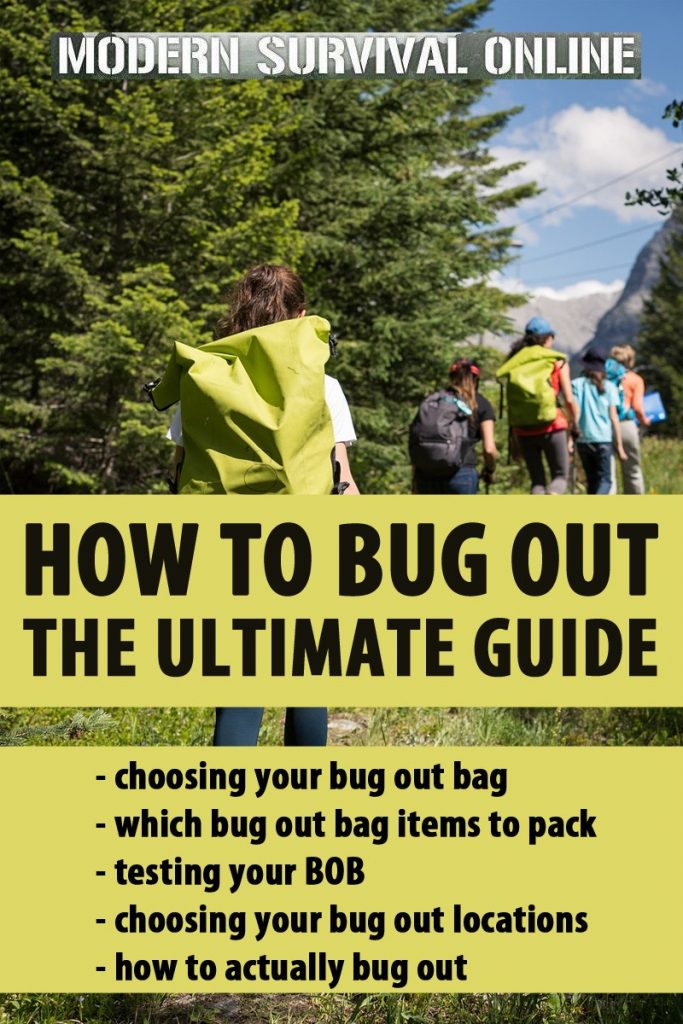
To accomplish this you’ll rely on the most foundational piece of bug-out gear: the bug-out bag, commonly abbreviated as the catchy acronym BOB.
BOB’s are defined by being intended for use during and packed for a bug-out event. BOBs should always be kept ready to roll out at a moment’s notice with everything you’ll need or think you’ll need contained therein.
Don’t leave your BOB half packed or empty to be filled when the “call” comes in; a BOB that is not packed is not worth much when minutes count!
To make sure you aren’t running around frantically while the sky is falling, or about to fall, always keep your BOB loaded, checked and set in a place where you have planned to retrieve it and don it before taking off into the wild blue yonder.
Don’t dig through your BOB for tools or supplies you want or need just because it is convenient- treat your BOB like the piece of emergency equipment it is.
That being said, chances are your BOB will contain items that expire or otherwise have a shelf life. You should set up reminders and have a schedule for checking on or rotating out those items which will or might have expired so you aren’t disappointed and left flapping in the breeze with dead batteries and spoiled rations.
You Haul It: Choosing a BOB
Preppers will argue without mercy or end as to what kind of pack is bet for a BOB. What brand? Should it be frameless or a framed pack? Internal or external frame? Should you go with camo for discreetness or a brighter color for visibility?
No matter what kind of pack you are thinking of buying you have three main concerns, in no particular order since they are all important. First, your BOB has to have ample capacity carry everything you’ll need while enroute to your destination and once you get there, if your location does not have any supplies pre-emplaced and waiting for you.
Second, it has to be durable, since the rigors of bugging out and carrying a heavily loaded pack over rough terrain is a far sight more demanding on man and material than hauling a load of books to and from class or toting a gym bag into the gym.
Lastly, your BOB must fit you well. This is something better covered in another article here on the site, but suffice it to say that a poorly fitted or poorly fitting pack will become nothing short of torturous when loaded.
This will sap your strength and stamina as well as your morale, making you more susceptible to injury. Remember, you will be carrying your pack on your back for many miles if you go by foot.
Even if you plan to take a car to your destination there always exists the possibility you’ll have to abandon the vehicle and run for it. If you do nothing else, grab your BOB and go!
Also, lastly, it goes without saying you want a bag that is a proper backpack, preferably with a belt and chest strap as well as shoulder straps. This is the only design that will permit you to carry and control it for long distances of travelling on foot.
Things like suitcases, shoulder bags and the like should not be considered at all unless you have, literally, no other choice at the moment.
Everything Except the Kitchen Sink: BOB Contents
Any BOB should contain the essential items needed to support life. Unfortunately, this is not your Precious Moments figurine collection or that wicked pirate ship in a bottle model. You’ll need a variety of gear and provisions to give yourself the best chance of bugging out possible.
You’ll need to cover your fundamental needs for life. That means shelter, to regulate your core temperature. You’ll need a way to procure clean, drinkable water. You’ll need food, for energy. You’ll also need weapons and tools for self-defense and for getting work done efficiently.
A short list of items you’ll likely need and want to have in your BOB:
- Water and Water Purification: Bottles, canteens, filters, steri-tabs.
- Food: Stable, high calorie meals ready to eat with little or no preparation.
- Shelter: Seasonal and weather appropriate clothing, bivy, tarp, flyweight tent.
- Fire: Lighters, matches, ferro rod, fire steel, tinder.
- Lighting: Flashlights, headlamps and plenty of batteries.
- Weaponry: Guns, knives.
- Tools: Hatchet, machete, bush knife, folding saw, pry bar.
- Hygiene Kit: Toothbrush, toothpaste, baby wipes, foot powder, soap, hand sanitizer.
- Medical: basic first aid kit with medicines, trauma kit.
Get a full list here.
A quick note on hygiene: before you consider leaving out your hygiene kit as “unnecessary” or just luxury items keep in mind that keeping clean is not just good for social success and feeling good, it is a necessary preventative measure to keep yourself mobile and healthy.
A skin rash that develops from you being plain dirty and unwashed can bloom into a nasty infection that will derail you. Dirty, wet, gross feet will blister readily and develop all sorts of fungal infestations.
Your private areas are likewise hotbeds of germ activity, and the longer they go unwashed the greater the chance of contamination.
Your teeth also need care. While your teeth are usually very slow to decay and break down, regular brushing will help prevent all kinds of gum related issues, not to mention bad breath that would knock a buzzard of a garbage truck at 50 yards.
Consider the second order effects; if you have others in your group, or just people in close proximity, would you rather be around people who smell nice or at least don’t reek, or be trapped in a miasma of stinking, fear-soaked unwashed humanity?
Don’t underestimate the power of cleanliness for morale boosting!
This represents the minimum you will want to carry, modified for your local climate and terrain, of course. I and other authors have delved deeply into the minutiae of BOB packing lists and breaking down precisely what you’ll need here on this site in other article
I suggest you dig into those as soon as you are finished digesting this one.
Trying it on for Size: Testing your BOB
One of the worst things you can do as a prepper making ready for a true big-out scenario, especially one by foot, is to neglect getting both your body and your BOB ready for movement under load.
Most people never have to carry any amount of weight on their backs over any distance. This means your body, even if you are fit, will not be “hardened” to the task and, boy oh boy, you will suffer if the time ever comes you have to do it for real.
This means you’ll need to practice hiking or at least walking with a pack that has some weight in it, and approach this training task as you would any other: like a prepper, with an improvement and better capability as the end goal.
To do this, you’ll start “rucking” like you would any other new activity or workout regimen: slowly with little weight, increasing distance, speed and weight as you improve.
Once you attempt this, even carrying something as light as a 15 lb. BOB, you’ll notice a drastic decrease in performance and an increase in exertion (and soreness!): your body’s tiny stabilizer muscles in your trunk will be little used to such hard work.
Likewise, your legs will be working overtime to support the additional weight and your feet will be taking a pounding. You will especially notice the sore shoulders from the pack’s straps pressing into you. While they may not be painful, they will leave marks!
All of this can be ameliorated by dedicated practice. The more you work on your rucking, the better prepared you’ll be for long, tiring movements by foot with a loaded BOB in tow!
The other goal you’ll accomplish simultaneously while strengthening your body for the rigors to come is a proper shakedown of your BOB and its loadout.
It is here, during an accurate simulation of actual use that you’ll discover any flaws in your pack’s configuration or load order, defects in its, material or construction, and any nagging issues with ride or fit.
Don’t wait for an actual event to discover your BOB’s straps chafe you painfully, or that you can hear and feel stitches in the panels pop-pop-popping right before spilling your vital, life-sustaining gear out onto the muddy trail.
It is only by proper hard-use testing and benchmarking that you can say for certain both you and your BOB are fit for the brutally unforgiving task of survival.
Luggage Optional: Other Types of BOBs
While the term BOB is often specifically applied to your pack you keep loaded and ready for taking with you when evacuating, it can also be broadly applied to several other kinds of specific-use emergency luggage.
Among these various bags are the EDC, or Everyday Carry bag, Get Home Bag, also known as a GHB and the INCH bag, a sort of Super BOB intended to carry the majority of things you will need to survive a permanent exodus from your home.
An EDC bag is usually a small satchel or backpack that is your “daily packer,” carrying a few essentials that don’t fit in your pockets or on your person, or is used to haul a slightly expanded kit full of essentials.
A small bag like this is painless to carry and is a cheap insurance policy against mishap when you leave your home. Common items include an expanded medical complement, spare ammunition, a small toolkit and similar handy, essential gear.
A Get Home Bag is a sort of mini-BOB intended to be kept in your vehicle or taken with you on longer trips from home, carrying inside it a selection of items intended to allow you to return on foot to your home at best speed should be overtaken by some event that prevents road transit.
A GHB will often contain comfortable clothes suitable for strenuous hikes or walks, some quick-energy foods, water and simple water filtration solutions, minimalist shelter gear as well as navigational aids and some defensive tools.
The INCH bag is the kitchen sink of bug out bags, a large pack more akin to the enormous rucksack carried by an infantryman than a hiker’s technical pack.
The “I’m Never Coming Home” pack is designed to support what the name suggests, long-term sustainment living, or at least the initiation of sustainment when you are leaving everything behind.
Often, the INCH kit will have more of what you pack in your BOB, and additional items like tools that you would omit for weight and bulk concerns in a standard BOB.
Beware, a true INCH bag is often a monster, and you’ll need to be very fit or move only in short intervals on foot or go by vehicle if you are going to carry one very far.
Hitting the Road
Where the rubber meets the road, often literally, is during transit. Whatever is happening, you have made the decision to get out of town and hopefully to safety and greener pastures.
You’ll be taking off on foot or using a vehicle and will be braving a world that has likely changed radically from the one you typically see when you step out of your front door.
On foot or by automobile, you’ll be contending with masses of panicked, fleeing people, environmental threats in the form of man-made hazards or bad weather and its aftermath, destruction, rubble, general mayhem and even sadly the predations of your fellow man.
You might be lucky or good, but chances are the challenges you’ll face will be tremendous. There will be danger. Bugging out is almost always dangerous, if only because you are stepping off into unknown situations in unknown territory.
There is also the matter of knowing where you are going. More preppers than you might think make the mistake of just wanting to “take off” and find some place they can pitch their tent and wait for the whole affair that sent them scurrying to blow over before coming home.
While that may, in theory, work if you have not taken the time to scout and carefully select your fallback points, known as bug-out locations or BOLs, as well as multiple traversable and hopefully safe routes to each of them you’ll be setting yourself up for a bad outcome and will likely endure more risk during your jaunt.
It may not be cool or fun, but the majority of your work will be done when putting together your bug-out plan during the “advance” phase: that’s the part where you get all your research, scouting and general route and BOL selection done.
In the next section, we’ll tackle the nuts and bolts of planning and preparing for your bug-out, and then we’ll come back around to choosing, stocking and packing your BOB.
Start at the End: Choosing Bug-Out Locations
All your planning, all your work and the countless hours of preparation you are going to pour into bugging out is for one, singular purpose: to ensure you can get somewhere safe, or safe enough.
All of that effort will be wasted if you don’t have a good place to go. Actually, you should have multiple places to go in case your initial plans get derailed.
Where you choose to head to could be anywhere, and could be almost any place. Do you have friends or family a little ways off from your home, but still reachable by vehicle or by an on-foot journey even if it would be a long and wearying one? That is one place you might choose. How about a friend’s house similarly situated? Sure.
Maybe you have your own little hideaway for the purpose. A cabin or cottage located well away from the greater mass of humanity may make a fine place to weather a storm. A bare patch of land where you can set up camp and easily react to additional events is likewise worth consideration.
You don’t have to stick with known habitation, either. Plenty of people choose to head to a remote or secluded patch of wilderness with easy access to water for their BOL.
Others might not go very far, even choosing to stay in a metropolitan or suburban area but “bugging out” to a group of friends, family or likeminded people in a mutual assistance group for increased security in times of trouble.
The options are nearly limitless. The most important thing is you choose a place that has access to drinkable water, with “drinkable” in this case meaning water that can be reliably filtered to make it safe.
Ideally, your BOL will be defensible and off the beaten path, at least enough where the mass of people sure to be fleeing and moving around in a panic will have to wantonly detour to run into you.
Generally speaking, the more unknown contacts you have to manage, the better the chances of having a dangerous run-in.
Another key consideration: make sure you choose BOL’s that are more or less evenly distributed around the region where you live. Ideally, you’ll want to be able to head out in any cardinal direction and reach a safe haven.
The reasons for this are many: what if there is greater trouble, or potential danger brewing closer to one of your BOLs than the others? What if you are dealing with something like unrest or factional violence than could potentially make any travel highly risky?
What if a man-made disaster has sent hazardous chemicals or lethal agents into water sources or made them airborne?
Yeah, you’ll want to go the other way and quickly. It is not just a matter of being able to go the long way around.
Getting There: Movement to your Chosen BOLs
Now that you have chosen your BOL’s, it is time to decide how you’ll get there: by foot, or by vehicle, whatever that looks like. You might be able to get to some via either mode of travel, or some only by one or the other, or by a special vehicle.
Right up front, if you require a specialized vehicle to reach your BOL (helicopter, plane, boat, hot-air balloon) you should only ever seriously count on getting to that location if you or someone in your survival group has full-time control of that vehicle and can access it at the outset of the crisis.
Otherwise, it is time to get out the maps and start deducing how on earth you’ll make it to these places, and weighing the risk factors. It is important to understand the pros and cons of your given mode of transit weighed against the likely risks you’ll face in an event and let that guide your final selection of plausible bug out locations.
For instance, a hike of 10 miles over flat, gentle land is a good workout and will take time, but anyone in decent shape and with appropriate footwear could be expected to complete it in more or less a timely fashion.
Take those same 10 miles and lay it over major hills, with lots of elevation changes and rough, uneven ground.
Now we are talking about serious exertion, considerably more time, greater risk of injury and ever increasing fatigue. Crank that difficulty dial all the way up: the same 10 miles of rough terrain, only now add on a heavy pack of 50 lbs. or more, an injured partner, two exhausted, shivering, children and bad weather. Now things are serious.
A car ride of 50 miles won’t take long at all on wide open highways with free-flowing or little traffic. But if those same highways are gridlocked, or you cannot even reach your primary route since your city is a morass of jagged metal, stalled and abandoned cars and clogged bridges, your car will not count for much. What now?
The point is you truly have to consider the route in its totality with a “filter” of mayhem over it: anything that can go wrong probably will. You’ll be heavily laden, stressed out, and fighting obstacles every step of the way.
Always have a Backup: Multiple Routes for Bug-Out Success
This is a two-pronged stratagem for bugging out: you always, always, always want multiple bug-out routes leading to every BOL you choose. Reason being you might encounter an obstacle that will temporarily detour and reroute you, or you might run into a major hazard or pathway-closing incident that forces you to double back and go another way.
The more ways you know in and out of your home to your BOL’s and from your current BOL to another BOL the better. Obviously you should take pains to have at least a couple for foot travel and a couple for vehicular travel.
May your path always be clear and the sailing easy, but you must be ready for all kinds of hazards on the road.
Follow the Yellow Brick Rail, er, Road: Using Alternate Lines of Travel
Always make a note of major, permanent routes that you might not necessarily think of as pathways to and from your BOLs.
Things like rivers, railroad tracks and even large cross-country power lines (the kind you don’t want to live under). Now, the latter two aren’t truly permanent, but anything short of a colossally destructive event will not erase them from the landscape. A river is truly permanent for our purposes.
If you get completely lost, turned around or otherwise flummoxed, you can simply follow either and be assured of knowing where you’ll wind up so long as you know where they go.
Write this Down: Mapping your Routes
Now, if this sounds like a lot to remember, it sure is. You might be the mental cartographer of the county and know every crook, bend, valley and hollow like the back of your own hand having lived in Hometown USA your whole life but you must still map everything we have discussed and more to ensure you can successfully navigate to your BOLs.
Why? Simple: travelling along a route under extreme stress, in dangerous conditions and perhaps having endured a major disaster that, very literally, altered the landscape, you can probably assume you’ll need some navigational aids.
Driving to the old vacation cabin by the normal route when the sun is shining and the birds are chirping is one thing. Doing it when the sky is dark, you have had to detour four counties out of the way and you are scared out of your mind is entirely another.
Plainly put, paper remembers what your mind forgets, even temporarily. And there is always the possibility of getting forced so far off all planned and practiced routes that you are truly in new territory.
Don’t risk going without maps. At the minimum, you’ll want a greater metro area/county map showing all points of interest and roads in and out, as well as topographic maps for all BOL’s. Also never, ever go without a road atlas, if going by foot or auto. Make sure all maps stay up to date.
Avoid Ahead of Time: Anticipating Problems and Obstacles
You should plan your routes taking in to account obstacles and situational hazards. Do not underestimate how precious time is in a SHTF situation. Delays could truly cost you your life.
Any road of any kind, any path, will be vulnerable to its own set of obstacles and potentially show-stopping delays. Bridges could be damage or clogged with pedestrians or vehicles, to say nothing of the prodigious traffic slowdown they often generate in normal times.
A railroad crossing with a train parked on it will surely be a major issue if you are counting on bugging out via automobile (though people on foot could just slip between the train cars).
Rural roads are themselves not immune to problems. Trees and power lines can fall, sometimes in abundance, making them impassible to vehicles.
Before you think you’ll just hop off road and drive around recall that muddy ground often becomes a quagmire for vehicles, and soon you could be facing a recover situation, or even become immobilized.
Roads and paths can be flooded. Trails grow over or wash away. Rioters might lock down entire blocks. Fire can consume pavement and plant alike.
There is always a chance that your chosen route, the one you are counting on to get you and yours to safety, will be impassible, or too dangerous to risk.
It pays to think things all the way through. Do you know what parts of your area are easy to drive through off-road? How about which parts become dicey when on foot in bad weather?
With some luck, you will be able to go straight from your point of departure to your destination with no major delays or detours, but don’t count on it.
Steer Clear: Avoiding Hazardous Areas
Which parts of your town or city are dangerous in normal times, i.e. crime ridden? Rest assured they and the areas beyond their “borders” will be considerably more dangerous in any crisis where emergency responders are overwhelmed or knocked out.
Now, that is reason enough to avoid them when planning your routes but if everyone knows to avoid that area it could make for a relatively clear and speedy exit. You should only attempt such a tactic if you know all other routes are closed to you and staying put might mean death.
Also take note of places like chemical plants and refineries in urban areas that if damaged or sabotaged will create major dangers all their own. Also be extremely cautious around police stations, military bases and National Guard armories, not just for what is likely to be a heightened security posture but also for their susceptibility to attracting looters and raiders.
If travelling via foot, you should always be extra cautious around river crossings, swamps, loose and avalanche prone hills, and any route with steep drops.
When travelling though the lonely and remote parts of the country even as something as “inconsequential” as a sprained ankle could spell certain doom when there is no one to call for help.
Get Home to Get Away
One common thread you’ll see in most bug-out planning sessions and discussions is that they begin at the beginning. Rather, they all start with you at home when the balloon goes up.
This is of course convenient if it happens and sure would be nice under the circumstances, but chances are that won’t happen unless you are retired. Most adults spend significant, even the majority, fractions of their lives away from their dwelling, either at work or out and about on some errand or enjoyable endeavor.
This means you likely will not be home when the sky darkens, the mountains tremble and the seas roar. Unless you want to head out into an increasingly hostile world with whatever you have in your pockets, you should probably have a plan to get home to your primary stash and then make ready to bug out with the full complement of gear you selected.
Also consider what you would do if you are separated by some distance from your family, either a city’s breadth or a tens or dozens of miles. Assume you cannot just turn around and drive their way, you’ll need to get to them, post-haste.
All of the above situations make a great case for the GHB discussed above. A Get Home bag is one of those items that should stay in your vehicle or perhaps at your office if you have secure storage for it so that you will have that cache of items needed for a march back home.
A GHB is a little more specialized than a BOB, intended to allow you to move quickly, longer (fitness allowing) so you can make best speed to where you are going. It will not emphasize sustainment items outside of what is needed to keep you moving and fueled up.
GHB’s often include a defensive component as well since any confrontations that don’t end favorably for you would necessarily be a show-stopper. Other important concerns are navigation aids- maps, compass, GPS, etc. If you cannot pathfind your way home from wherever you happened to be, you’ll be in worse shape.
Think of a get home event as a sort of bug-out in reverse; you need to head for home and hearth from wherever you might be.
Momentary Respite: Note All Safe Havens
Sometimes, things just will not go to plan no matter what you do. You’ll need to stop short after a leg of your trip takes way too long. Maybe you run afoul of an injury or mechanical breakdown that means you need to “pit in” and assess the damage to man or machine.
Maybe things are just plain falling apart and it would be nice to have a place to collect your thoughts in relative safety. You need places to do this, just in case.
You don’t often want to sit dead in the water on any primary route of travel since you are significantly more likely to encounter other travelers. These travelers may not have your best interests at heart, at best being solely concerned with their own survival and at worst being willing to rob you blind or kill you out of desperation or sheer malice.
You can make things easy on them by looking like easy prey or a quick means to an end- waylaid, broken down, injured, lost or just scared, confused and exhausted.
To help prevent this eventuality, you’ll want to note any and all potential “safe havens” on your routes. What is a safe haven? This could be a structure or terrain feature that could potentially afford you better security or just more time to react to any eventuality.
If travelling by vehicle, this will be any place that will help hide or disguise your ride from view by those moving along the main route. On foot, this can be any place that lets you stay out of sight or potentially button up for rest in relative safety.
You might also count safe havens as friends’ or family dwellings; if they are staying put, you might be able to put all of your heads together for mutual security and planning what to do next. Other options include any government or civic installations willing and able to provide some measure of aid to civilians in need.
This is always a dicey proposition in major catastrophes since resources and manpower will naturally be strained to the breaking point, and several of these would-be saviors will stop functioning all together.
Also worth noting is any location that could potentially, ahem, “provide” life-saving gear or supplies. Think fire houses, police stations, EMS and ambulance bays, etc. If things become truly dire and society is crumbling, you might be able to secure critical gear from abandoned or destroyed places like those.
Consideration: Bugging Out with Pets and Livestock
Not everyone has the “luxury” of being able to stay or go with no concern or care given to any other living thing. Most of us have not only people who depend on us that we are responsible for but also our animal companions, be they money-making assets or just faithful and fun members of the family.
You should start planning now in accordance with how large the animal is and how specialized its life and care requirements are.
A dog or cat is easy enough to prepare for, being mobile and nominally easy to carry or at least able to keep up with you on foot. Dogs and cats are also “food versatile” and can survive at least on the short term with little to no ill effects.
Assuming you are planning to take your furry canine or feline with you, you must plan for taking along their specialized medication and supplements they require.
Muzzles are also a requirement: while dogs and cats are generally okay if you are okay, they can and will panic in scary situations and you don’t want you or anyone with you to suffer a bite on top of whatever else has sent you fleeing.
Larger animals like common livestock- cows, goats, pigs and so forth- will require large vehicles and trailers to move at all and doing so will dramatically complicate your bug-out plans unless you are just doing the slow highway slog away from something like a hurricane.
Horses on the other hand have the advantage of being able to carry both man and cargo on their backs. The disadvantage of horses is that they require an awful lot of food and specialized care to keep them able to work.
Managing horses, to say nothing of riding them, is a specialized skill of its own and will require considerable investment of time and energy prior to bugging out if you have any hope of utilizing a horse as a viable means of transport.
Conclusion
Having a bug-out plan is something fundamental to prepping, but for as much as it gets discussed, very few people have taken the time to learn and apply all the various disciplines they need to in order to be truly bug-out ready.
Don’t be a wide-eyed wreck with a loot box strapped to your back come the Big One: read this guide and then learn all you can about the information presented before crafting your own comprehensive bug-out plan.